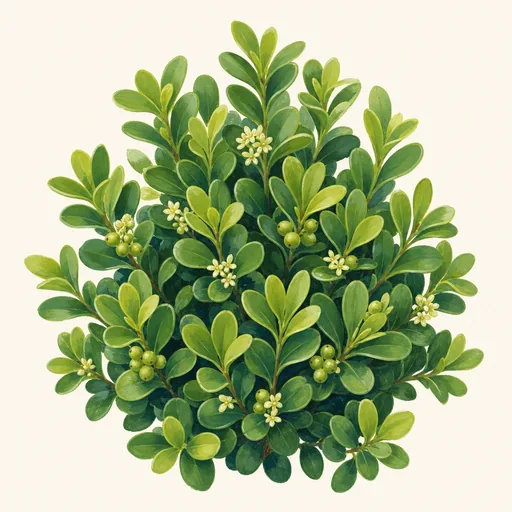
Buxus
Buxus sempervirens · Buxaceae
- Plant outFrom 2 weeks before to 4 weeks after the last frostMar 27 – May 14
- Plant in autumn6–8 weeks before the first autumn frostAug 30 – Sep 19
- Space0.5–1.2 m (1–4 ft) apart
Description
Buxus, commonly known as boxwood, is a genus of flowering plants in the family Buxaceae, consisting of about 70 species, primarily native to Europe, Asia, Africa, and Central and South America. Boxwoods are evergreen shrubs or small trees, renowned for their dense, compact growth habit and rich green foliage, which can be oval or rounded in shape. The leaves are thick and waxy, contributing to their durability and ability to withstand pruning.
Boxwood is highly valued in gardens and landscaping for its versatility. It can be shaped into hedges, topiaries, or used as low borders in formal gardens, making it a popular choice for creating structured designs. The plants are typically slow-growing, ranging in size from small shrubs to larger specimens, depending on the species and cultivar.
In terms of care, boxwoods prefer well-drained soil and thrive in full sun to partial shade. While they are relatively hardy and tolerant of various soil types, they do benefit from regular watering, especially in dry conditions. Pruning is essential to maintain their shape and encourage healthy growth, and it's best done in late winter or early spring.
One of the most significant threats to boxwood is boxwood blight, a fungal disease that can cause rapid decline. Gardeners should monitor for signs of disease and maintain good air circulation to help prevent issues. Overall, with proper care, Buxus is an enduring plant that adds elegance and structure to garden landscapes.
Growing Conditions
0.6–3 m (2–10 ft) tall, 0.6–3 m (2–10 ft) wide
- Smallest
- Largest
Part sun, 2+ hours
Tolerates full sun, part shade
Moderate
Keep evenly moist, not soggy.
Ideal 10–25 °C (50–77 °F)
Survives down to −29 °C (−20 °F).
pH 6–8 · neutral to alkaline
Photos
Photo credits
Where it Grows
Planting
When to Plant
Buxus, commonly known as boxwood, is a popular evergreen shrub valued for its versatility in gardens and landscapes. Knowing when to plant Buxus is essential for ensuring healthy growth and success in your gardening endeavors.
Ideal Planting Seasons
-
Fall Planting: The best time to plant Buxus is in the fall, typically from late September to early November. During this time, temperatures are cooler and conditions are generally more favorable, allowing the plant to establish its root system before the winter. The soil remains warm, promoting root growth while the shrub goes dormant.
-
Spring Planting: If you miss the fall planting window, early spring is another suitable time, particularly before new growth begins. Aim to plant Buxus between mid-March and early May, depending on your climate zone. Early spring planting enables the shrub to take advantage of the upcoming growing season.
Regional Considerations
-
Climate Zones: The exact timing can vary based on your USDA hardiness zone. In warmer climates, fall planting can extend later into the year, while colder regions may require earlier spring planting to avoid frost.
-
Soil Conditions: Ensure that the soil is workable. If the ground is frozen or overly saturated with water, it’s advisable to wait until conditions improve before planting.
Signs of Readiness
-
Soil Temperature: Before planting, check the soil temperature. Ideally, it should be at least 60°F (15°C) for optimal root development.
-
Frost Dates: Be mindful of the last frost dates in your area. Planting too close to frost can damage young Buxus plants.
Conclusion
By carefully monitoring local climate conditions and adhering to the recommended planting times, you can successfully cultivate Buxus in your garden. With proper timing, this hardy shrub can thrive, providing structure, beauty, and year-round greenery to your landscape.
How to Plant
Planting Buxus (Boxwood)
Buxus, commonly known as boxwood, is a versatile evergreen shrub prized for its dense foliage and adaptability in the garden. To successfully establish boxwood, follow these essential steps for planting.
-
Choosing the Location: Boxwoods thrive in well-drained soil and prefer partial to full shade. Ensure the site receives indirect sunlight, as excessive direct light can scorch the leaves.
-
Preparing the Soil: Test the soil pH, as boxwoods prefer slightly acidic to neutral conditions (pH 6.0 to 7.5). Amend the soil with organic matter, like compost, to improve drainage and nutrient content.
-
Digging the Hole: Create a planting hole that is twice the width of the root ball and as deep as the root ball itself. This encourages roots to spread into the surrounding soil.
-
Planting: Remove the plant from its container and gently loosen any tightly bound roots. Place the boxwood in the center of the hole, ensuring the top of the root ball is level with the soil surface. Backfill with soil, pressing lightly to eliminate air pockets.
-
Watering: After planting, water thoroughly to help settle the soil. Keep the soil consistently moist, particularly during the first growing season, to promote root establishment.
With proper care, your Buxus will flourish, providing structure and greenery to your garden for years to come.
Planting Calendar
- Plant outdoors: from 2 weeks before to 4 weeks after the last frost
- Autumn planting: 6–8 weeks before the first autumn frost
- Plant out: Mar 27 – May 14
- Autumn planting: Aug 30 – Sep 19
Care
Care Calendar
- Thin · Mar 13 – Apr 30
Remove a few crowded interior stems in dry weather to improve airflow. - Mulch · Mar 27 – May 14
Apply a thin layer of organic mulch, keeping it clear of the stems. - Prune · May 8 – Jun 25
Shape lightly after spring growth begins, using clean tools and avoiding wet foliage. - Protect · Oct 11 – Nov 28
In exposed sites, use a burlap screen to shield shrubs from winter wind and sun.
Watering
Watering Buxus, commonly known as boxwood, requires a balanced approach to ensure healthy growth and prevent diseases. The best strategy is to establish a consistent watering routine based on the plant's age, size, and environmental conditions.
-
Soil Check: Before watering, check the top 1-2 inches of soil. If it feels dry, it's time to water.
-
Deep Watering: Water deeply rather than frequently to encourage deep root growth. Aim for about 1-2 inches of water per week, adjusting based on rainfall and humidity.
-
Seasonal Considerations: In spring and summer, Buxus may need more frequent watering, while in fall and winter, reduce the frequency as the plant enters dormancy.
-
Avoid Overwatering: Ensure good drainage, as boxwoods are susceptible to root rot. Mulching can help retain moisture while preventing disease.
This careful approach leads to a healthier, well-established Buxus.
Pruning
Pruning a Buxus, commonly known as boxwood, is essential for maintaining its shape and health. The best strategy involves several key steps. First, wait until late spring or early summer when new growth has fully emerged, as this ensures minimal damage to the plant. Start by removing any dead, damaged, or diseased branches, cutting them back to healthy tissue. Maintain the desired shape by gently trimming the outer leaves, ensuring not to remove more than one-third of the plant's total foliage in a single session. For a more formal look, use shears to create clean lines, while a natural shape may benefit from selective pruning for a more organic appearance. Always sanitize your tools to prevent spreading disease. Regular pruning every couple of years encourages healthy growth and dense foliage, enhancing both aesthetic and structural integrity of your Buxus.
Weeding
Weeding around Buxus plants, commonly known as boxwoods, requires a careful approach to protect their foliage and roots. The best strategy involves a combination of hand weeding and mulching.
Begin by assessing the area around your Buxus for unwanted weeds, especially during the growing season. Hand pulling is ideal, as it minimizes disruption to the soil and avoids damage to the delicate boxwood roots. Pull weeds when the soil is moist to make removal easier, ensuring you extract the entire root to prevent regrowth.
After weeding, apply a layer of organic mulch, such as wood chips or shredded leaves, around the base of the plant. This not only suppresses new weeds but also helps retain moisture and improve soil health. Keep the mulch a few inches away from the base of the Buxus to avoid crown rot. Regular maintenance is essential to keep your Buxus thriving amidst competition from weeds.
Mulching
Mulching around Buxus, commonly known as boxwood, is essential for maintaining soil moisture, regulating temperature, and suppressing weeds. The best strategy for mulching involves choosing an organic mulch, such as shredded bark or wood chips, which not only enriches the soil as it breaks down but also provides a neat appearance.
Begin by applying a layer of mulch about 2 to 4 inches thick around the base of the plant, ensuring it stays a few inches away from the stems to reduce the risk of rot. Aim for a wider circle, extending it out to the drip line of the plant. This helps maintain even moisture levels while allowing air circulation in the root zone. Regularly check the mulch layer, replenishing it as needed, particularly after heavy rain or wind, to ensure consistent coverage. Proper mulching not only supports plant health but also enhances the garden's aesthetic appeal.
Fertilizing
When fertilizing a Buxus plant, or boxwood, the best strategy involves using a slow-release, balanced fertilizer specifically formulated for shrubs. Apply the fertilizer in early spring as new growth begins, providing a boost of nutrients during the plant's active growing season. A general N-P-K ratio of 10-10-10 or a similar formulation works well.
Be sure to spread the fertilizer evenly around the base of the plant, extending out to the drip line to cover the root area without piling it against the stem, which can cause burn. Water the area afterward to help dissolve the fertilizer and promote absorption.
Avoid over-fertilization, which can lead to excessive leaf growth and weaken the plant against pests and diseases. Regularly testing the soil can help determine specific nutrient needs and ensure optimal health for your Buxus.
Growing in Containers
Grows well in a pot of at least 20 litres (5.3 US gallons), with drainage holes. Best kept outdoors.
Propagation
From cuttings
- Take 10–15 cm (4–6 in) semi-hardwood stem cuttings in late summer.
- Remove the leaves from the lower half of each cutting.
- Insert the cuttings into a free-draining propagation mix.
- Keep them humid and in bright, indirect light.
- Pot them up after they develop roots.
By layering
- Choose a flexible, low-growing branch in spring.
- Remove the leaves where the branch will touch the soil.
- Pin that section beneath a shallow layer of soil, leaving the tip exposed.
- Keep the soil lightly moist until roots form.
- Cut the rooted branch from the parent plant and transplant it.
Companion Plants
Good neighbors
- Roses: Boxwood is traditionally planted as a low evergreen border around rose beds in formal gardens.
Common Problems
- Winding tunnels in leaves
- Spots on leaves
- Leaves dropping
Leaf miners are the larvae of several kinds of flies, moths, beetles, and sawflies, rather than a single species with…
- Holes in leaves
- Insects visible on the plant
- Stems chewed or cut through
- Wilting
Caterpillars are the larval stage of butterflies and moths, not a single species. Many feed on garden plants, although…
- Yellowing leaves
- Sticky residue on leaves
- Black sooty coating
- Stunted growth
Scale insects are small, sap-feeding insects that settle on garden and houseplants. Adults often look like bumps on…
- Yellowing leaves
- Wilting
- Stunted growth
- Leaves dropping
Root rot is a general name for the decay of plant roots, not a single disease with one scientific name. It can result…
- Brown or crispy leaf edges
- Bleached or scorched patches
- Yellowing leaves
- Wilting
Leaf scorch is a description of leaf damage, not a single disease with a scientific name. It develops when leaves lose…
Varieties
A popular low, rounded boxwood for borders and small hedges.
- compact
- rounded
- cold hardy
Its naturally pyramidal shape suits accents and taller hedges.
- upright
- conical
- cold hardy
A dense, slow-growing choice for low edging.
- compact
- rounded
- cold hardy
This widely sold selection responds well to shaping but may bronze in winter.
- vigorous
- cold hardy
- good for hedges
Traditional for formal edging, it is a poor choice where boxwood blight is prevalent.
- dwarf
- slow growing
- blight susceptible
A relatively compact selection bred for resistance to two common boxwood problems.
- blight resistant
- leafminer resistant
- rounded
This faster-growing selection suits larger hedges and frequent shaping.
- blight resistant
- leafminer resistant
- vigorous
More about varieties
Common Varieties of the Buxus Plant (Boxwood)
Buxus, commonly known as boxwood, is a popular evergreen shrub that is widely used in landscaping for its versatility and adaptability. Different varieties of Buxus offer a range of sizes, shapes, and growth habits, making them suitable for various garden styles. Below are some of the most common varieties of Buxus:
-
Buxus sempervirens (Common Boxwood)
- Description: This is the most widely recognized species of boxwood. It typically grows to a height of 10 to 15 feet but can be easily pruned for smaller sizes. It features small, glossy green leaves that lend a formal appearance to gardens.
- Uses: Often used for hedges, topiaries, and as foundation plants in formal gardens.
-
Buxus microphylla (Korean Boxwood)
- Description: Known for its smaller leaves and dense growth, Korean boxwood is more cold-hardy than some other varieties. It grows to about 2 to 3 feet in height, making it suitable for low hedges or borders.
- Uses: Ideal for smaller gardens or as an accent plant.
-
Buxus sinica (Chinese Boxwood)
- Description: This variety has a more upright growth habit and is often used in formal settings. It features smaller leaves compared to B. sempervirens and is known for its resilience to diseases.
- Uses: Suitable for hedging or formal garden arrangements.
-
Buxus sempervirens 'Suffruticosa' (English Boxwood)
- Description: A dwarf variety that grows to about 2 to 3 feet tall, English boxwood has a compact form and dense foliage. Its small leaves give it a delicate appearance.
- Uses: Perfect for low hedges, borders, and container planting.
-
Buxus microphylla var. japonica (Japanese Boxwood)
- Description: Similar to the Korean boxwood, Japanese boxwood is known for its compact growth and rounded habit. It can be shaped easily, making it a favorite for topiary.
- Uses: Frequently used in small gardens or as a foundation planting.
-
Buxus sempervirens 'Variegata' (Variegated Boxwood)
- Description: This variety features leaves that are green with creamy-white edges, adding a unique visual interest to garden arrangements. It retains the same structure as the common boxwood but presents a distinctive appearance.
- Uses: Works well as an accent plant among traditional green boxwoods or other foliage.
-
Buxus 'Green Mountain'
- Description: A hybrid variety known for its pyramidal shape. The 'Green Mountain' boxwood exhibits a dense growth with glossy, dark green leaves.
- Uses: The ideal choice for taller hedges and formal pyramidal topiaries.
-
Buxus 'Wintergreen'
- Description: This variety is prized for its vigorous growth and resilience during the winter months. It has small, dark green leaves and can reach about 3 to 4 feet in height.
- Uses: Excellent for foundation plantings, low hedges, and mixed borders.
Each of these varieties offers unique characteristics and can serve different purposes in a garden. The choice of which boxwood to plant often depends on factors such as climate, intended use, and aesthetic preferences. When planting, always consider local soil conditions and the potential for pests or diseases, as proper care is essential to ensure healthy growth and longevity.
Health Benefits
Buxus, commonly known as boxwood, is more than just an attractive ornamental shrub; it has been utilized in various health and wellness applications throughout history. While not widely lauded for medicinal properties, certain cultural practices have recognized its potential.
Traditionally, certain parts of the Buxus plant, particularly the leaves, have been used in folk medicine to treat ailments such as inflammation, coughs, and even rheumatism. The leaves contain compounds that exhibit mild antibacterial and antifungal properties, suggesting potential benefits for general wellness. However, it’s crucial to note that Buxus contains toxic alkaloids. Therefore, any therapeutic uses should be approached with caution and under professional guidance.
In modern gardening therapy, the act of tending to boxwood can provide mental wellness benefits. Its dense, evergreen foliage and structured growth lend themselves to creating serene garden spaces. Engaging with plants like Buxus can reduce stress, encourage mindfulness, and promote physical activity, contributing to overall well-being.
In summary, while Buxus may not be widely recognized for direct health benefits, it plays a role in promoting wellness through gardening practices, contributing to mental tranquility and providing a natural backdrop for relaxation. Always prioritize safety and consult with a healthcare professional when considering any herbal remedies.
Fun Facts
-
Longevity: Boxwood plants can live for several decades, with some specimens recorded to be over 500 years old, making them a reliable choice for long-term landscaping.
-
Variety of Species: There are approximately 70 species of Buxus, with Buxus sempervirens (Common Boxwood) and Buxus microphylla (Japanese Boxwood) being the most widely cultivated for hedges and topiary.
-
Topiary Potential: Due to their dense foliage and ability to be easily shaped, boxwoods are popular in topiary art, where they can be trimmed into various forms and designs in gardens.
-
Soil Adaptability: Boxwoods are known for their adaptability to different soil types, although they thrive best in well-drained, fertile soils and can tolerate some degree of drought once established.
-
Wildlife Benefits: Boxwood shrubs are not only aesthetically pleasing but also provide shelter and habitat for various wildlife, including birds, butterflies, and beneficial insects, enhancing biodiversity in gardens.
Notice an error or have a question about Buxus? Contact us