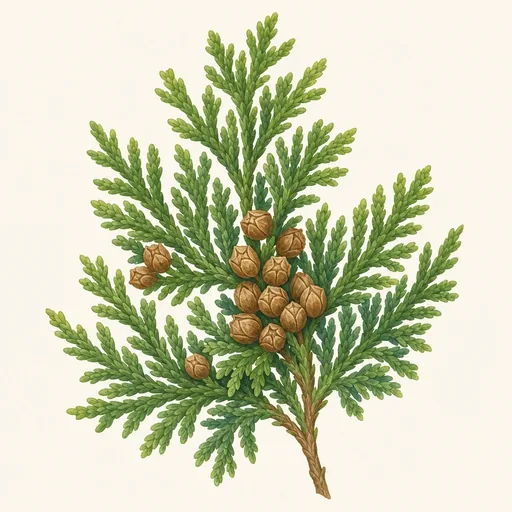
Thuja
Thuja plicata · Cupressaceae
- Plant outFrom 4 weeks before to 6 weeks after the last frostMar 13 – May 28
- Plant in autumn6–8 weeks before the first autumn frostAug 30 – Sep 19
- Space0.9–1.8 m (3–6 ft) apart
Description
Thuja, commonly known as arborvitae, is a genus of coniferous trees and shrubs in the Cypress family (Cupressaceae). The most popular species include Thuja occidentalis (American arborvitae) and Thuja plicata (Western red cedar). These evergreen plants are characterized by their scale-like leaves, which can be arranged in flat sprays, giving them a distinctive texture and appearance.
Thuja plants can range from small shrubs to tall trees, with some species growing over 100 feet high. They are typically noted for their dense, conical shape and bright green foliage, which often turns yellowish-brown in winter in some varieties. They produce small, rounded cones, which can be green before maturing to a brownish hue.
Arborvitaes are valued in landscaping for their ornamental qualities, serving as privacy hedges, windbreaks, or foundation plantings. They are also relatively low-maintenance, requiring moderate watering and well-drained soil. They can adapt to various soil types but prefer slightly acidic conditions. However, they thrive best in full sun to partial shade.
These plants are also known for their natural resistance to pests and diseases, although they can occasionally be affected by issues like bagworms or root rot in overly wet conditions. Thuja is generally hardy, with many species suited for USDA hardiness zones ranging from 2 to 7, making them accessible to a wide range of gardeners. Overall, Thuja offers both aesthetic appeal and functional benefits, making it a popular choice for landscape design.
Growing Conditions
Full sun
Tolerates part sun, part shade
Moderate
Keep evenly moist, not soggy.
Ideal 10–25 °C (50–77 °F)
Survives down to −40 °C (−40 °F).
acidic to neutral
Photos
Photo credits
Where it Grows
Planting
When to Plant
Planting Thuja, commonly known as arborvitae, is a rewarding endeavor for many gardeners, offering natural privacy screens, hedges, or accent plants. Timing your planting can significantly affect the establishment and growth of these evergreen beauties.
Ideal Planting Times
-
Spring Planting:
- The most suitable time to plant Thuja is in the spring, after the last frost date in your area. This usually falls between March and May, depending on your climate zone. Planting in spring allows the plant to become established as soil temperatures begin to warm, promoting root growth.
-
Fall Planting:
- Early fall is also a viable option for planting Thuja, typically from late September to early November. This timeframe allows the plant to establish roots before the ground freezes. However, be mindful of planting too late in the fall, as it can lead to difficulties in establishment, especially in colder regions.
-
Avoiding Extreme Temperatures:
- It is crucial to avoid planting Thuja during extreme heat in summer or extremely cold conditions in winter. High temperatures can stress the plant, making it harder for it to establish roots, while frozen ground can prevent proper planting.
Additional Considerations
-
Soil Preparation:
- Before planting, ensure that the soil is well-drained and rich in organic matter. This preparation can be done ahead of time, allowing the soil to stabilize and warm up.
-
Climate and Microclimate:
- The specific variety of Thuja and your local climate will dictate the best planting time. For instance, varieties like Thuja occidentalis are well-suited for colder climates, while Thujas like ‘Green Giant’ thrive exceptionally well in a broader range of conditions.
-
Observing Weather Patterns:
- Monitoring localized weather patterns can also help in determining the best time to plant. Early spring or early fall often has stable temperatures conducive to planting.
By understanding these factors, you can ensure that your Thuja plants establish well and thrive in your garden, contributing beauty and privacy for years to come.
How to Plant
Planting a Thuja, commonly known as Arborvitae, involves several key steps to ensure healthy growth and establishment. Firstly, select a suitable location with well-drained soil and full sun to partial shade. Thuja thrives in various soil types but prefers slightly acidic to neutral pH levels.
Begin by digging a hole that is twice as wide as the root ball and slightly deeper than its height. This allows the roots to spread comfortably. When removing the Thuja from its container, gently loosen the roots if they are tightly bound to encourage outward growth. Place the plant in the center of the hole, ensuring that the top of the root ball is level with the surrounding soil.
Backfill the hole with the original soil, pressing down lightly to eliminate air pockets. Water thoroughly after planting to help settle the soil around the roots. Applying a layer of mulch around the base can help retain moisture and regulate temperature, but avoid piling it against the trunk.
Regularly monitor your Thuja for the first year to ensure it receives adequate water, especially during dry spells. With proper care, your Thuja will flourish, providing lush greenery to your landscape for years to come.
Planting Calendar
- Plant outdoors: from 4 weeks before to 6 weeks after the last frost
- Autumn planting: 6–8 weeks before the first autumn frost
- Plant out: Mar 13 – May 28
- Autumn planting: Aug 30 – Sep 19
Care
Care Calendar
- Prune · Mar 27 – May 28
Trim lightly to shape, leaving green foliage on every branch. - Mulch · Apr 10 – May 14
Spread mulch over the root zone, keeping it clear of the trunk. - Protect · Oct 11 – Nov 14
Shield young or exposed shrubs from winter wind and sun with a loose burlap screen.
Watering
When watering a Thuja plant, also known as arborvitae, it’s essential to adopt a strategy that promotes healthy growth without overwhelming the roots. Initially, newly planted Thujas require consistent moisture to establish. Water them deeply at least once a week, allowing the soil to dry out slightly between watering sessions.
For mature plants, reduce frequency to once every two weeks, though this can vary based on climate and soil conditions. Applying mulch around the base helps retain moisture and regulate soil temperature. During hot, dry spells, regular checks are crucial; consider increasing watering frequency. Early morning is the best time to water, as it allows foliage to dry before evening, reducing the risk of fungal diseases. Always ensure the soil has good drainage to prevent root rot, as Thujas prefer well-aerated, loamy conditions.
Pruning
Pruning a Thuja, commonly known as Arborvitae, requires a thoughtful approach to promote healthy growth and maintain its shape. The best strategy is to prune in early spring, just before new growth starts. This timing allows for the removal of any dead or damaged branches while minimizing stress on the plant.
Begin by using sharp, clean pruning shears to make precise cuts. Focus on removing any dead or diseased foliage first, followed by thinning out crowded areas to improve airflow and sunlight penetration. Aim to maintain a natural shape; avoid cutting into old wood, as Thuja may not regenerate growth from bare branches.
For shaping, lightly trim the outer foliage to maintain a consistent structure, but avoid excessive cutting, as this can lead to browning or a sparse appearance. Regular maintenance through light pruning each year will help keep the plant healthy and visually appealing.
Weeding
Weeding around a Thuja plant requires a careful, strategic approach to preserve the health of the tree while effectively managing unwanted vegetation. First, remove weeds by hand to avoid disturbing the Thuja's root system. Use a hand trowel or garden fork for deeper-rooted weeds, ensuring to extract the entire root to prevent regrowth. It's best to weed just after a rain or watering, as the soil will be softer and weeds easier to pull.
Mulching is an effective preventive strategy; applying a 2-3 inch layer of organic mulch, like wood chips or bark, around the base of the Thuja can smother weeds, retain moisture, and regulate soil temperature. Additionally, regular maintenance—checking for weeds every few weeks—will help keep the area weed-free. Remember, avoid using chemical herbicides, as they can harm the Thuja and disrupt the surrounding ecosystem.
Mulching
Mulching is an effective strategy to promote the health of your Thuja (arborvitae) plants. Start by selecting a suitable organic mulch, such as shredded bark, wood chips, or pine needles, which help retain moisture and suppress weeds.
Begin by clearing the area around the base of the Thuja of any weeds or debris. Apply a layer of mulch that is approximately 2 to 3 inches thick, ensuring it extends out to the plant's drip line. Avoid piling the mulch directly against the trunk to prevent moisture retention that can lead to rot.
Regularly check the mulch and replenish it as needed, especially after heavy rain or in the fall, as it may break down over time. Maintaining this mulch layer not only conserves soil moisture but also gradually improves soil health as it decomposes, contributing to the overall vitality of your Thuja plants.
Fertilizing
Fertilizing a Thuja plant, commonly known as arborvitae, is essential for promoting healthy growth and vibrant foliage. The best strategy involves timing, type of fertilizer, and application method.
Fertilize in early spring as new growth begins, using a balanced, slow-release fertilizer with a ratio of 10-10-10 or similar. This helps provide necessary nutrients without overwhelming the plant. First, ensure the soil is well-draining; if not, consider amending it to prevent root rot.
Apply the fertilizer evenly around the base of the plant, extending to the drip line, and lightly incorporate it into the top layer of soil. Water thoroughly after application to help the nutrients penetrate the root zone. Avoid fertilizing late in the season, as this can stimulate new growth susceptible to winter damage. Regularly monitor the health of your Thuja to adjust your fertilization strategy as needed.
Growing in Containers
Grows well in a pot of at least 30 litres (7.9 US gallons), with drainage holes. Best kept outdoors.
Propagation
From cuttings
- Take 10–15 cm cuttings from healthy shoots in late summer or early autumn.
- Strip foliage from the lower half of each cutting.
- Dip the cut ends in rooting hormone and insert them into moist, free-draining propagation mix.
- Keep the cuttings humid in bright, indirect light.
- Pot them individually once roots have formed.
From seed
- Collect ripe cones in autumn and let them dry until they release their seeds.
- Place the seeds in a moist medium in the refrigerator for 30–60 days.
- Sow the seeds shallowly in spring in moist seed-starting mix.
- Keep the mix evenly moist until seedlings emerge.
- Pot up the seedlings when they are large enough to handle.
Common Problems
- Stems chewed or cut through
- Stunted growth
Deer are browsing mammals that feed on many garden plants. “Deer” refers to several species in the family Cervidae…
- Holes in leaves
- Insects visible on the plant
- Stems chewed or cut through
- Wilting
Caterpillars are the larval stage of butterflies and moths, not a single species. Many feed on garden plants, although…
- Winding tunnels in leaves
- Spots on leaves
- Leaves dropping
Leaf miners are the larvae of several kinds of flies, moths, beetles, and sawflies, rather than a single species with…
- Pale speckles or stippling
- Yellowing leaves
- Brown or crispy leaf edges
- Fine webbing
Spider mites are tiny, plant-feeding arachnids in the family Tetranychidae, not insects. Several species attack garden…
- Yellowing leaves
- Wilting
- Stunted growth
- Leaves dropping
Root rot is a general name for the decay of plant roots, not a single disease with one scientific name. It can result…
Varieties
A popular upright choice for compact screens and hedges.
- narrow
- dense
- green year-round
Allow ample space for this large screening shrub.
- fast-growing
- tall
- screening
It tolerates regular light trimming into a formal hedge.
- fast-growing
- upright
- hedging
Its slender habit suits tighter spaces.
- narrow
- upright
- cold-hardy
This low globe generally needs little shaping.
- dwarf
- rounded
- compact
It forms a small mound suited to borders and foundation plantings.
- dwarf
- rounded
- compact
Its golden foliage may take on a bronze tint in winter.
- golden foliage
- compact
- rounded
Its rounded form provides a bright accent in sunny sites.
- golden foliage
- rounded
- compact
More about varieties
Common Varieties of the Thuja Plant
The Thuja plant, commonly known as arborvitae, is a popular choice in landscaping for its evergreen foliage, growth habits, and versatility. This genus of coniferous trees and shrubs belongs to the cypress family (Cupressaceae) and includes several species and cultivars that are well-suited for various gardening needs. Below are some of the most common varieties of the Thuja plant:
-
Thuja occidentalis (Eastern Arborvitae) One of the most widely recognized species, Eastern Arborvitae is native to North America. It is often used as a hedge or privacy screen due to its dense foliage. Varieties include:
- 'Smaragd' (Emerald Green Arborvitae): Known for its narrow, pyramidal shape and vibrant green foliage that holds its color throughout the winter.
- 'Techny': A hardy variety that displays a broad, bushy form, making it suitable for windbreaks and large hedges.
-
Thuja plicata (Western Red Cedar) This species is native to the Pacific Northwest, renowned for its resistance to rot and ability to thrive in a range of soil types. Common cultivars include:
- 'Zebrina': Notable for its striking yellow and green striped foliage, this cultivar is often used as a specimen plant in gardens.
- 'Heritage': A more disease-resistant selection with a pleasing conical form and fragrant foliage.
-
Thuja orientalis (Oriental Arborvitae) This species is found in Asia and is characterized by its dense and bushy appearance. Some popular cultivars are:
- 'Sunshine': Known for its bright golden-yellow foliage that adds a pop of color to landscapes, this compact plant is a favorite in smaller gardens.
- 'Aurea': A round, slow-growing form with colorful, bright yellow foliage, particularly stunning when placed against darker backdrops.
-
Thuja koraiensis (Korean Arborvitae) A lesser-known species that is admired for its tolerance to cold climates. It features a more irregular shape and has fine, green foliage.
-
Hybrid Varieties Some gardeners may also encounter hybrid variants that combine desirable traits of different species. For instance:
- 'Green Giant': A fast-growing hybrid between Thuja plicata and Thuja standishii, this variety is favored for its quick height gain and adaptability, commonly used for screening.
These common varieties of Thuja showcase versatility in landscape design and gardening applications. From tall hedges and windbreaks to ornamental features, Thuja plants are prized for their adaptability and enduring beauty. When selecting a variety for your garden, consider factors such as climate, soil type, and intended use to ensure you choose the best suitable option for your outdoor space.
Health Benefits
Health and Wellness Applications of Thuja
Thuja, commonly known as arborvitae, is a genus of coniferous trees that has garnered attention for its potential health benefits. Traditionally, parts of the Thuja plant, especially the leaves, have been used in herbal medicine due to their purported therapeutic properties.
One notable application is in the field of respiratory health. Thuja extracts are believed to have expectorant properties, which can help alleviate symptoms of coughs and colds by clearing mucus from the respiratory tract. Additionally, certain compounds in Thuja may have antimicrobial effects, which could aid in fighting off respiratory infections.
Thuja is also used in homeopathic medicine, where it is often prepared as a remedy for conditions like warts and skin irritations. Some practitioners believe that Thuja can stimulate the body's natural healing processes, making it useful for treating skin issues.
Moreover, essential oils derived from Thuja are sometimes employed in aromatherapy for their calming effects, promoting relaxation and potentially reducing stress levels. However, it is crucial to note that Thuja should be used with caution, as some parts of the plant can be toxic if consumed in large quantities. Always consult a healthcare professional before starting any new treatment involving herbal remedies.
Fun Facts
-
Common Names: Often known as arborvitae, the name "Thuja" is derived from a Greek word that means "to sacrifice" or "to offer," implying its historical significance in various cultures.
-
Evergreen Characteristics: Thuja trees are evergreen conifers, meaning they retain their foliage year-round. They can provide year-round privacy and greenery in gardens and landscapes.
-
Variety of Heights: Thuja species vary significantly in size, with some reaching heights of up to 70 feet, while dwarf varieties can remain under 2 feet tall, making them suitable for various landscaping needs.
-
Natural Deer Repellent: The aromatic foliage of Thuja is known to be unappealing to many herbivores, including deer. This makes them a popular choice for gardeners looking to keep wildlife at bay.
-
Air Purifying Qualities: Thuja trees are recognized for their ability to improve air quality. They absorb pollutants and release oxygen, contributing to a healthier environment around your home or garden.
Notice an error or have a question about Thuja? Contact us