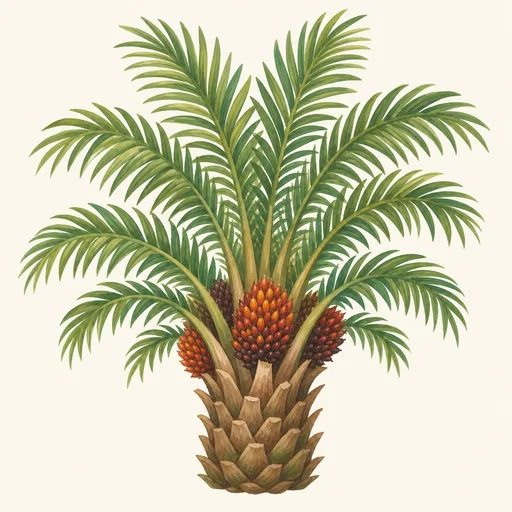
Oil Palm
Elaeis guineensis · Arecaceae
Description
The oil palm plant, scientifically known as Elaeis guineensis, is a tropical tree native to West Africa but is now cultivated extensively in various regions around the world, particularly in Southeast Asia, such as Indonesia and Malaysia. It is renowned for its efficient production of palm oil, a versatile vegetable oil used in cooking, food processing, cosmetics, and biodiesel.
Oil palms typically grow to heights of 15 to 20 meters and feature a stout, unbranched trunk topped with a crown of large, feathery fronds, which can reach lengths of up to 5 meters. The leaves are pinnate, with leaflets arranged along a central rib, giving them a frond-like appearance. Oil palms are dioecious, meaning there are distinct male and female plants. The female palms bear clusters of small, round fruits that are rich in oil, while the male palms produce pollen.
The fruit of the oil palm is typically bright red when ripe and consists of a fleshy outer layer and a hard shell that encases the seed. The oil is extracted from both the flesh (palm oil) and the kernel (palm kernel oil), making the plant highly productive.
Oil palm cultivation requires a warm, humid climate and well-drained soils, and while it is economically significant, it has drawn criticism due to deforestation and habitat destruction in regions where it is farmed. Sustainable farming practices are being developed to mitigate these environmental impacts. Overall, the oil palm is a key player in the global agricultural economy, contributing significantly to both local and international markets.
Growing Conditions
15–25 m (49–82 ft) tall, 6–9 m (20–30 ft) wide
- Smallest
- Largest
Full sun, 6+ hours
High
Keep the soil consistently moist.
Ideal 24–32 °C (75–90 °F)
Survives down to 0 °C (32 °F).
pH 4.5–6.5 · acidic to neutral
Photos
Photo credits
Where it Grows
Planting
When to Plant
The oil palm, scientifically known as Elaeis guineensis, is a tropical tree species cultivated primarily for its oil-rich fruit, which is used in cooking and numerous industrial applications. It thrives in warm climates and requires specific conditions to grow successfully.
Ideal Growing Conditions Before determining the best planting time for oil palms, it's essential to understand their preferred growing conditions:
-
Climate: Oil palms flourish in tropical regions with consistent high temperatures ranging between 24°C to 30°C (75°F to 86°F). They need a humid climate and can be quite sensitive to cold temperatures.
-
Soil: Well-draining soils rich in organic matter, such as loamy or sandy loam soils, are ideal. Oil palms are not suited for flooded areas or heavy clay soils that retain water.
-
Rainfall: These palms require ample rainfall, ideally between 1,500 mm to 3,500 mm (59 to 138 inches) annually, with a well-distributed quantity throughout the year.
When to Plant Oil Palms The timing for planting oil palms can depend on several factors, as detailed below:
-
Seasonal Considerations:
- Rainy Season: The best time to plant oil palms is at the beginning of the rainy season, allowing the plants to establish their roots in moist soil. This usually falls between March and May in tropical regions, but can vary based on your geographic location.
- Drought Considerations: Avoid planting during dry seasons or prolonged drought periods, as seedlings are less likely to survive without sufficient moisture.
-
Soil Temperature:
- Check soil temperature, which should ideally be above 24°C (75°F). Warmer soil helps with root establishment and encourages healthy growth.
-
Seedling Age:
- It's recommended to plant oil palm seeds when they are about 6 to 12 months old. This ensures that the seedlings are strong enough to withstand early planted environmental conditions.
Preparing for Planting Before actual planting, the following steps should be taken:
-
Site Preparation: Clear the area of weeds and debris. Consider proper spacing—aim for a distance of about 8 meters (26 feet) between each palm to promote healthy growth and airflow.
-
Soil Amendment: Test the soil to assess pH and nutrient levels. Consider adding organic matter or fertilizers to improve soil health before planting.
-
Planting Technique: Dig holes deep and wide enough to accommodate the seedlings’ root balls and gently place the seedlings in with the root collar slightly above soil level to prevent waterlogging.
By considering the optimal growing conditions and timing for planting oil palms, gardeners and hobbyists can enhance their chances of creating a thriving and productive oil palm plantation.
How to Plant
Planting Oil Palm: A Comprehensive Guide
To successfully plant an oil palm (Elaeis guineensis), careful preparation and consideration of environmental factors are key. Start by selecting a suitable site that receives full sun and has well-draining, fertile soil with a pH between 4.5 and 7.0.
-
Seedlings: Purchase healthy, disease-free seedlings from a reputable nursery. Young oil palms are often sold in polybags, which helps protect their roots during transport.
-
Site Preparation: Clear the area of weeds, debris, and previous crops. Dig holes about 1 meter deep and wide, spaced approximately 8-10 meters apart.
-
Soil Enrichment: Incorporate organic matter, such as well-rotted compost or manure, to enhance soil fertility. This will provide essential nutrients and improve soil structure.
-
Planting: Carefully remove the seedling from the polybag, being cautious not to damage the roots. Place the seedling in the center of the hole, gently backfill with soil, and water thoroughly to eliminate air pockets.
-
Care: Post-planting, maintain consistent moisture and mulch the base to suppress weeds and retain soil moisture. Fertilize regularly, especially during the early growth stages, to promote healthy development.
With patience and proper care, your oil palm will thrive, eventually yielding the sought-after oil from its fruit.
Growth Timeline
- Establishing 3 years
- First flowers possible years 3–4
Care
Care Calendar
- Prune · Apr 10 – Jun 11
Remove only dead or badly damaged fronds, taking care around their spines. - Mulch · Apr 10 – May 14
Apply organic mulch to retain moisture, keeping it clear of the trunk. - Feed · Apr 24 – Sep 3
Feed during active growth with a palm fertilizer containing potassium and magnesium. - Protect · Sep 27 – Oct 24
Move container-grown palms to a warm, bright, frost-free place before temperatures approach freezing.
Watering
Watering an Oil Palm (Elaeis guineensis) is crucial for its growth and development, as these plants thrive in moist environments. The best strategy involves establishing a consistent watering schedule while considering environmental factors.
Firstly, assess the soil moisture regularly; the top 1-2 inches should be dry before watering again. Deep watering is essential, allowing the water to reach the root zone effectively. Aim for a thorough soak until water reaches about 12-18 inches deep, promoting healthy root development.
During dry spells, more frequent watering may be necessary, while excess rainfall may reduce watering needs. Ensure good drainage to prevent waterlogging, which can lead to root rot. Additionally, mulching around the base can help retain soil moisture and regulate temperature, benefiting the Oil Palm. Overall, a balance between consistency and adaptability to external conditions will yield a healthy, thriving Oil Palm plant.
Pruning
Pruning an Oil Palm (Elaeis guineensis) is essential for maintaining plant health and optimizing productivity. The best strategy begins with timing; perform pruning during the dry season to reduce the risk of fungal infections. Focus on removing older, yellowing fronds and any fronds obstructing fruit bunches to enhance sunlight penetration.
Utilize clean, sharp tools to prevent disease transmission. Begin by cutting the frond at its base, close to the trunk, ensuring minimal damage to the plant. Regularly assess the palm, pruning 10 to 15 fronds yearly, which allows the plant to allocate energy toward fruit production rather than maintaining excess foliage.
Finally, avoid removing too many fronds at once, as this can stress the plant. Instead, aim for a balanced approach that promotes overall health and maximizes fruit yield while keeping the Oil Palm visually appealing and vigorous.
Weeding
Weeding around oil palm plants is essential for their growth and productivity, as weeds compete for nutrients, water, and light. The best strategy involves a combination of manual and mechanical techniques, particularly during the early stages of the plant’s growth.
-
Manual Weeding: Hand-pulling weeds is effective, especially in young plants where the root system of the palms is still shallow. Ensure to remove the entire root to prevent regrowth.
-
Mulching: Apply organic mulch around the base of the palms. This not only suppresses weed growth but also retains soil moisture and adds organic matter as it decomposes.
-
Mechanical Weeding: For larger plantations, consider using tools like hoes or powered weeders. This method is efficient for covering more ground quickly.
-
Chemical Control: As a last resort, selectively apply herbicides designed for agricultural use. Always follow safety guidelines and manufacturer instructions to protect the palms and the surrounding ecosystem.
By combining these strategies, you can effectively manage weeds while promoting healthy oil palm growth.
Mulching
Mulching Oil Palm plants is an essential practice to enhance growth and health. The best strategy involves applying organic or inorganic materials around the base of the palm. Organic materials like wood chips, straw, or palm fronds improve soil fertility as they decompose, while helping retain moisture in the soil and suppressing weeds.
To mulch effectively, spread a layer 4-6 inches thick, ensuring it covers the entire root zone but keeps it a few inches away from the trunk to prevent rot. Applying mulch during the dry season is ideal, as it helps maintain soil moisture levels and provides insulation against temperature fluctuations.
Regularly monitoring the mulch for thickness and replenishing it as it breaks down is crucial. This practice not only enriches the soil but also supports beneficial microorganisms, contributing to the overall health of the Oil Palm plant.
Fertilizing
Fertilizing oil palm (Elaeis guineensis) is crucial for achieving optimal growth and high yields. The best strategy involves a balanced approach, informed by soil tests to identify nutrient deficiencies. Typically, oil palms require a mix of nitrogen, phosphorus, and potassium, with micronutrients such as magnesium and boron also essential for healthy development.
Fertilizer application should be done in multiple stages throughout the year. Start with a base application during the planting phase, followed by regular top-dressing every 2-3 months during the growing season. Granular fertilizers are commonly used, but liquid and foliar applications can supplement nutrient availability.
It's important to apply fertilizers in a way that matches the plant's growth stages—higher nitrogen during vegetative growth and more potassium and phosphorus as the palms mature and during fruiting. Moreover, ensuring proper irrigation practices helps maximize nutrient uptake and minimize losses. Regular monitoring of plant health and adjusting the regime based on aquifer and environmental conditions will lead to the best outcomes.
Growing in Containers
Not well suited to growing in pots.
Propagation
From seed
- Obtain pre-germinated oil palm seeds from a reputable supplier.
- Plant each seed in a deep pot of moist, free-draining potting mix.
- Keep the pots warm, ideally around 28–35 °C, and the mix evenly moist.
- Move seedlings into larger pots as they grow, taking care not to damage their roots.
Companion Plants
Good neighbors
- Tropical kudzu: Used as a ground cover in oil palm plantings, it suppresses weeds and adds nitrogen when kept clear of young palm stems.
- Calopo: This leguminous ground cover is grown among oil palms to reduce weeds and improve soil cover.
Common Problems
- Holes in leaves
- Insects visible on the plant
- Stems chewed or cut through
- Wilting
Caterpillars are the larval stage of butterflies and moths, not a single species. Many feed on garden plants, although…
- Spots on leaves
- Yellowing leaves
- Leaves dropping
Fungal leaf spot is a general name for diseases caused by many different fungi, not a single species. These fungi…
- Yellowing leaves
- Wilting
- Stunted growth
- Leaves dropping
Root rot is a general name for the decay of plant roots, not a single disease with one scientific name. It can result…
- Brown or crispy leaf edges
- Wilting
- Bleached or scorched patches
- Leaves dropping
Frost damage is an injury caused when plant tissues become cold enough for ice to form or for cells to lose water to…
Varieties
The oil palm (Elaeis guineensis) is a tropical plant known for its high yield of palm oil, a versatile and widely-used vegetable oil. Two primary varieties of the oil palm are primarily cultivated for commercial purposes, each having distinct characteristics and benefits.
1. Dura Palm The Dura variety is characterized by its thick shell and large fleshy fruit, making it rich in oil content. This variety typically yields higher amounts of oil per fruit compared to others, but it usually has a lower number of fruit bunches.
- Physical Characteristics: Thick-shell fruit with less pulp.
- Oil Content: Higher oil yield per fruit.
- Common Uses: Primarily grown for the extraction of palm oil on a commercial scale.
2. Pisifera Palm The Pisifera variety is nearly seedless and has a thinner shell compared to Dura. This type is valued for its high oil yield when crossed with Dura.
- Physical Characteristics: Thinner-shelled fruit, containing very little pulp.
- Oil Content: Extremely high oil yield when crossed with Dura (cross-breeds known as Dura-Pisifera).
- Common Uses: Used in breeding programs to enhance oil yield in hybrid palms.
3. Tenera Palm The Tenera variety is a hybrid of Dura and Pisifera. It is commonly planted in commercial oil palm plantations due to its advantageous traits. It combines the high oil yield characteristic of Dura with the thin shell characteristic of Pisifera, resulting in a plant that is both productive and economically beneficial.
- Physical Characteristics: A combination of thick pulp and lower shell thickness.
- Oil Content: Higher oil extraction rate compared to either parent variety.
- Common Uses: The leading variety in commercial oil palm production, favored for its balance between fruit yield and oil content.
Conclusion When selecting a variety of oil palm for cultivation, the choice between Dura, Pisifera, and Tenera may depend on the specific goals of the grower, such as oil yield efficiency, land capacity, and market demands. Understanding these varieties helps amateur gardeners and hobbyists navigate the complexities of oil palm cultivation while tapping into its potential benefits.
Health Benefits
The oil palm (Elaeis guineensis), primarily cultivated for its oil, has various applications in health and wellness, largely due to the nutritional properties of palm oil. Rich in saturated fats, particularly palmitic acid, palm oil is often considered a healthier alternative to trans fats found in processed foods. It provides a significant source of energy and is a good source of vitamins A and E, which are important for immune function and skin health.
In traditional medicine, various parts of the oil palm tree have been utilized for their therapeutic potential. Palm kernel oil, derived from the kernel of the oil palm fruit, is known for its antioxidant properties, which may help combat oxidative stress and inflammation in the body. Additionally, some studies suggest that the high carotenoid content in red palm oil may contribute to improved vision and skin health, while also promoting heart health by supporting cholesterol balance.
Furthermore, the oil palm's fiber content can aid digestion, contributing to overall gastrointestinal wellness. While it's essential to consume palm oil in moderation, its potential health benefits make it a versatile ingredient worth considering in dietary applications.
Fun Facts
-
Native Habitat: The oil palm is native to West Africa but is now widely cultivated in tropical regions around the world, particularly in Southeast Asia, making it a major agricultural commodity with significant economic impact.
-
Versatile Uses: Beyond producing palm oil, the oil palm tree has multiple uses. Its fronds can be used for thatching, its trunks for construction, and even its leftover biomass can be converted into biofuel.
-
High Yield: The oil palm tree is incredibly efficient in terms of oil production. It produces more oil per hectare than any other oilseed crop, making it a key player in meeting global vegetable oil demands.
-
Biodiversity Concerns: The expansion of oil palm plantations has been linked to deforestation and habitat loss, particularly in regions like Indonesia and Malaysia. This has raised significant environmental concerns regarding biodiversity and climate change.
-
Economic Importance: The oil palm industry supports millions of livelihoods, particularly in developing countries where it is a major source of income for smallholder farmers and contributes to the economies of producing nations.
Notice an error or have a question about Oil Palm? Contact us