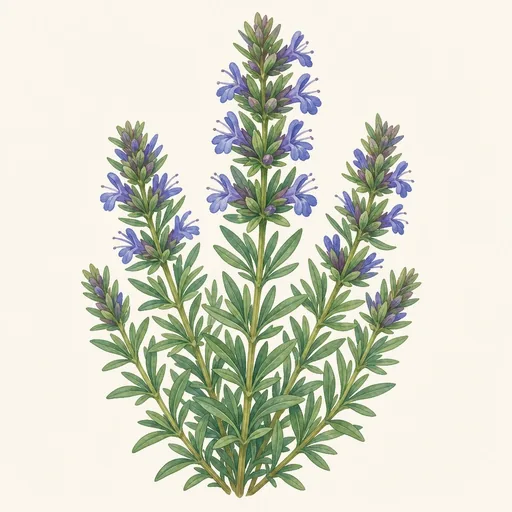
Hyssop
Hyssopus officinalis · Lamiaceae
- Start indoors8–10 weeks before the last frostJan 30 – Feb 19
- Sow outdoorsFrom the last frost until 2 weeks afterApr 10 – Apr 30
- Plant outFrom the last frost until 2 weeks afterApr 10 – Apr 30
- Space30–45 cm (12–18 in) apart
- Harvest90–120 days after plantingJul 9 – Sep 18
Description
Hyssop is a perennial herb in the mint family, grown for its aromatic leaves and flower spikes. It forms a compact, bushy plant, usually reaching 30–60 cm tall. Its narrow, dark green leaves grow in opposite pairs on upright, increasingly woody stems. From summer into early autumn, dense spikes of small, tubular flowers appear, most often blue or violet, though pink and white forms are also cultivated. The flowers attract bees, butterflies, and other pollinators.
Native to parts of southern Europe and western Asia, hyssop thrives in sunny, well-drained places, including dry slopes and rocky ground. In gardens, it suits herb beds, borders, and containers. Established plants tolerate drought better than waterlogged soil. Hyssop prefers lean to moderately fertile soil; excessive fertilizer can encourage soft growth at the expense of the compact shape gardeners often want. Light pruning after flowering helps keep plants tidy, while harder pruning in spring can refresh older stems. Avoid cutting into bare, old wood if it shows no new growth.
The leaves have a strong, resinous scent and a slightly bitter, mintlike flavor. They can be used sparingly, fresh or dried, to season savory dishes or make herbal tea. Both leaves and flowers are edible, but their intensity means a little usually goes a long way. Hyssop also has a long history of use in herbal preparations and as a fragrant garden plant; traditional medicinal uses should not be taken as proof that it treats disease.
Hyssop can be started from seed or propagated from stem cuttings. Good air circulation and free-draining soil help prevent problems associated with damp conditions. Its flowers make it especially useful in pollinator-friendly plantings, while its evergreen or semi-evergreen foliage provides texture outside the flowering season in milder climates. Concentrated hyssop essential oil should not be consumed without qualified medical guidance.
Growing Conditions
45–90 cm (1–3 ft) tall, 30–60 cm (12–24 in) wide
- Smallest
- Largest
Full sun, 6+ hours
Tolerates part sun
Low
Let the soil dry out between waterings.
Ideal 15–27 °C (59–81 °F)
Survives down to −34 °C (−29 °F).
pH 6.5–8 · neutral to alkaline
Where it Grows
Planting
When to Plant
Plant hyssop outdoors in spring after the last frost, once the soil has warmed and is workable. Established plants tolerate cold, but young seedlings are more vulnerable to frost and cold, wet soil. If you are growing it from seed, start seeds indoors about 6–8 weeks before your usual last frost date, then move the seedlings outside after gradually acclimating them for about a week. You can also sow seeds directly outdoors after frost danger has passed; germination is most reliable in warm soil, around 60–70°F (16–21°C). In regions with mild winters, early fall planting is another option: allow several weeks for roots to establish before cold weather arrives. Choose a period when the planting site is not waterlogged. If spring stays unusually wet, waiting for the soil to drain is better than planting on the calendar date. Container-grown hyssop can be planted during the growing season if you keep it watered while it establishes.
How to Plant
Choose a spot with full sun—at least six hours of direct light—and well-drained soil. Hyssop grows well in relatively lean, sandy or gravelly ground and dislikes roots that stay wet. If your soil is heavy clay, use a raised bed or a container with drainage holes rather than adding a little sand to the planting hole. Avoid rich fertilizer, which can encourage soft growth at the expense of the compact, aromatic habit.
For direct sowing, loosen the soil, scatter or place seeds about ¼ inch (6 mm) deep, and water gently. Keep the surface lightly moist until seedlings emerge, usually within about two to three weeks in suitable warmth. Thin them to roughly 12–18 inches (30–45 cm) apart so air can circulate. For nursery plants or indoor-grown seedlings, dig a hole just wide enough to spread the roots, set the plant at the same depth it grew in its pot, and firm the soil gently around it. Space plants about 12–18 inches apart.
Water thoroughly after planting. Keep the soil moderately moist while roots establish, but let the surface begin to dry between waterings; established hyssop usually needs little supplemental water. A thin layer of gravel mulch can help keep stems dry without holding excess moisture against the crown.
Growth Timeline
- Germination 14–21 days
- Seedlings indoors 5–10 weeks
- Growing in the garden 90–120 days
- Harvest 16–22 weeks
Planting Calendar
- Start seeds indoors: 8–10 weeks before the last frost
- Sow outdoors: from the last frost until 2 weeks after
- Plant outdoors: from the last frost until 2 weeks after
- Germination: 14–21 days
- Start indoors: Jan 30 – Feb 19
- Sow outdoors: Apr 10 – Apr 30
- Plant out: Apr 10 – Apr 30
- Harvest: Jul 9 – Sep 18
Care
Care Calendar
- Prune · Mar 13 – Apr 16
Trim last year’s growth to keep plants compact, without cutting into old bare wood. - Prune · Jul 3 – Aug 20
Trim spent flower stems after the main bloom to keep plants tidy. - Pinch out · Apr 24 – May 28
Pinch the tips of young plants to encourage bushier growth.
Watering
Water newly planted hyssop regularly through its first growing season while its roots establish. Check the soil before watering: when the upper 1–2 inches (2.5–5 cm) are dry, soak the root zone thoroughly, then let it dry again. Adjust to rainfall and soil conditions rather than following a rigid schedule. Established plants are drought-tolerant and usually need extra water only during prolonged hot, dry weather. Water at the base of the plant instead of wetting the foliage, especially in humid weather. Good drainage matters more than frequent watering: hyssop can develop root rot if its roots remain in wet soil. Container-grown plants dry out faster, so check them more often and water when the top inch of potting mix feels dry. Make sure the pot has drainage holes, and empty any saucer that holds standing water.
Pruning
In early spring, after the worst frost has passed, remove dead or damaged stems and lightly trim the plant to encourage compact, bushy growth. During the growing season, pinch or snip soft stem tips if you want more branching and a regular supply of tender leaves. After the main flowering flush, lightly shear spent flower stems to tidy the plant and sometimes encourage further growth or bloom. Avoid cutting far back into old, leafless wood, which may not produce new shoots readily. If winters are cold where you live, avoid heavy pruning late in the season; tender new growth may be damaged by frost. Use clean, sharp shears and remove no more than about one-third of the leafy growth at a time. Older plants that have become very woody may be easier to replace than to rejuvenate with a severe cut.
Weeding
Keep the area around young hyssop free of weeds while the plant establishes. Weeds compete for water, light and nutrients, and vigorous grasses can crowd its base. Pull weeds by hand when the soil is slightly moist, taking care not to disturb the hyssop’s roots or break its woody stems. Remove weeds before they flower and set seed; a quick, regular check is easier than clearing a dense patch later. Where plants are spaced closely, avoid deep hoeing around their crowns. Once established, hyssop generally needs less attention, but continue to remove weeds that grow through or over it. In containers, pull out volunteer seedlings before their roots become tangled with the hyssop’s. Good spacing and a light layer of suitable mulch can reduce weed growth while preserving the open, well-drained conditions this herb prefers.
Mulching
Mulch can suppress weeds and reduce soil temperature swings, but keep it light around hyssop. The plant prefers a relatively dry crown and well-drained soil, so avoid piling damp organic material against its stems. A thin layer of gravel or small stones suits dry garden beds and lets water move through readily. If you use compost, shredded leaves or another organic mulch, spread a modest layer over the surrounding soil and leave a clear gap around the base of the plant. Check that the mulch does not hide persistently wet soil, especially in a humid climate or a bed with heavy clay. Mulch is most useful while young plants establish or where weeds are a problem; established hyssop in a dry, open bed may need little or none. In containers, drainage holes and a free-draining potting mix are more important than a mulch layer.
Fertilizing
Hyssop usually needs little fertilizer. In reasonably fertile, well-drained garden soil, it can grow without routine feeding. If the soil is very poor or growth is weak, work a small amount of finished compost into the surrounding soil in spring, keeping it away from the stems. Avoid repeated applications of high-nitrogen fertilizer: lush, soft growth can reduce the plant’s compact shape and may be less suited to dry conditions. Before feeding a struggling plant, check that it receives enough sun and that its soil drains freely; excess moisture or shade is not corrected with fertilizer. Container-grown hyssop has fewer available nutrients than a garden plant, but still needs only modest feeding. If growth slows despite adequate light and water, use a balanced liquid fertilizer at a diluted rate during active growth, following the label. Do not feed heavily late in the growing season.
Pest Management
Hyssop is generally trouble-free when grown in full sun with good airflow and drainage. Inspect new shoots and the undersides of leaves occasionally for aphids; a firm spray of water can dislodge small colonies. Spider mites may appear during hot, dry spells, especially on stressed plants. Look for fine webbing or stippled leaves, and check the plant’s watering conditions before treating it. If pests persist, use an insecticidal soap labeled for edible herbs, following all label directions and avoiding open flowers where pollinators are visiting. Powdery mildew may develop where foliage stays humid or crowded; space plants well, thin nearby vegetation and water at soil level. Root rot is the more serious risk in persistently wet ground. Prevent it with well-drained soil and restrained watering rather than trying to treat an affected plant. Remove badly diseased material and clean pruning tools afterward.
Harvesting
Snip young hyssop leaves and tender stem tips as needed for culinary use once the plant is growing strongly. For a larger leaf harvest, cut stems just before flowering, when the leaves are aromatic. The flowers are also edible and can be picked as they open, but leave some for bees and other pollinators. Harvest on a dry morning after dew has evaporated, and use clean scissors. Take leafy shoots rather than cutting back into bare, woody stems, and avoid stripping more than about one-third of the plant at once so it can continue growing. Fresh leaves have a strong flavor, so start with small amounts in food. To preserve a harvest, tie small bundles of stems and hang them in a dry, airy place out of direct sunlight, or dry the leaves in a dehydrator at a low setting. Store fully dried leaves in an airtight container.
Growing in Containers
Grows well in a pot of at least 10 litres (2.6 US gallons), with drainage holes. Best kept outdoors.
Propagation
From seed
- Sow seeds indoors in spring or outdoors after the last frost.
- Cover the seeds lightly with soil.
- Keep the soil lightly moist until germination.
- Thin or transplant seedlings into a sunny, well-drained spot.
From cuttings
- Take short, nonflowering stem cuttings in late spring or summer.
- Remove the lower leaves.
- Insert the stems into moist, free-draining potting mix.
- Keep them in bright, indirect light until rooted.
- Transplant the rooted cuttings.
By division
- Dig up an established clump in spring.
- Separate it into sections with roots and shoots.
- Replant the sections in well-drained soil.
- Water them in.
Companion Plants
Good neighbors
- Cabbage: Hyssop is traditionally planted near cabbage to help deter cabbage butterflies.
- Grapes: Planting hyssop near grapevines is a long-established gardening practice, partly for attracting beneficial insects.
Keep apart from
- Radishes: Gardeners traditionally keep hyssop away from radishes because it may inhibit their growth.
Common Problems
- Yellowing leaves
- Sticky residue on leaves
- Black sooty coating
- Curled or cupped leaves
Aphids are small, soft-bodied insects that feed by piercing plants and drawing out sap. The group includes many…
- White powdery coating
- Yellowing leaves
- Curled or cupped leaves
- Distorted new growth
Powdery mildew is a group of fungal diseases, not a single species. Different fungi infect different hosts, including…
- Yellowing leaves
- Wilting
- Stunted growth
- Leaves dropping
Root rot is a general name for the decay of plant roots, not a single disease with one scientific name. It can result…
- Root rot: Poorly drained soil and frequent watering can cause roots to decay. Let the soil dry between waterings.
- Powdery mildew: White, powdery growth may appear when plants are crowded or air circulation is poor.
- Aphids and spider mites: These pests can occasionally damage leaves, especially on stressed plants.
- Woody, sparse growth: Older plants may become bare at the base. Light pruning after flowering helps keep them compact; avoid cutting deeply into old wood.
Varieties
This white-flowered form can be grown and harvested like ordinary hyssop.
- white flowers
- pollinator friendly
This form has pink flowers and the same aromatic foliage as ordinary hyssop.
- pink flowers
- pollinator friendly
This low-growing form suits edging and rock gardens.
- compact
- blue flowers
More about varieties
- Hyssopus officinalis ‘Albus’: A white-flowered selection.
- Hyssopus officinalis ‘Roseus’: A pink-flowered selection.
- Hyssopus officinalis ‘Nana’: A compact, dwarf selection suited to small spaces.
Health Benefits
Hyssop (Hyssopus officinalis) has a long history of use as a culinary and medicinal herb. People have traditionally made tea from its leaves and flowering tops for coughs, sore throats, and digestive discomfort. Its strongly aromatic leaves have also been used in gargles. These are traditional uses, not proven treatments: there is not enough good-quality human research to establish that hyssop reliably relieves these conditions or to determine an effective medicinal dose.
Hyssop contains aromatic compounds and plant polyphenols. Laboratory studies have investigated antimicrobial and anti-inflammatory activity in hyssop extracts, but results from a test tube do not show that drinking hyssop tea will prevent or treat an infection. Ordinary culinary amounts are generally distinct from concentrated preparations.
Do not ingest hyssop essential oil. It can contain pinocamphone and related compounds that may trigger seizures, particularly at high doses. People with epilepsy or a history of seizures should avoid medicinal hyssop preparations. Because safety information is limited, pregnant or breastfeeding people and children should also avoid medicinal use unless a qualified clinician advises otherwise. Hyssop should not replace medical care for persistent cough, breathing difficulties, fever, or other concerning symptoms.
Fun Facts
- Hyssop is a member of the mint family, Lamiaceae.
- Its flowers attract bees and other pollinators.
- Its pungent leaves can be used sparingly to season savory foods.
- The plant called “hyssop” in the Bible may not be the same species as garden hyssop.
Notice an error or have a question about Hyssop? Contact us