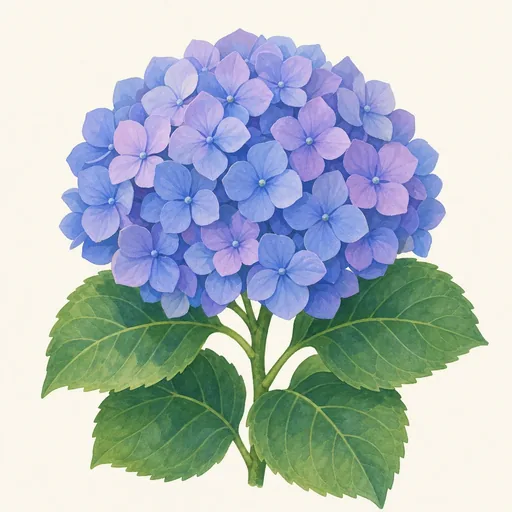
Hydrangea
Hydrangea macrophylla · Hydrangeaceae
- Plant outFrom 2 weeks before to 4 weeks after the last frostMar 27 – May 14
- Plant in autumn6–8 weeks before the first autumn frostAug 30 – Sep 19
- Space0.9–1.8 m (3–6 ft) apart
Description
Hydrangeas are popular flowering shrubs known for their large, vibrant blooms and lush foliage. Belonging to the genus Hydrangea, these perennial plants thrive in a variety of climates, mainly found in temperate regions of Asia and the Americas. They can vary significantly in size, ranging from compact varieties that reach about 1-3 feet tall to larger ones that can grow up to 15 feet or more.
The most notable feature of hydrangeas is their iconic flower clusters, which come in various shapes and colors, including blue, pink, white, and purple. The color of the flowers can be influenced by soil pH; for instance, acidic soils often produce blue blooms while alkaline soils may yield pink ones. This unique property makes them particularly appealing for gardeners experimenting with soil amendments.
Hydrangeas can be broadly categorized into several species, the most common being Hydrangea macrophylla (bigleaf hydrangea), Hydrangea paniculata (panicle hydrangea), and Hydrangea arborescens (smooth hydrangea). They can be further distinguished based on their flowering habits: some bloom on old wood while others bloom on new wood.
These plants prefer well-drained, moist soil and typically thrive in partial shade, although some varieties can tolerate full sun. They are generally low-maintenance but may require spring pruning depending on the species. Hydrangeas also attract pollinators, making them a valuable addition to pollinator gardens. With their lush foliage and stunning blooms, hydrangeas are a beloved choice for gardeners looking to add beauty and diversity to their landscapes.
Growing Conditions
0.6–3 m (2–10 ft) tall, 0.9–3 m (3–10 ft) wide
- Smallest
- Largest
Part sun
Tolerates part shade, full sun
Moderate
Keep evenly moist, not soggy.
Ideal 15–25 °C (59–77 °F)
Survives down to −40 °C (−40 °F).
acidic to neutral
Photos
Photo credits
Where it Grows
Planting
When to Plant
Hydrangeas are beloved for their stunning blooms and versatility in a variety of garden settings. Timing your planting is crucial for ensuring that these hardy shrubs establish well and flourish in your landscape.
Ideal Planting Time
-
Spring Planting: The best time to plant hydrangeas is in the spring, after the threat of frost has passed. In most regions, this typically falls between late March and early May. Planting during this time allows the hydrangeas to establish their root systems throughout the warmer growing months.
-
Fall Planting: While spring is often recommended, fall planting can also be successful in milder climates. Late summer to early fall is the ideal period, generally from mid-September to early October. Planting in the fall gives hydrangeas the chance to root before winter dormancy, but it is essential to ensure that they are well-watered and mulched to protect them from late frost.
Factors Influencing Planting Time
-
Climate Zone: Your USDA Hardiness Zone plays a significant role in determining the best planting time. In colder areas (Zones 3-5), spring planting is preferable, while gardeners in warmer regions (Zones 6-9) may have more flexibility, allowing for fall planting as well.
-
Health of the Plant: When purchasing a hydrangea, choose healthy plants with strong stems and vibrant leaves, regardless of the time of year. Avoid planting if the ground is frozen or overly wet, as this can hinder root establishment.
-
Soil Conditions: Ensure the soil is workable – not too wet or dry. Hydrangeas thrive in well-drained, rich, and slightly acidic soils. Testing your soil pH before planting can provide useful information for optimal plant health.
-
Watering Needs: After planting, be mindful of the watering needs of your newly planted hydrangeas. They require regular watering, especially in the first year, to help them establish a robust root system.
Conclusion
Planting hydrangeas at the right time greatly enhances your chances of success. By considering spring or fall planting based on your region’s climate and ensuring that the plants are healthy and the soil is suitable, you'll be well on your way to enjoying the beautiful blooms these versatile shrubs can offer. Be sure to monitor their water requirements as they grow, and you will soon be rewarded with magnificent flowers.
How to Plant
Planting a hydrangea successfully involves a few key steps to ensure healthy growth and blooming. First, choose a suitable location with well-draining soil, preferably rich in organic matter. Hydrangeas thrive in partial shade, though some varieties can tolerate full sun.
Begin by preparing the planting area. Dig a hole that is approximately twice the width of the hydrangea's root ball and as deep as it is tall. Loosen the soil at the bottom and sides of the hole to encourage root penetration. If your soil is heavy clay or sandy, amend it with compost or peat moss to improve drainage and nutrient content.
Next, remove the hydrangea from its pot gently, taking care not to disturb the roots too much. Place the plant in the center of the hole, ensuring that the top of the root ball is level with the surrounding soil. Backfill the hole with the soil you removed, making sure to eliminate air pockets by gently firming the soil around the base.
Water the newly planted hydrangea thoroughly to help settle the soil and promote root establishment. Apply mulch around the base to retain moisture and suppress weeds. Regular watering, especially in dry spells, will support your hydrangea’s growth in its first year.
Planting Calendar
- Plant outdoors: from 2 weeks before to 4 weeks after the last frost
- Autumn planting: 6–8 weeks before the first autumn frost
- Plant out: Mar 27 – May 14
- Autumn planting: Aug 30 – Sep 19
Care
Care Calendar
- Prune · Feb 27 – Apr 2
Prune panicle and smooth hydrangeas in late winter; leave bigleaf stems intact. - Prune · Jul 5 – Aug 22
If shaping a bigleaf hydrangea, prune lightly just after flowering, before next year's buds form. - Feed · Apr 10 – May 14
Apply a slow-release fertilizer at the label rate as growth begins. - Mulch · Apr 10 – May 14
Spread mulch over the root zone, keeping it clear of the stems. - Protect · Oct 11 – Nov 14
In cold areas, shelter bigleaf hydrangea stems to preserve their flower buds.
Watering
Proper watering is crucial for thriving Hydrangea plants, as they prefer consistently moist soil but can suffer from overwatering. The best strategy is to water deeply and infrequently, ensuring the soil remains damp but not soggy. Aim to water once a week during the growing season, providing about 1 to 2 inches of water, adjusting based on rainfall and temperature conditions.
Early morning is the ideal time for watering, as it allows plants to absorb moisture before the heat of the day. To check if your Hydrangea needs water, stick your finger about an inch into the soil; if it feels dry, it's time to water. Additionally, applying a layer of mulch around the base can help retain soil moisture and suppress weeds. Remember, different varieties may have varying moisture needs, so observe your plants for signs of stress, such as wilting or yellowing leaves.
Pruning
Pruning Hydrangeas can significantly affect both their growth and blooming. The best strategy depends on the type of hydrangea you have. For Hydrangea macrophylla, commonly known as bigleaf hydrangeas, prune in late winter or early spring before new growth appears. Remove dead wood, and cut back to a pair of healthy buds on older stems to encourage fresh blooms.
On the other hand, Hydrangea paniculata (panicle hydrangea) blooms on new wood. For these, you can prune them back in late winter or early spring as well, cutting them down to about one-third of their height to promote robust growth and larger flower clusters.
Always make clean cuts and remove any dead or damaged branches. Regular deadheading of spent blooms throughout the summer can also encourage a longer flowering season. Proper pruning not only shapes the plant but enhances its overall health and aesthetics.
Weeding
Weeding around Hydrangea plants is crucial for their health, as invasive weeds compete for nutrients and moisture.
The best strategy begins with prevention: apply a layer of mulch around the base of the plant. This helps suppress weed growth while retaining moisture. When weeding, it’s essential to pull weeds by hand or use a hoe, taking care not to disturb the Hydrangea's roots.
Focus on weeding during the early morning or late afternoon when the soil is moist, making it easier to remove weeds by the roots. Ensure to tackle weeds regularly—weekly during growing seasons—before they set seed, as this minimizes potential re-infestation.
Always inspect for any signs of pests or diseases while weeding, and remember to wear gloves to protect your hands. Treat any emerging issues promptly to maintain the health and beauty of your Hydrangeas.
Mulching
Mulching Hydrangeas is essential for maintaining moisture, improving soil structure, and suppressing weeds. To effectively mulch your Hydrangeas, start by applying a layer of organic material, such as shredded bark, wood chips, or pine needles, around the base of the plant. Aim for a depth of about 2 to 4 inches, ensuring it extends beyond the plant's root zone.
Before applying mulch, clear away any weeds or grass to prevent competition for nutrients. It's also advisable to create a small well around the root zone to help retain water while avoiding direct contact between the mulch and the plant stems, which can lead to rot. Mulching is best done in early spring or late fall to help stabilize soil temperatures and moisture levels. Regularly check and replenish the mulch to maintain its effectiveness throughout the growing season. This will contribute significantly to the health and vibrancy of your Hydrangeas.
Fertilizing
Fertilizing Hydrangeas effectively enhances their growth and blooms. The best strategy begins in early spring, just as new growth emerges. Use a balanced, slow-release fertilizer with an NPK ratio such as 10-10-10 or 12-4-8, or opt for a fertilizer specifically formulated for flowering shrubs.
Apply a half cup to one cup of fertilizer per plant, spreading it evenly within the drip line—this is the area under the branches' outermost reach—and watering it in well. For some varieties, such as the bigleaf Hydrangea, you might also consider using a fertilizer high in phosphorus to promote blooming.
Avoid over-fertilization, as it can lead to excessive foliage with fewer flowers. It is also advisable to check the soil pH, as some Hydrangeas change color based on acidity; applying lime raises pH (blue flowers), while sulfur lowers it (pink flowers). Regular feeding throughout the growing season encourages vibrant blooms and robust growth.
Growing in Containers
Grows well in a pot of at least 30 litres (7.9 US gallons), with drainage holes. Best kept outdoors.
Propagation
From cuttings
- Take a nonflowering softwood stem cutting in late spring or early summer.
- Remove the lower leaves and trim the cutting just below a leaf node.
- Insert it into moist, free-draining propagation mix.
- Cover loosely to retain humidity and keep it in bright, indirect light.
- Pot it up once roots have developed.
By layering
- Choose a low, flexible stem in spring.
- Lightly scrape the underside where it will touch the soil.
- Pin that section beneath a few inches of soil, leaving the tip exposed.
- Keep the soil moist until roots form.
- Sever the rooted stem from the parent and transplant it.
By division
- Choose an established, clump-forming hydrangea with rooted shoots.
- Dig around and lift the clump while dormant.
- Separate a rooted section with several healthy stems.
- Replant it at its original depth and water thoroughly.
Companion Plants
Good neighbors
- Hostas: They thrive in the partial shade and moist, well-drained soil favored by many hydrangeas.
- Ferns: Many garden ferns suit the shaded, consistently moist conditions around hydrangeas.
- Astilbes: They share hydrangeas’ preference for partial shade and reliably moist soil.
Common Problems
- Spots on leaves
- Yellowing leaves
- Leaves dropping
Fungal leaf spot is a general name for diseases caused by many different fungi, not a single species. These fungi…
- White powdery coating
- Yellowing leaves
- Curled or cupped leaves
- Distorted new growth
Powdery mildew is a group of fungal diseases, not a single species. Different fungi infect different hosts, including…
- Yellowing leaves
- Sticky residue on leaves
- Black sooty coating
- Curled or cupped leaves
Aphids are small, soft-bodied insects that feed by piercing plants and drawing out sap. The group includes many…
- Yellowing leaves
- Brown or crispy leaf edges
- Stunted growth
Iron chlorosis is a nutrient disorder in which a plant cannot obtain enough usable iron to make chlorophyll. It is not…
- Brown or crispy leaf edges
- Wilting
- Bleached or scorched patches
- Leaves dropping
Frost damage is an injury caused when plant tissues become cold enough for ice to form or for cells to lose water to…
Varieties
It can flower on both old and new growth, with bloom color influenced by soil conditions.
- reblooming
- pink or blue flowers
This reblooming selection bears rounded flower clusters on sturdy, reddish stems.
- reblooming
- pink or blue flowers
Its large flower heads may bend the stems, especially after rain.
- large white blooms
- blooms on new growth
It has strong stems that better support its large flower heads.
- large white blooms
- sturdy stems
Its large flower clusters open greenish and age through cream to pink.
- lime-green blooms
- blooms on new growth
It offers a smaller-growing alternative to Limelight.
- compact
- lime-green blooms
This dwarf shrub produces abundant white flower clusters that age pink.
- compact
- white blooms
Its flower clusters open white and gradually turn pink to red.
- pink-aging blooms
- blooms on new growth
More about varieties
Hydrangeas are beloved for their stunning blooms and versatility in garden design. There are several common varieties of hydrangeas, each with unique characteristics, sizes, and color ranges. Below, we explore some of the most popular types:
1. Hydrangea macrophylla (Mophead and Lacecap)
- Mophead: This variety features large, rounded flower heads composed of numerous small blossoms. The color can vary based on soil pH; acidic soils often yield blue flowers, while alkaline soils produce pink blooms.
- Lacecap: Unlike the mophead, lacecap hydrangeas have a flatter bloom structure, with small inner flowers surrounded by larger outer flowers. They also show color variations based on soil conditions.
2. Hydrangea paniculata (Panicle Hydrangea)
- Known for its cone-shaped flower clusters, panicle hydrangeas bloom on new wood, making them hardy and reliable bloomers. Varieties like 'Limelight' and 'Pinky Winky' are particularly popular, showcasing creamy white to pink flowers that can be enjoyed from mid-summer to fall.
3. Hydrangea arborescens (Smooth Hydrangea)
- Commonly known as the smooth hydrangea, this species includes the well-known 'Annabelle' variety. It produces large, round flower heads typically in white or cream, and is noted for its ability to thrive in various climates and its resilience to cold.
4. Hydrangea quercifolia (Oakleaf Hydrangea)
- This variety is notable for its distinctive oak-shaped leaves, which provide excellent autumn color. It produces panicles of white flowers that turn to pink as they mature. It's a great choice for gardeners seeking multi-season interest.
5. Hydrangea serrata (Mountain Hydrangea)
- Originating from the mountainous regions of Asia, mountain hydrangeas are smaller in stature and can thrive in partially shaded areas. They feature lacecap flowers and are often prized for their unique colors and compact growth, making them suitable for smaller gardens.
6. Hydrangea anomala subsp. petiolaris (Climbing Hydrangea)
- A unique hydrangea that grows as a vine, climbing hydrangeas can be trained to cover walls or trellises. They boast white flowers during the summer and have attractive foliage that can remain green year-round in mild climates.
7. Hydrangea aspera (Hairy Hydrangea)
- Known for its large, coarse leaves and fuzzy stems, this species produces flat clusters of flowers that are often blue or purple. It’s a more exotic addition, appreciated for its unique texture and beauty.
Cultivation Tips Different varieties of hydrangeas have specific requirements for sunlight, soil type, and water needs. While many thrive in partial shade, some may prefer more sun or can tolerate full shade. Soil acidity affects bloom color particularly in H. macrophylla, so adjusting the soil pH can lead to exciting changes in flower hues. Regular pruning is recommended for most types to promote healthy growth, so understanding the blooming habits of each variety is crucial.
Whether you're looking to create a lush, colorful border, a cottage garden, or a statement climbing feature, these various hydrangea types offer plenty of options for gardeners of all skill levels. Starting with the right variety can ensure beautiful blooms and a thriving garden space for years to come.
Health Benefits
Hydrangea, particularly its species Hydrangea macrophylla, has been utilized in traditional medicine for various health and wellness applications, particularly in Asian cultures. One of the most notable uses of hydrangea is in promoting urinary health. The plant contains specific compounds that are believed to support kidney function and promote the excretion of toxins, making it helpful in treating urinary tract infections and passing kidney stones.
Additionally, hydrangea has been noted for its anti-inflammatory properties. It is sometimes used to alleviate symptoms of inflammatory conditions such as arthritis. The plant's root is often prepared as a decoction or extract, which may help in reducing swelling and pain, although scientific backing is limited.
Furthermore, hydrangea has been used in homeopathy to balance hormones and has potential applications in managing symptoms associated with menstruation and menopause.
It’s essential to note that while these applications are rooted in traditional practices, scientific evidence is still emerging. Therefore, anyone interested in using hydrangea for health purposes should consult a healthcare professional for guidance on safety and dosage. As with any medicinal plant, proper identification and preparation are crucial for obtaining the desired benefits.
Fun Facts
-
Color-Changing Blooms: The color of hydrangea flowers can change based on the soil's pH level. Acidic soils (pH below 6) produce blue flowers, while alkaline soils (pH above 7) yield pink flowers. Neutral soils generally result in purple blooms.
-
Variety of Types: There are over 75 species of hydrangeas, with the most common types being Hydrangea macrophylla (bigleaf), Hydrangea paniculata (panicle), and Hydrangea arborescens (smooth hydrangea). Each type has unique characteristics and preferred growing conditions.
-
Long Bloom Period: Hydrangeas are known for their long flowering season, typically lasting from late spring to fall. Some varieties can even bloom multiple times within a single growing season, providing continuous aesthetic appeal in gardens.
-
Symbolic Meaning: In the language of flowers, hydrangeas symbolize gratitude and understanding. They are often associated with heartfelt emotions and are popular in bouquets for occasions such as weddings and anniversaries.
-
Historical Importance: Native to Asia and the Americas, hydrangeas have been cultivated since the 18th century. They were introduced to Western gardens by explorers and have since become a staple in ornamental gardening, celebrated for their lush foliage and stunning flower clusters.
Notice an error or have a question about Hydrangea? Contact us