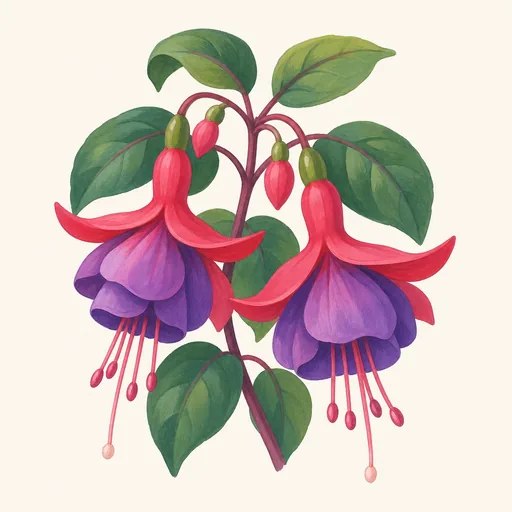
Fuchsia
Fuchsia · Onagraceae
- Plant out1–3 weeks after the last frostApr 17 – May 7
- Space30–60 cm (12–24 in) apart
- Bloom30–60 days after plantingMay 17 – Jul 27
Description
Fuchsia is a genus of flowering shrubs and small trees admired for its graceful, often pendulous blooms. Most garden plants are hybrids bred from species native to Central and South America, although the genus also includes species from New Zealand and other Pacific islands. Depending on the variety, fuchsias may form upright bushes, trailing plants for hanging baskets, or, in mild climates, larger woody shrubs.
The flowers usually hang from slender stalks and have four prominent, backward-curving sepals surrounding a tube and a shorter, often contrasting corolla. Long stamens and a style project beyond the petals, giving many blooms their distinctive, lanternlike appearance. Colors range from white and pale pink to red, purple, and violet, frequently in two-tone combinations. Leaves are generally oval, pointed, and arranged opposite one another or in whorls. Flowering commonly continues from late spring into autumn when temperatures remain moderate. Hummingbirds pollinate many American species; the fleshy fruits that follow are berries. Fruits of many species are edible, though their flavor varies.
Fuchsias grow best in fertile, well-drained soil that stays evenly moist without becoming waterlogged. They generally appreciate morning sun or bright filtered light and protection from hot afternoon sun, especially in warm regions. Regular watering during active growth and occasional feeding support abundant flowers; pinching young shoots encourages a fuller shape. Most popular hybrids are damaged by frost, so gardeners in colder climates bring containers indoors before freezing weather or grow them as seasonal plants. Hardier types, including cultivars derived from Fuchsia magellanica, can overwinter outdoors in suitable sheltered sites, often dying back and resprouting in spring. Good airflow and checking for aphids, whiteflies, and fuchsia gall mites help keep plants healthy.
Growing Conditions
30–90 cm (1–3 ft) tall, 30–75 cm (12–30 in) wide
- Smallest
- Largest
Part shade, 2+ hours
Tolerates part sun
Moderate
Keep evenly moist, not soggy.
Ideal 15–24 °C (59–75 °F)
Survives down to −1 °C (30 °F).
pH 6–7 · acidic to neutral
Where it Grows
Planting
When to Plant
Plant fuchsias outdoors in spring, once the danger of frost has passed. This gives their roots a full growing season to establish before winter. Check your local last-frost date and the forecast rather than relying on a calendar month: a late cold snap can damage new growth. Hardy fuchsias can go into the ground when conditions are mild and the soil is workable. In regions with mild winters, early autumn planting is also possible if there is enough time for roots to establish before cold weather. Tender fuchsias are usually grown in pots; keep them under cover until nights are reliably frost-free, then move them outdoors gradually over about a week so their leaves adjust to brighter light and wind. If a plant has spent winter indoors, wait for settled warmth before putting it outside. Avoid planting during a heatwave or when the soil is waterlogged.
How to Plant
Choose a sheltered spot with morning sun or bright, dappled shade. Fuchsias generally flower best with some light but appreciate protection from strong afternoon sun, especially in hot climates. They need fertile soil that stays evenly moist without becoming waterlogged. For a garden plant, loosen the soil over an area wider than the root ball and mix in compost if the soil is poor. Dig a hole wide enough to spread any circling roots gently. Set a hardy fuchsia with the top of its root ball about 5 cm (2 in) below the surrounding soil surface; this helps protect the base of the plant in winter. Backfill, firm lightly, and water thoroughly.
For a tender fuchsia, choose a pot with drainage holes, only a little larger than its root ball. Use a good-quality, moisture-retentive but free-draining potting mix, and keep the plant at the same depth it grew before. Water until excess drains away. Whether planted in the ground or a pot, keep the soil consistently moist while the plant establishes, but do not let it sit in water. A layer of mulch helps garden soil retain moisture; leave a small gap around the stems.
Growth Timeline
- Growing in the garden 30–60 days
- In bloom 12–20 weeks
Planting Calendar
- Plant outdoors: 1–3 weeks after the last frost
- Plant out: Apr 17 – May 7
- Bloom: May 17 – Jul 27
Care
Care Calendar
- Prune · Mar 27 – Apr 30
Cut back overwintered plants and remove dead stems from hardy plants as new growth appears. - Pinch out · Apr 10 – May 28
Pinch young shoot tips to encourage bushy growth. - Feed · Apr 24 – Aug 6
Feed container plants regularly with a diluted balanced fertilizer while they are growing and flowering. - Deadhead · Jul 5 – Oct 31
Remove faded flowers and developing seed pods to encourage more blooms. - Protect · Oct 11 – Oct 31
Move tender plants indoors before frost and keep them cool and frost-free. - Mulch · Oct 25 – Nov 21
Cover the crowns of hardy plants with mulch after the first frost.
Watering
Keep the soil evenly moist while fuchsias are actively growing and flowering, but do not leave roots standing in water. Check the top 1–2 cm (about ½–1 inch) of soil; water thoroughly when it begins to feel dry. Containers and hanging baskets may need water daily during hot or windy weather, while plants in the ground usually need it less often. Let excess water drain freely, and empty saucers after watering. Water the soil rather than routinely soaking the foliage. Fuchsias generally prefer cool conditions, so move containers into afternoon shade during heatwaves and check them more often. Wilting can signal either dry soil or waterlogged roots: feel the soil before adding water. As growth slows in autumn, reduce watering. Keep overwintering plants only lightly moist, particularly if they have lost their leaves.
Pruning
Pinch out the tips of young shoots in spring to encourage branching and more flowering stems. Stop pinching once buds are forming, or whenever you want the plant to begin flowering. During the growing season, remove dead, damaged, or crossing stems and faded flowers if you are not keeping the berries. Light trimming can tidy a plant that has become straggly. For established hardy fuchsias in cold climates, leave the stems in place over winter to help protect the crown, then cut back dead growth after the risk of severe frost has passed in spring. Tender fuchsias kept frost-free can be shaped before storage or pruned as new growth starts in spring. Make cuts just above a healthy leaf pair or bud, using clean tools. Avoid heavy late-season pruning that encourages tender new growth before cold weather.
Weeding
Keep the area around outdoor fuchsias free of weeds, especially while the plants are becoming established. Weeds compete for moisture and nutrients, and dense growth around the stems can restrict air circulation. Pull small weeds by hand when the soil is slightly damp, taking care not to disturb the fuchsia’s relatively shallow roots. For larger weeds, loosen the soil gently with a hand tool rather than digging deeply beside the plant. Check beneath spreading stems, where seedlings can be easy to miss. In containers and hanging baskets, remove stray seedlings promptly; the limited volume of potting mix makes competition more significant. Dispose of weeds before they set seed. A mulch layer can reduce new weeds outdoors, but leave a small gap around the fuchsia’s stems. Avoid spraying herbicide near the plant, since drift can damage its foliage and shoots.
Mulching
Spread a 5–8 cm (2–3 inch) layer of compost, shredded leaves, or other organic mulch around fuchsias growing in the ground. Mulch helps the soil retain moisture, moderates temperature changes, and suppresses weeds. Apply it over moist soil in spring or early summer, leaving a few centimetres clear around the stems to reduce the risk of rot. Renew the layer as it breaks down, rather than piling fresh mulch onto an already thick covering. For hardy fuchsias in colder areas, a loose layer over the root zone after the ground has cooled can provide some winter protection; uncover emerging shoots gradually in spring. In pots, a thin surface layer may slow drying, but it is no substitute for checking the potting mix regularly. Do not block drainage holes or bury the plant’s crown under heavy, wet material.
Fertilizing
Fuchsias flower best with steady, moderate feeding during active growth. In containers, start feeding after new spring growth is under way, using a balanced liquid fertilizer at the label rate every two to four weeks. Plants watered very frequently may benefit from smaller, more frequent doses if the product label allows. In the ground, mix compost into the planting area or top-dress established plants in spring; additional fertilizer is usually needed only if growth is weak or the soil is poor. Avoid excessive nitrogen, which can promote leafy growth at the expense of flowers. Apply fertilizer to moist soil to reduce the chance of root damage. As growth slows in late summer or autumn, taper off feeding so plants are not pushed into soft new growth before winter. Do not fertilize dormant plants. Follow the product label rather than combining several feeds at full strength.
Pest Management
Inspect leaf undersides and shoot tips regularly, especially on plants kept indoors or in greenhouses. Aphids and whiteflies can be washed off with a gentle stream of water; persistent infestations may need insecticidal soap applied according to its label, with good coverage of leaf undersides. Hot, dry conditions can favour spider mites, so check for fine webbing and pale, speckled leaves. Slugs and snails may damage young outdoor growth; remove hiding places and use a suitable control if needed. Distorted shoots caused by fuchsia gall mite should be removed and discarded promptly. Do not compost infested material or share cuttings from affected plants. Give plants good air circulation, avoid prolonged wet foliage, and remove badly diseased leaves. Identify a problem before treating it, and use pesticides only as directed, taking care around pollinators.
Harvesting
Fuchsias are usually grown for their flowers rather than for a crop, but their ripe berries are edible. Flavour varies greatly by species and cultivar, so sample a berry before harvesting many. Let fruits ripen fully on the plant; they commonly darken and soften, although colour differs among varieties. Pick them gently by hand and use them soon, as soft berries bruise and spoil quickly. They can be eaten fresh or used in preserves. Flowers are also edible and can be picked when fresh and fully open. Harvest only from plants you have positively identified as fuchsias and that have not been treated with pesticides unsuitable for edible crops. Wash flowers and fruit before use. If you remove spent flowers throughout the season to encourage a tidy display, leave some in place to develop berries. In colder climates, fruit may not ripen before frost.
Growing in Containers
Grows well in a pot of at least 5 litres (1.3 US gallons), with drainage holes. Can be grown indoors as a houseplant.
Propagation
From cuttings
- Take a 7–10 cm cutting from a healthy, nonflowering shoot in spring or summer.
- Remove the leaves from the lower half of the stem.
- Insert the stem into moist, free-draining propagation mix.
- Keep it in bright, indirect light and maintain even moisture.
- Pot it up once roots have formed.
Companion Plants
Good neighbors
- Begonias: They are commonly grown with fuchsias in partly shaded containers and share a preference for consistently moist, well-drained soil.
- Impatiens: They make a familiar shade-garden pairing with fuchsias and thrive with similar watering.
- Ferns: They are commonly paired with fuchsias in sheltered, partly shaded plantings with moist soil.
Common Problems
- Yellowing leaves
- Sticky residue on leaves
- Black sooty coating
- Curled or cupped leaves
Aphids are small, soft-bodied insects that feed by piercing plants and drawing out sap. The group includes many…
- Yellowing leaves
- Sticky residue on leaves
- Black sooty coating
- Curled or cupped leaves
Whiteflies are a family of tiny, sap-feeding insects that infest vegetables, ornamentals, and greenhouse plants…
- Pale speckles or stippling
- Yellowing leaves
- Brown or crispy leaf edges
- Fine webbing
Spider mites are tiny, plant-feeding arachnids in the family Tetranychidae, not insects. Several species attack garden…
- Orange or rust-colored spots
- Spots on leaves
- Yellowing leaves
- Leaves dropping
Rust is a group of plant diseases caused by fungi in the order Pucciniales, not a single species. Different rust fungi…
- Holes in leaves
- Wilting
- Stunted growth
- Leaves dropping
Vine weevil, also called black vine weevil, is a beetle that damages many garden and container plants, including…
- Aphids, whiteflies, and spider mites can weaken plants and discolor leaves.
- Fuchsia gall mites can cause distorted, swollen shoots and buds.
- Vine weevil larvae may damage roots, especially in containers.
- Rust causes orange-brown spots on leaves; gray mold can affect flowers in damp, still air.
- Waterlogged soil can lead to root rot, while heat or inconsistent watering may cause buds to drop.
Varieties
Its red sepals and white corollas make it a popular choice for hanging baskets.
- trailing
- double flowers
It bears red sepals above deep purple corollas.
- trailing
- double flowers
This shrub-form fuchsia has red sepals and purple corollas.
- upright
- cold tolerant
It produces large flowers with pale sepals and blue-violet corollas.
- upright
- large flowers
This small shrub bears red and purple flowers.
- compact
- cold tolerant
Its slender orange-red flowers attract hummingbirds, but the plant needs frost-free winter protection.
- upright
- hummingbird-attracting
It has red sepals and ruffled purple corollas.
- compact
- double flowers
More about varieties
- ‘Swingtime’ — a trailing cultivar with double white-and-red flowers, popular in hanging baskets.
- ‘Dollar Princess’ — a compact cultivar with red sepals and double purple flowers; relatively hardy in mild climates.
- ‘Gartenmeister Bonstedt’ — an upright, heat-tolerant cultivar with long orange-red tubular flowers.
- ‘Hawkshead’ — a hardy Fuchsia magellanica cultivar with slender, nearly white flowers.
- ‘Delta’s Sarah’ — a large-flowered cultivar with white sepals and a blue-violet corolla.
Fun Facts
- The genus was named in honor of the German botanist Leonhart Fuchs.
- Many fuchsias have dangling flowers suited to pollination by hummingbirds.
- Fuchsia berries are edible, although their flavor varies considerably among species and cultivars.
- Despite its association with tropical-looking flowers, some fuchsias can survive outdoors through mild winters.
Notice an error or have a question about Fuchsia? Contact us