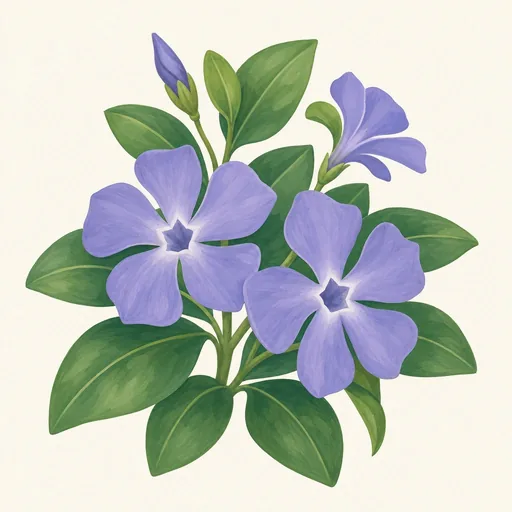
Vinca
Vinca · Apocynaceae
- Start indoors10–12 weeks before the last frostJan 16 – Feb 5
- Plant out2–4 weeks after the last frostApr 24 – May 14
- Space20–30 cm (8–12 in) apart
- Bloom0–42 days after plantingApr 24 – Jul 16
Description
Vinca is a genus of low-growing, flowering perennials commonly called periwinkles. The two species most often grown in gardens are lesser periwinkle (Vinca minor) and greater periwinkle (Vinca major). Both have trailing stems that spread across the ground and can root where they touch soil, forming a dense mat. Their opposite, evergreen leaves are usually glossy and dark green, although cultivars with cream- or yellow-edged foliage are available.
The flowers are typically blue-violet, with five petals that give them a pinwheel-like shape. White and pale purple forms also occur. Flowering is heaviest in spring, with occasional blooms later in the growing season. Vinca minor generally has smaller leaves and a lower habit than Vinca major. Both are grown chiefly as ground covers, especially beneath trees, along borders, and on banks where a continuous planting is wanted.
Vinca tolerates partial to full shade and grows in a range of well-drained soils. Established plants can withstand some drought, but they spread best where moisture is reasonably consistent. Water new plantings until their roots are established. To keep the edges of a planting tidy, trim wandering stems and remove unwanted rooted sections. Plants can be propagated by division or by transplanting pieces of rooted stem.
Vinca is native to parts of Europe, North Africa, and western Asia and is cultivated far beyond that range. Its vigorous growth is useful where other plants struggle, but it can also crowd out smaller plants. In some regions, particularly parts of North America, it escapes gardens and is considered invasive. Check local guidance before planting it near woodland or other natural areas. Vinca is different from the warm-season bedding flower often called annual vinca, which belongs to the genus Catharanthus.
Growing Conditions
20–45 cm (8–18 in) tall, 20–45 cm (8–18 in) wide
- Smallest
- Largest
Full sun, 4+ hours
Tolerates part sun, part shade
Low
Let the soil dry out between waterings.
Ideal 20–30 °C (68–86 °F)
Survives down to −1 °C (30 °F).
pH 5.5–7 · acidic to neutral
Where it Grows
Planting
When to Plant
For true vinca—the perennial groundcovers Vinca minor and Vinca major—plant in spring after the ground has thawed or in early fall while the soil is still warm. These mild conditions give roots time to establish before summer heat or winter cold. In colder regions, spring is the safer choice, especially for the less cold-hardy V. major. In warmer regions, fall planting often works well because cooler weather reduces watering needs. Choose a day when the soil is workable, not frozen or waterlogged, and avoid planting during a heat wave or drought. You can usually tell the time is right when you can dig easily and several weeks of moderate weather are expected. Container-grown plants can go into the ground outside these ideal windows, but they will need closer attention to watering. This advice is for perennial Vinca, not the frost-tender bedding plant often called annual vinca, which is Catharanthus roseus.
How to Plant
Choose a site with well-drained soil and partial shade; Vinca minor also grows in deeper shade, though it may flower less. Check local guidance before planting: vinca can spread aggressively, and V. major is invasive in some regions. Keep it away from natural areas, or use an alternative where its spread would be difficult to contain.
Loosen the soil and remove weeds and their roots. Set nursery plants about 12–18 inches (30–45 cm) apart for V. minor; allow more room for the larger V. major. Dig each hole as deep as the root ball and roughly twice as wide. Slip the plant from its pot, gently loosen any tightly circling roots, and set it so the top of the root ball is level with the surrounding soil. Backfill, firm the soil lightly, and water thoroughly. Add a thin layer of mulch to limit weeds and conserve moisture, keeping it clear of the stems.
Keep the soil evenly moist, but not soggy, while the plants establish. Afterward, water during prolonged dry spells. Remove shoots that cross the planting boundary before they take root; do not dump cut stems where they could establish elsewhere.
Growth Timeline
- Germination 7–14 days
- Seedlings indoors 10–15 weeks
- Growing in the garden 0–42 days
- In bloom 14–22 weeks
Planting Calendar
- Start seeds indoors: 10–12 weeks before the last frost
- Plant outdoors: 2–4 weeks after the last frost
- Germination: 7–14 days
- Start indoors: Jan 16 – Feb 5
- Plant out: Apr 24 – May 14
- Bloom: Apr 24 – Jul 16
Care
Care Calendar
- Mulch · Apr 24 – May 21
Apply a thin layer around plants, keeping it away from the stems. - Feed · May 8 – Aug 20
Feed lightly with a balanced fertilizer every four to six weeks. - Protect · Oct 11 – Oct 31
Cover plants on nights when frost is forecast.
Watering
Water newly planted Vinca regularly through its first growing season so the soil stays lightly moist while roots establish. Water deeply, then let the upper inch (2–3 cm) of soil begin to dry before watering again. Established periwinkle usually needs little supplemental water in temperate climates, but give it a thorough soaking during prolonged hot, dry spells, especially where it grows under trees and competes with their roots. Check the soil rather than watering on a fixed schedule: shade, rainfall, soil type, and drainage all affect how quickly it dries. Aim water at the soil in the morning to keep leaves drier. Avoid persistently wet ground, which can encourage root and stem diseases. Drooping leaves during heat can signal thirst, but wet soil alongside yellowing or wilting suggests a drainage problem instead. Container-grown plants dry out faster and need more frequent checks.
Pruning
Prune Vinca mainly to keep its spreading stems within the space you have allotted. After its principal spring flowering, trim runners that reach paths, lawns, or neighboring plants. A light cutback can also tidy a thin or uneven patch and encourage fresh growth. For an overgrown bed, cut stems back more firmly, but leave some leafy growth and avoid cutting into the crowns or scraping the soil. Remove dead, damaged, or diseased stems whenever you notice them; clean your tools after working with diseased material. Gather up cut stems, since pieces left in contact with moist soil may root. Do not dump trimmings where they could establish outside the garden. Vinca can spread beyond its planting area, so inspect bed edges several times during the growing season and remove escaped stems, including any rooted sections, before they form a new patch.
Weeding
Weed regularly while young Vinca plants are filling in. Remove weeds by hand or with shallow tools, taking care not to pull up the Vinca’s shallow, rooting stems. Work when the soil is slightly moist so you can lift weeds with their roots; remove perennial weeds, such as grasses, before their root systems become tangled in the groundcover. Avoid deep hoeing, which can damage Vinca and bring buried weed seeds to the surface. Once the foliage forms a dense mat, it suppresses many small weeds, but check for those emerging through gaps or along edges. Pull seedlings before they set seed. If you open a patch while weeding, cover the exposed soil with a thin layer of mulch until the Vinca grows across it. Also watch for Vinca stems rooting beyond the bed: removing those promptly is an important part of keeping this vigorous groundcover contained.
Mulching
Apply a 1–2 inch (2–5 cm) layer of shredded leaves, fine bark, or another organic mulch around newly planted Vinca. Mulch helps conserve moisture and slows weed growth while the plants are still too far apart to shade the soil. Keep it slightly back from each plant’s crown, and do not bury the trailing stems or leaves under a thick layer. Excess mulch can hold moisture against the foliage and make it harder to spot problems. As Vinca spreads into a dense groundcover, it generally shades the soil well enough that little additional mulch is needed. Replenish mulch only in open areas or where it has broken down. If fallen tree leaves collect over a Vinca bed, clear away heavy, matted layers that block light and airflow. A light scattering of leaves is less likely to interfere with healthy, established growth.
Fertilizing
Vinca generally needs little fertilizer when grown in ordinary garden soil. In spring, a light top-dressing of compost around plants can provide nutrients and improve the soil; keep it off the crowns. If growth is weak and the soil is known to be low in nutrients, apply a balanced, slow-release fertilizer at the label rate for groundcovers, then water it in. Do not assume that sparse growth means the plant needs feeding: deep shade, drought, poor drainage, or competition from tree roots may be the real cause. A soil test can help if the problem persists. Avoid heavy or frequent applications, particularly of high-nitrogen fertilizer, which may produce lush stems without improving flowering and can contribute to excessive spread. Established Vinca growing and flowering well needs no routine feeding. Fertilize in spring rather than late in the season, when tender new growth has less time to mature.
Pest Management
Check Vinca occasionally for discolored or spotted leaves, collapsing stems, and insects, especially in crowded or poorly drained beds. Aphids or scale insects may appear on stems and leaves; small infestations can often be removed by hand or with a directed spray of water. Use an insecticidal soap labeled for the pest only if needed, following its directions. Slugs and snails may damage tender growth; remove hiding places and check plants after dark if you see irregular holes. Stem blights, leaf spots, and root rots are more likely when foliage stays wet or soil drains poorly. Remove affected stems and fallen debris, water at soil level, and improve airflow rather than repeatedly wetting the leaves. If a plant wilts despite wet soil, inspect the roots and drainage. Dispose of badly diseased material instead of leaving it in the bed, and clean tools after pruning it.
Growing in Containers
Grows well in a pot of at least 3 litres (0.8 US gallons), with drainage holes. Can be grown indoors as a houseplant.
Propagation
From seed
- Sow seeds indoors 10–12 weeks before the last frost.
- Cover the seeds lightly; they germinate best in darkness.
- Keep the mix warm and lightly moist until seedlings emerge.
- Move seedlings into bright light and transplant outdoors after frost danger passes.
From cuttings
- Take a 3–4-inch cutting from a healthy, nonflowering stem.
- Remove the lower leaves.
- Insert the stem into moist, well-draining potting mix.
- Keep it warm in bright, indirect light until roots form.
Common Problems
- Yellowing leaves
- Wilting
- Stunted growth
- Leaves dropping
Root rot is a general name for the decay of plant roots, not a single disease with one scientific name. It can result…
- Spots on leaves
- Yellowing leaves
- Leaves dropping
Fungal leaf spot is a general name for diseases caused by many different fungi, not a single species. These fungi…
- Yellowing leaves
- Sticky residue on leaves
- Black sooty coating
- Curled or cupped leaves
Aphids are small, soft-bodied insects that feed by piercing plants and drawing out sap. The group includes many…
- Pale speckles or stippling
- Yellowing leaves
- Brown or crispy leaf edges
- Fine webbing
Spider mites are tiny, plant-feeding arachnids in the family Tetranychidae, not insects. Several species attack garden…
- Root rot: Poorly drained soil or overwatering can cause yellowing, wilting, and dying stems.
- Stem blight and leaf spot: Fungal diseases can leave stems dark and collapsing or leaves spotted, especially where foliage stays damp.
- Aphids, scale, and spider mites: These pests may weaken plants, though established vinca is usually resilient.
- Unwanted spread: Creeping stems root as they grow. Vinca minor and Vinca major can escape gardens and become invasive in some regions.
Varieties
This series offers several flower colors and strong resistance to aerial Phytophthora blight.
- disease resistant
- heat tolerant
Its spreading habit suits hanging baskets and containers.
- trailing
- disease resistant
This series produces large blooms on bushy plants.
- large flowers
- heat tolerant
Its compact plants flower in a wide range of colors.
- compact
- heat tolerant
This spreading series works well in baskets and over container edges.
- trailing
- heat tolerant
Its blooms have distinctive dark centers and color markings.
- patterned flowers
- heat tolerant
More about varieties
- Vinca minor (lesser periwinkle): A low, evergreen groundcover with typically blue-purple spring flowers.
- Vinca major (greater periwinkle): A larger, more vigorous species with bigger leaves and flowers.
- Vinca minor ‘Bowles’ (Bowles’s Variety): A popular selection known for its abundant violet-blue flowers.
- Vinca major ‘Variegata’: A form with creamy-edged leaves.
- Vinca difformis (intermediate periwinkle): A spreading species often grown in mild climates.
Health Benefits
Vinca, or periwinkle, has a history of use in herbal medicine, but it is not a well-established home remedy. Vinca minor contains vincamine, an alkaloid that has been studied for possible effects on blood flow and cognitive function. Evidence that vinca preparations improve memory or treat a medical condition is insufficient to recommend them. Products sold for “brain health” may instead contain vinpocetine, a compound made from vincamine; it should not be assumed to have the same effects or safety profile as the plant. The U.S. Food and Drug Administration has warned that vinpocetine may pose risks during pregnancy.
A common source of confusion is the name “vinca.” The important anticancer medicines vincristine and vinblastine come from Madagascar periwinkle (Catharanthus roseus), which was formerly classified as Vinca rosea. It is a different genus from the creeping vincas commonly planted as groundcover. Those medicines are purified, carefully dosed prescription drugs—not a reason to eat or brew either plant.
For most gardeners, vinca’s clearest wellness use is simply as an attractive, low-growing plant in a garden. Do not ingest it or use it to treat illness without advice from a qualified healthcare professional.
Fun Facts
- Vinca belongs to the dogbane family, Apocynaceae.
- Its five-petaled flowers often look like small pinwheels.
- Creeping stems can root where they touch the ground, helping the plant form a dense mat.
- Many vincas keep their leaves through winter in suitable climates.
- Madagascar periwinkle is widely called “annual vinca,” but its scientific name is Catharanthus roseus.
Notice an error or have a question about Vinca? Contact us