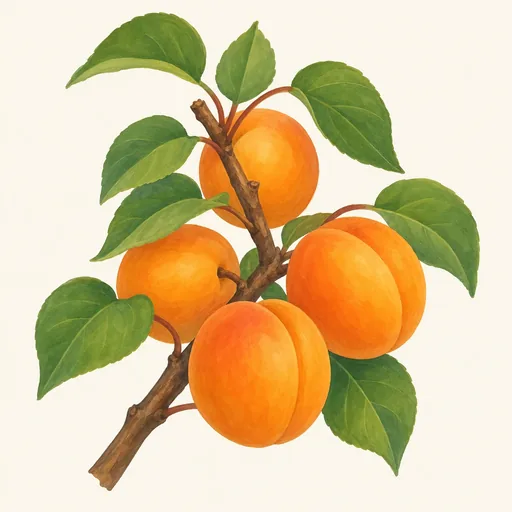
Apricot
Prunus armeniaca · Rosaceae
- Plant outFrom 4 weeks before the last frost until the last frostMar 13 – Apr 16
- Plant in autumn6–8 weeks before the first autumn frostAug 30 – Sep 19
- Space4.5–6 m (15–20 ft) apart
- HarvestAfter 2–4 years
Description
Apricot is a small deciduous fruit tree in the rose family, closely related to peaches, plums, and cherries. It usually reaches 3–8 meters tall, with a rounded crown and smooth, reddish-brown young branches. Its broad, finely toothed leaves appear around the time its white to pale pink flowers open in early spring. Because the flowers bloom early, a late frost can damage them and sharply reduce the crop.
The fruit is a rounded stone fruit, typically smaller than a peach, with velvety skin that ripens from yellow to orange, sometimes developing a red blush. Its flesh ranges from firm and mildly tart to soft, sweet, and fragrant, depending on the variety and ripeness. A hard pit encloses the seed. Apricots are eaten fresh, dried, or made into preserves, pastries, and sauces. The seeds should not be eaten casually: they can contain amygdalin, which releases cyanide when digested.
Apricot trees grow best in full sun and well-drained soil. They need some winter cold to flower normally, followed by a warm growing season, but they dislike waterlogged roots. Gardeners often plant them in a sheltered spot to reduce frost damage. Many varieties can set fruit without another tree, although pollination requirements vary by cultivar. Regular watering while fruit develops, moderate pruning, and thinning crowded young fruit can improve fruit size and tree health. Harvest apricots when they have developed their full color and yield slightly to gentle pressure; they bruise easily and do not become much sweeter after picking.
Cultivated for centuries across Asia and the Mediterranean, apricots are now grown in temperate regions worldwide. Their short fresh-fruit season helps explain why dried apricots are widely available throughout the year.
Growing Conditions
4.5–9 m (15–30 ft) tall, 4.5–7.5 m (15–25 ft) wide
- Smallest
- Largest
Full sun, 6+ hours
Moderate
Keep evenly moist, not soggy.
Ideal 18–27 °C (64–81 °F)
Survives down to −29 °C (−20 °F).
pH 6–7.5 · neutral
Where it Grows
Planting
When to Plant
Plant an apricot tree while it is dormant, before its buds begin to open. For a bare-root tree, this usually means late winter or early spring, as soon as the soil has thawed and is workable. In a mild-winter climate, you can also plant after leaf fall in autumn, giving roots time to establish before spring. A container-grown tree can be planted in spring or autumn, provided the ground is not frozen or waterlogged; avoid planting during summer heat if possible. Choose a day when the soil is moist but not saturated. Timing matters because apricots bloom early and their flowers are vulnerable to late frost. Before planting, check the cultivar’s suitability for your climate and choose a spot where cold air can drain away, rather than settling around the tree. If you cannot plant a bare-root tree promptly, keep its roots cool and moist until you can.
How to Plant
Choose a sunny site with at least six to eight hours of direct light and well-drained soil. Avoid low spots that collect standing water or cold air. Allow enough room for the mature tree: spacing depends on the cultivar and rootstock, so check the nursery label. If planting bare-root, soak the roots in water for a few hours first and trim only broken roots. For a container-grown tree, remove the pot and gently loosen any circling roots.
Dig a hole about twice as wide as the root spread or root ball, but no deeper than the roots need. Set the tree on firm soil with its root flare at ground level; keep the graft union above the soil. Spread bare roots outward without bending them sharply. Backfill with the original soil, gently firming it as you go, and water thoroughly to settle the soil. Do not add fertilizer to the planting hole. Apply a layer of mulch over the root area, leaving a gap around the trunk. Water deeply when the upper soil begins to dry during the first growing season, adjusting for rainfall and soil conditions. Stake only if the tree needs support, and remove or loosen ties as it grows.
Growth Timeline
- Establishing 2 years
- First harvest possible years 2–4
Planting Calendar
- Plant outdoors: from 4 weeks before the last frost until the last frost
- Autumn planting: 6–8 weeks before the first autumn frost
- Plant out: Mar 13 – Apr 16
- Autumn planting: Aug 30 – Sep 19
Care
Care Calendar
- Protect · Feb 27 – Apr 23
Cover blossoms with frost cloth when freezing nights are forecast, removing it during the day. - Protect · May 29 – Aug 13
Net ripening fruit if birds are taking it. - Mulch · Mar 27 – May 7
Spread organic mulch over the root zone, keeping it clear of the trunk. - Thin · Apr 24 – Jun 4
When fruits are small, thin clusters to leave about 2–4 inches between fruits. - Prune · Jun 5 – Aug 20
Prune after harvest in dry weather to open the canopy and remove dead or crossing wood.
Watering
Water newly planted apricot trees deeply after planting, then keep the root zone evenly moist through their first growing season. Check the soil several inches down before watering: if it is drying, soak slowly enough to wet the roots rather than giving frequent shallow sprinkles. Established trees usually need supplemental water during prolonged dry spells, especially from fruit set through harvest and during late-summer bud development. A deep watering every week or two may be appropriate in hot, dry weather, but adjust for rainfall, soil type, and drainage. Sandy soil dries faster than clay. Water at the soil surface or use drip irrigation; keeping leaves and fruit dry helps limit disease. Avoid waterlogged ground, which can damage roots. Try to keep moisture reasonably consistent as fruit ripens, since abrupt changes can contribute to cracking. Continue watering during a dry autumn until the tree enters dormancy.
Pruning
Train a young apricot to an open center or another well-spaced framework suited to your site, keeping a few strong scaffold branches and removing competing shoots. On established trees, remove dead, damaged, crossing, or crowded wood and thin the canopy enough for light and air to reach developing fruit. Apricots fruit largely on short-lived spurs, so avoid cutting away large amounts of productive wood each year. Make clean cuts just outside the branch collar; do not leave stubs. In areas where bacterial canker or other wound infections are common, prune during a stretch of dry weather, often after harvest in summer, so cuts can dry quickly. In drier regions, late-winter pruning before growth begins is also practiced. Avoid pruning in wet weather and avoid heavy cuts in autumn. Thin an overly heavy fruit crop by hand as needed; this reduces broken branches and improves fruit size.
Weeding
Keep grass and weeds out of the area immediately around an apricot tree, particularly while it is young. They compete with its shallow feeder roots for water and nutrients and can make it harder to see problems at the trunk. Maintain a weed-free circle at least about 1 m (3 ft) across around a new tree, enlarging it as practical as the tree grows. Remove weeds by hand or hoe lightly; deep cultivation can injure roots. A layer of organic mulch can suppress new weeds, but pull persistent perennial weeds before laying it down. Check the mulch regularly for seedlings and remove them while small. If using herbicides, follow the product label for fruit trees and prevent spray from touching the trunk, leaves, shoots, or exposed roots. Do not pile pulled weeds or fresh grass clippings against the bark, where they can hold moisture and shelter pests.
Mulching
Spread about 5–10 cm (2–4 in) of wood chips, shredded leaves, or other coarse organic mulch over the root zone. Mulch helps conserve soil moisture, moderate temperature, reduce weed growth, and protect shallow roots from cultivation. Start with a broad ring around a young apricot and extend it outward as the tree grows; covering more of the area beneath the canopy is useful where practical. Leave a clear gap of at least 10–15 cm (4–6 in) around the trunk so the bark stays dry and visible. Mulch heaped against the trunk can encourage decay and provide cover for rodents. Replenish the layer as it decomposes rather than continually piling more on top. Keep the mulch loose, not compacted, and check beneath it periodically if rodents are a problem. In poorly drained sites, mulch cannot correct waterlogged soil; address drainage first.
Fertilizing
Base fertilizer decisions on a soil test and the tree’s growth rather than feeding automatically. Apricots need adequate nutrients, but excess nitrogen can produce vigorous leafy shoots at the expense of fruit and may increase disease problems. If a young tree grows poorly and a nutrient shortage is likely, apply a modest amount of fertilizer labeled for fruit trees in early spring, following its directions for the tree’s size and age. Spread it over the root zone, away from the trunk, and water it in. Mature trees with healthy leaves, reasonable annual shoot growth, and good crops may need little or no fertilizer. Compost can provide a gentle nutrient supply when spread thinly over the soil and kept clear of the trunk. Avoid late-summer nitrogen applications, which can encourage tender growth before cold weather. If leaves show unusual yellowing or growth is weak, check soil pH, drainage, watering, and nutrient levels before adding more fertilizer.
Pest Management
Inspect apricot trees regularly, especially new shoots, developing fruit, and the undersides of leaves. Aphids and mites may be manageable with a firm water spray or a product labeled for edible fruit trees; apply any treatment according to its label. Caterpillars such as peach twig borer can damage shoots and fruit in some regions, while local pests may require different controls. Remove fallen or mummified fruit, prune out infected twigs, and thin crowded growth to reduce brown rot and other diseases. Harvest ripe fruit promptly and avoid overhead watering. Apricots can also develop bacterial canker and leaf-spot diseases; choose a suitable planting site and prune in dry weather to lower risk. Use local extension guidance to identify problems before spraying, since treatments and timing vary by region. Follow all label directions and preharvest intervals. Never spray insecticides while the tree is flowering and bees are visiting.
Harvesting
Apricots ripen in late spring or summer, depending on the variety and climate. Check fruit frequently as the harvest approaches: ripe apricots develop their characteristic orange or golden color, feel slightly soft under gentle pressure, smell fragrant, and come away from the stem with a light twist. Color alone can be misleading on red-blushed varieties, so sample a fruit for flavor. Pick carefully into shallow containers; apricots bruise easily and do not keep long. Fruit picked slightly firm can soften after harvest, but it will not develop the full sweetness of fruit allowed to ripen on the tree. Harvest in several passes because fruit on one tree rarely ripens all at once. Eat or process fully ripe apricots promptly. Refrigerate sound, ripe fruit for a few days if needed, and bring it to room temperature before eating for the best flavor. Remove fallen fruit from beneath the tree.
Growing in Containers
Grows well in a pot of at least 50 litres (13 US gallons), with drainage holes. Best kept outdoors.
Propagation
From seed
- Remove and clean the pit from a ripe apricot.
- Chill it in a moist medium in the refrigerator for 8–12 weeks.
- Sow the pit in well-drained potting mix.
- Keep it moist until it sprouts.
- Expect the seedling to differ from the parent variety.
By grafting
- Obtain a compatible stone-fruit rootstock.
- Collect healthy, dormant apricot scion wood in late winter.
- Graft the scion onto the rootstock as growth begins, aligning the cambium layers.
- Wrap and seal the graft.
- Remove shoots growing from below the graft.
Companion Plants
Good neighbors
- Another apricot variety: A compatible variety with overlapping bloom can improve fruit set, especially if the original variety needs cross-pollination.
Common Problems
- Brown or crispy leaf edges
- Wilting
- Bleached or scorched patches
- Leaves dropping
Frost damage is an injury caused when plant tissues become cold enough for ice to form or for cells to lose water to…
- Yellowing leaves
- Sticky residue on leaves
- Black sooty coating
- Curled or cupped leaves
Aphids are small, soft-bodied insects that feed by piercing plants and drawing out sap. The group includes many…
- Spots on leaves
- Yellowing leaves
- Holes in leaves
- Leaves dropping
Bacterial leaf spot is a name for leaf diseases caused by several bacteria, commonly species of Xanthomonas or…
- Wilting
- Leaves dropping
- Stunted growth
- Soft or rotting stems
Canker is a general name for a localized area of dead bark and underlying tissue on a woody stem or branch, not a…
- Wilting
- Stunted growth
- Leaves dropping
- Stems chewed or cut through
Borers are the larvae of various moths, beetles, flies, and other insects that feed inside plant tissue. “Borers” is a…
- Late frost: Spring freezes can kill early blossoms and prevent fruit set.
- Brown rot: Fungal infection causes blossoms to wilt and fruit to develop soft, rotting patches, especially in wet weather.
- Bacterial canker: Sunken lesions on branches may cause dieback and oozing gum.
- Shot-hole disease: Small spots fall out of leaves, leaving holes; fruit may also be blemished.
- Aphids and fruit pests: Aphids distort new growth, while pests such as plum curculio can damage fruit in regions where they occur.
- Poor drainage: Waterlogged soil can weaken roots and increase the risk of root rot.
Varieties
Also sold as Royal Blenheim, it is prized for fresh eating and drying.
- rich flavor
- freestone
This traditional variety produces flavorful fruit where its blossoms escape frost.
- heirloom
- rich flavor
Its firm fruit is popular for canning and drying.
- freestone
- good for preserving
Bred for colder regions, it still needs protection from frost during bloom.
- cold hardy
- early
This Canadian-bred variety is a useful choice for cooler growing regions.
- cold hardy
- firm fruit
Its relatively late bloom can reduce, but not eliminate, spring frost losses.
- cold hardy
- later blooming
It produces large, flavorful fruit early in the apricot season.
- early
- large fruit
Developed for the Pacific Northwest, it suits some cooler-summer gardens.
- cool-climate adapted
- later blooming
More about varieties
- Moorpark: An old variety prized for its rich flavor; best suited to places with a suitable winter chill and a mild spring.
- Blenheim (Royal): A flavorful, aromatic apricot often eaten fresh or dried; its soft fruit does not ship well.
- Tilton: A firm, productive variety traditionally used for canning and drying.
- Goldcot: A cold-hardy variety developed for areas with colder winters.
- Harcot: A Canadian variety valued for good flavor and relatively late flowering.
Health Benefits
Apricots are commonly eaten fresh, dried, or cooked as a way to add fruit to the diet. Fresh apricots provide fiber, potassium, and vitamin C, along with carotenoids, including beta-carotene. The body can convert beta-carotene to vitamin A, which supports normal vision and immune function. Fiber supports regular bowel movements, while potassium helps the body maintain normal muscle and nerve function. These benefits come from apricots as part of an overall balanced diet, not from using them as a treatment for a disease.
Dried apricots offer many of the same nutrients in a smaller serving, but drying concentrates their natural sugars and calories. They are also chewy and can stick to teeth, so moderation and routine dental care matter. Some commercially dried apricots contain sulfites to preserve their bright orange color; people sensitive to sulfites should check labels. Unsulfured dried apricots are typically darker.
Apricot kernels are sometimes marketed as a wellness product, but they are not a safe substitute for food or medical treatment. They contain amygdalin, which can release cyanide when eaten. Eating kernels—particularly bitter ones—can cause serious poisoning. The flesh of the apricot is the part ordinarily eaten.
Fun Facts
- An apricot is a drupe: its seed sits inside a hard pit, much like a peach or plum.
- Apricot blossoms often open before the leaves emerge, making the trees especially vulnerable to late frosts.
- The scientific name Prunus armeniaca refers to Armenia, although the species has a much wider history of cultivation across Asia.
- Bright orange dried apricots are often treated with sulfites; untreated ones usually turn brown.
Notice an error or have a question about Apricot? Contact us