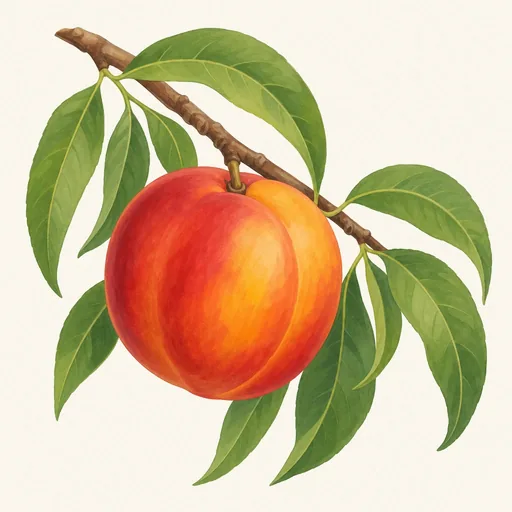
Nectarine
Prunus persica var. nucipersica · Rosaceae
- Plant outFrom 6 weeks before the last frost until the last frostFeb 27 – Apr 16
- Plant in autumn4–6 weeks before the first autumn frostSep 13 – Oct 3
- Space3–6 m (10–20 ft) apart
- HarvestAfter 2–4 years
Description
The nectarine is a smooth-skinned form of peach grown for its sweet, juicy fruit. It belongs to the rose family and is botanically very close to the fuzzy-skinned peach; the chief difference is a naturally occurring genetic trait that produces skin without fuzz. Nectarine trees are deciduous and usually have narrow, pointed leaves and pink blossoms that open in early spring, often before the leaves fully emerge. The flowers develop into round fruits with a central stone, or pit.
Nectarines may have yellow or white flesh. Yellow-fleshed varieties often taste sweet with a noticeable tang, while white-fleshed varieties are typically milder and lower in acidity. Their skin commonly shows red blush over a yellow or cream background. Depending on the cultivar, the flesh either separates readily from the stone, called freestone, or clings to it, called clingstone. Fruit is usually harvested in summer, though the season varies with climate and variety.
The trees grow best in full sun and fertile, well-drained soil. Most cultivars need a period of winter chill to flower and fruit reliably, but their early blossoms can be damaged by late frost. Growers prune trees to admit light and air, manage their size, and encourage productive new growth. Fruit thinning helps prevent overcrowding and allows the remaining nectarines to develop good size. Like peaches, nectarines can be affected by peach leaf curl, brown rot, and insect pests.
Nectarines are eaten fresh, often with their edible skin, and are also used in salads, pies, preserves, and grilled dishes. They bruise easily and taste best when allowed to ripen until fragrant and slightly yielding. A ripe nectarine can be refrigerated briefly to slow further softening.
Growing Conditions
3–6 m (10–20 ft) tall, 3–6 m (10–20 ft) wide
- Smallest
- Largest
Full sun, 6+ hours
Moderate
Keep evenly moist, not soggy.
Ideal 18–30 °C (64–86 °F)
Survives down to −29 °C (−20 °F).
pH 6–7 · acidic to neutral
Where it Grows
Planting
When to Plant
Plant bare-root nectarine trees while they are dormant, usually in late winter or early spring, after the ground can be worked but before the buds open. This gives the roots time to establish before summer heat. In regions with mild winters and well-drained soil, fall planting is also possible once hot weather has passed. In colder regions, spring is safer because a newly planted tree may struggle through a hard winter. Container-grown trees can be planted in spring or fall; avoid periods of extreme heat, drought, or freezing weather. Whatever the season, wait if the soil is frozen or waterlogged. Choose a day when you can water the tree immediately after planting and continue watering as needed through its first growing season. Select the site in advance: nectarines need full sun, good air circulation, and a spot that is not a frost pocket, since late frosts can damage their early blossoms.
How to Plant
Choose a site with at least six to eight hours of direct sun and soil that drains well. Allow room for the tree’s mature size; spacing depends on its rootstock and how you plan to prune it. Before planting a bare-root tree, soak its roots in water for a few hours and trim only roots that are broken or dead. For a container-grown tree, slide it out of the pot and gently loosen any roots circling the outside.
Dig a hole about twice as wide as the roots or root ball, but no deeper than needed to set the tree at its original soil level. Spread bare roots over a small mound of soil in the hole. Keep the root flare at or just above ground level and any graft union several inches above the finished soil. Backfill with the soil you removed, firming it gently to remove large air pockets; do not pack it hard or add fertilizer to the hole. Water thoroughly, then add a 2–3-inch layer of mulch, keeping it clear of the trunk. Water regularly during establishment, letting the soil drain between waterings. Stake only if the tree cannot stand securely without support.
Growth Timeline
- Establishing 2 years
- First harvest possible years 2–4
Planting Calendar
- Plant outdoors: from 6 weeks before the last frost until the last frost
- Autumn planting: 4–6 weeks before the first autumn frost
- Plant out: Feb 27 – Apr 16
- Autumn planting: Sep 13 – Oct 3
Care
Care Calendar
- Prune · Feb 13 – Apr 2
On a dry day in late winter, remove dead wood and maintain an open-centered shape. - Protect · Feb 27 – Apr 16
Cover the tree during freezes when flower buds or blossoms are exposed. - Protect · Jun 5 – Sep 3
Net the tree as fruit begins to ripen to deter birds. - Feed · Mar 6 – Apr 16
Apply a modest amount of balanced fertilizer as growth begins. - Mulch · Mar 27 – Apr 30
Spread mulch over the root area, keeping it clear of the trunk. - Thin · Apr 10 – May 28
After fruit set, thin young fruit to about 4–6 inches apart.
Watering
Water young nectarine trees regularly while their roots establish. In dry weather, a deep watering once or twice a week is usually better than frequent light sprinkling. For established trees, aim for roughly 1–2 inches of water per week from rain and irrigation during the growing season, adjusting for heat, soil type, and tree size. Check moisture a few inches below the surface before watering: the soil should be moist, not soggy. Water is especially important while fruit is enlarging; drought at this stage can reduce fruit size and increase fruit drop. Apply water over the root area rather than against the trunk. Drip irrigation or a soaker hose helps keep leaves dry, which can limit disease. Reduce watering during rainy periods, and make sure the site drains well: nectarine roots are vulnerable to prolonged waterlogging.
Pruning
Train nectarine trees to an open-center shape, with several strong scaffold branches surrounding a clear middle. This lets sunlight reach the fruit and improves airflow. Each year, remove dead, damaged, diseased, crossing, and inward-growing wood, along with vigorous upright shoots that crowd the canopy. Nectarines bear fruit mainly on shoots that grew the previous season, so retain a supply of healthy one-year-old wood while cutting back or removing some older, unproductive growth. Prune during dormancy, preferably after the coldest weather has passed and before vigorous spring growth. Where bacterial canker is a problem, follow local advice on pruning during dry weather to reduce infection risk. Use clean, sharp tools, and avoid removing too much at once. After fruit sets, thin crowded fruit by hand; this is separate from pruning but helps prevent broken branches and improves fruit size.
Weeding
Keep a weed-free area around the nectarine tree, especially while it is young. Grass and weeds compete with shallow feeder roots for water and nutrients, and dense vegetation can hide damage around the trunk. Remove weeds by hand or with shallow cultivation, taking care not to cut roots or scrape bark. A layer of organic mulch can suppress new weeds and reduce how often you need to disturb the soil. Maintain a clear gap around the trunk so weeds and mulch do not hold moisture against the bark. Check the area regularly during spring and summer, when competition is greatest. If using an herbicide, choose one labeled for use around fruit trees and follow all directions closely; keep spray off leaves, green shoots, and bark. Avoid using a string trimmer against the trunk, as even small wounds can cause lasting damage.
Mulching
Spread 2–4 inches of organic mulch, such as wood chips or shredded leaves, over the soil beneath the nectarine tree. Extend it outward toward the drip line if practical, but leave a 4–6-inch gap around the trunk. Mulch conserves moisture, moderates soil temperature, and suppresses weeds, reducing competition with the tree’s roots. Apply it to soil that is already moist, then water thoroughly; mulch should not be used to conceal persistently dry or waterlogged ground. Replenish the layer as it breaks down, but avoid repeatedly piling fresh material on top until it becomes too deep. Keep mulch from covering the root flare or touching the bark, since trapped moisture can encourage decay and provide shelter for pests. In poorly drained sites, prioritize improving drainage rather than relying on mulch to manage soil moisture.
Fertilizing
Start with a soil test if possible, and use its results to correct nutrient deficiencies or unsuitable pH rather than fertilizing by habit. A newly planted nectarine tree usually needs no fertilizer at planting if the soil is reasonably fertile; focus first on establishment and watering. For an established tree, apply a modest amount of fertilizer in early spring if growth is weak or a soil test indicates a need. Follow the product label and local extension guidance for rates suited to the tree’s age and size. Spread fertilizer over the root area, not against the trunk, and water it in. Avoid excess nitrogen: it can produce soft, vigorous shoots at the expense of fruit quality and may increase pest or disease problems. Do not fertilize late in the growing season, when new growth may fail to harden before cold weather.
Pest Management
Inspect leaves, shoots, trunk, and developing fruit regularly so problems are noticed early. Remove fallen or rotting fruit and any fruit left hanging after harvest; these can harbor brown rot and insect pests. Prune for airflow, avoid wetting foliage when irrigating, and thin fruit so neighboring nectarines are not pressed together. Common problems vary by region but may include peach leaf curl, brown rot, aphids, scale insects, borers, and fruit-feeding moths. Identify the problem before treating it. Peach leaf curl, for example, requires a preventive treatment during dormancy where the disease is troublesome; spraying after leaves curl will not repair them. Follow local extension guidance and the label for any treatment, including its timing and preharvest interval. Avoid spraying insecticides while the tree is flowering, when pollinators are visiting, and use the least disruptive effective control.
Harvesting
Harvest nectarines when they have reached their expected mature size, their green background color has changed to yellow or creamy white, and they have a noticeable fruity aroma. Ripe fruit should yield slightly to gentle pressure; a red blush alone is not a reliable sign of ripeness. Lift and twist each nectarine gently rather than pulling hard, and handle it carefully to avoid bruising. Fruit on a tree does not all ripen at once, so check every day or two and pick in several passes. Nectarines picked mature but still firm can soften after harvest, though their sweetness will not increase much. Leave fruit for fresh eating on the tree until it tastes good, provided birds and pests do not get it first. Refrigerate ripe nectarines promptly if you cannot eat or process them soon, and wash them just before use.
Growing in Containers
Grows well in a pot of at least 50 litres (13 US gallons), with drainage holes. Best kept outdoors.
Propagation
By grafting
- Obtain a compatible peach or nectarine rootstock.
- Collect healthy, dormant scion wood from the desired variety.
- Graft the scion onto the rootstock in late winter or early spring.
- Wrap the graft union securely.
- Remove shoots that grow from below the graft.
From seed
- Remove and clean the pit from a ripe nectarine.
- Chill it in a moist medium for 8 to 12 weeks.
- Plant it in well-drained potting mix.
- Keep the mix lightly moist until it sprouts.
- Expect the seedling's fruit to differ from the parent variety.
Companion Plants
Good neighbors
- Sweet alyssum: Its flowers attract hoverflies and other beneficial insects that prey on aphids in orchards.
Keep apart from
- Lawn grass: Grass growing directly beneath a young nectarine tree competes with its roots for water and nutrients.
Common Problems
- Curled or cupped leaves
- Distorted new growth
- Yellowing leaves
- Leaves dropping
Peach leaf curl is a fungal disease of peach and nectarine trees caused by Taphrina deformans. The fungus survives on…
- Spots on leaves
- Yellowing leaves
- Holes in leaves
- Leaves dropping
Bacterial leaf spot is a name for leaf diseases caused by several bacteria, commonly species of Xanthomonas or…
- Yellowing leaves
- Sticky residue on leaves
- Black sooty coating
- Curled or cupped leaves
Aphids are small, soft-bodied insects that feed by piercing plants and drawing out sap. The group includes many…
- Wilting
- Stunted growth
- Leaves dropping
- Stems chewed or cut through
Borers are the larvae of various moths, beetles, flies, and other insects that feed inside plant tissue. “Borers” is a…
- Brown or crispy leaf edges
- Wilting
- Bleached or scorched patches
- Leaves dropping
Frost damage is an injury caused when plant tissues become cold enough for ice to form or for cells to lose water to…
- Peach leaf curl: Causes puckered, discolored leaves, especially after cool, wet spring weather.
- Brown rot: Rots fruit on the tree and can affect blossoms and twigs.
- Bacterial spot: Produces leaf spots and blemishes on fruit.
- Insect pests: Aphids, peach tree borers, and plum curculios can damage growth or fruit.
- Late frost: Can kill blossoms and sharply reduce the crop.
- Fruit cracking or split pits: May occur, particularly when water supply fluctuates during fruit development.
Varieties
A widely grown nectarine with large fruit and a late harvest.
- freestone
- late season
Its firm, flavorful fruit is suited to eating fresh.
- freestone
- large fruit
This variety produces large fruit with red skin over a golden background.
- freestone
- late season
A useful choice for cooler growing regions, though its blossoms still need frost protection.
- cold hardy
- freestone
Its white flesh has a mild, sweet flavor.
- sweet
- low acid
This early-ripening variety bears sweet, white-fleshed fruit.
- early
- sweet
More about varieties
- Fantasia: A popular yellow-fleshed, freestone nectarine that ripens late in the season.
- Flavortop: A large, yellow-fleshed freestone variety known for its rich flavor.
- Arctic Glo: An early-ripening, white-fleshed variety with a sweet-tart flavor.
- Harko: A yellow-fleshed variety bred in Canada and noted for its cold hardiness.
Health Benefits
Nectarines are enjoyed primarily as a nutritious fresh fruit rather than as a medicine. A medium nectarine provides water, dietary fiber, vitamin C, potassium, and carotenoid pigments, with relatively few calories. Eating whole nectarines can help people meet daily fruit and fiber goals. Fiber supports regular bowel movements and helps make a snack satisfying. Vitamin C supports normal immune function and collagen formation, while potassium contributes to normal muscle and nerve function and healthy blood-pressure regulation as part of an overall balanced diet.
Yellow-fleshed nectarines contain carotenoids, including beta-carotene, which the body can convert to vitamin A. White-fleshed varieties generally have less of these pigments. The skin also contains fiber and plant polyphenols, so washing and eating the fruit unpeeled retains more of those compounds.
Nectarines can be sliced into yogurt or oatmeal, served in salads, or eaten on their own as an alternative to sweets. Whole fruit generally provides more fiber and is more filling than juice. Nectarines are not a treatment for any disease, and their nutrient content varies by cultivar and ripeness. People with peach allergies may also react to nectarines. Anyone advised to limit potassium or certain carbohydrates should follow their clinician’s dietary guidance.
Fun Facts
- Nectarines and peaches belong to the same species, Prunus persica.
- A nectarine’s smooth skin results from a naturally occurring genetic variation; it is not a peach–plum hybrid.
- A peach tree can occasionally produce a branch bearing nectarines through a genetic change called a bud sport.
- Most nectarine varieties are self-fertile, so a single tree can produce fruit.
- Despite the species name persica, peaches and nectarines originated in China, not Persia.
Notice an error or have a question about Nectarine? Contact us