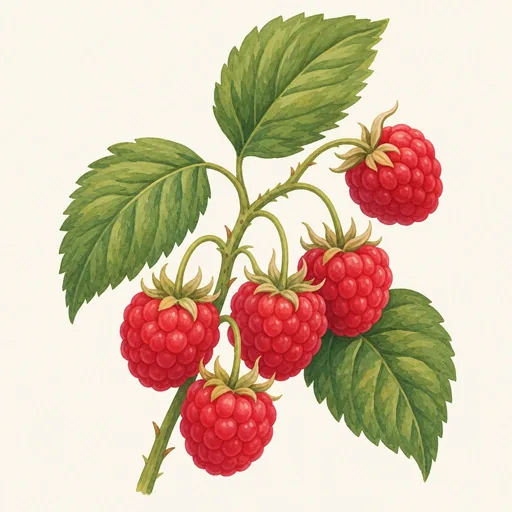
Raspberry
Rubus idaeus · Rosaceae
- Plant outFrom 4 weeks before the last frost until the last frostMar 13 – Apr 16
- Plant in autumn4–6 weeks before the first autumn frostSep 13 – Oct 3
- Space45–60 cm (18–24 in) apart
Description
Raspberry is a deciduous, fruit-bearing shrub in the rose family. The familiar red raspberry is most commonly identified as Rubus idaeus, although cultivated raspberries include varieties with complex ancestry. Its fruit is made up of many small, juicy sections called drupelets clustered around a central core. When a ripe raspberry is picked, the core stays on the plant, leaving the fruit hollow inside. Most are red, but some varieties produce yellow or golden fruit.
The plant has a perennial root system that sends up upright or arching stems called canes. Individual canes usually live for two growing seasons. Summer-fruiting varieties bear on second-year canes; autumn-fruiting varieties can bear on first-year canes. Small white or pinkish flowers attract bees and other pollinators before developing into fruit. Raspberry plants often spread by underground shoots, forming a patch unless their growth is managed.
Raspberries grow best in cool or temperate conditions, with full sun, fertile, well-drained soil and steady moisture. They dislike waterlogged ground and may need support to keep canes upright. Pruning depends on the variety, but removing spent canes helps maintain healthy, productive plants. Good air circulation can reduce problems such as gray mold, while birds may need to be kept away from ripening fruit.
The berries are usually harvested when fully colored and easy to detach. They bruise and spoil quickly, so they are often eaten fresh or promptly chilled, frozen, or made into jam and desserts. Their sweet-tart flavor comes with dietary fiber and vitamin C. Raspberries are grown in home gardens and commercially across many temperate regions.
Growing Conditions
1.2–2 m (4–7 ft) tall, 0.6–1.2 m (2–4 ft) wide
- Smallest
- Largest
Full sun, 6+ hours
Tolerates part sun
Moderate
Keep evenly moist, not soggy.
Ideal 16–26 °C (61–79 °F)
Survives down to −40 °C (−40 °F).
pH 5.5–6.5 · acidic
Where it Grows
Planting
When to Plant
Plant raspberries while they are dormant, before new growth begins. In most areas, late winter to early spring is the best time for bare-root plants: wait until the soil has thawed and can be worked, but plant before the buds open. In regions with mild winters, fall planting is also suitable, provided the plants have several weeks to establish before the ground freezes. Buy bare-root plants close to planting time, and keep their roots cool and moist until they go in the ground.
Container-grown raspberries can be planted in spring or fall and, with careful watering, at other times during the growing season. Avoid planting during hot, dry weather or when the soil is frozen or waterlogged. If your site stays soggy after rain, improve drainage or use a raised bed before planting. The exact calendar date depends on your local climate and soil conditions, not a fixed month.
How to Plant
Choose a spot with at least six to eight hours of direct sun and fertile, well-drained soil. Raspberries grow best in slightly acidic soil, around pH 5.5–6.5. Avoid ground where tomatoes, potatoes, peppers, eggplants, or strawberries have recently grown, because some soil-borne diseases can affect raspberries too. Remove perennial weeds and work compost into the planting area ahead of time; do not put concentrated fertilizer against the roots.
Set plants in a row, typically 2–3 feet apart for red or yellow raspberries, with about 6–8 feet between rows. Check the variety’s label for any different spacing. Dig a hole wide enough to spread bare roots without bending them. Set the crown at or just below soil level; plant container-grown raspberries at roughly the depth they grew in the pot. Backfill with soil, firm it gently, and water thoroughly. Keep the soil evenly moist while the plants establish, but not soggy.
Add a 2–3-inch layer of mulch to limit weeds and retain moisture, keeping it clear of the canes. Install posts and wires or another suitable support early, before the row fills in. Follow the nursery’s pruning instructions for newly planted bare-root canes.
Planting Calendar
- Plant outdoors: from 4 weeks before the last frost until the last frost
- Autumn planting: 4–6 weeks before the first autumn frost
- Plant out: Mar 13 – Apr 16
- Autumn planting: Sep 13 – Oct 3
Care
Care Calendar
- Prune · Feb 27 – Apr 2
For a fall-only crop, cut all canes to the ground; for summer crops, remove canes that fruited last year. - Feed · Mar 20 – Apr 30
Apply compost or a balanced fertilizer around the canes as growth begins. - Mulch · Mar 27 – May 7
Spread organic mulch around the canes, keeping it clear of their bases. - Stake · Mar 27 – May 14
Tie tall canes loosely to wires or a trellis to keep them upright. - Thin · Apr 24 – Jun 25
Remove weak canes and suckers growing outside the planting row. - Protect · Jun 5 – Sep 3
Net the plants as berries begin to ripen if birds are taking the fruit.
Watering
Keep raspberry soil evenly moist, especially from flowering through harvest and while new canes are growing. As a starting point, provide about 1–2 inches of water per week, including rainfall; sandy soil and hot weather may require more frequent watering. Check moisture a few inches below the surface rather than watering by a fixed schedule. Water deeply enough to moisten the root zone, then let the surface begin to dry. Drip irrigation or a soaker hose delivers water to the roots without wetting the fruit and foliage, which helps limit disease. Water in the morning if using a sprinkler. Newly planted raspberries need more frequent checks while their roots establish. Avoid both prolonged drought, which can reduce berry size, and waterlogged soil, which can damage roots. Good drainage is essential; irrigation cannot compensate for a persistently soggy site.
Pruning
First identify whether the raspberry is summer-bearing or fall-bearing. For summer-bearing types, remove canes that fruited as soon as harvest ends: they will not fruit again. Leave the vigorous new canes, which will bear next year, and in late winter remove dead, damaged, or weak growth and thin crowded canes for airflow. Fall-bearing raspberries can be managed for one main autumn crop by cutting every cane to ground level in late winter, before new growth starts. Alternatively, leave canes for a smaller early-summer crop as well, then remove the portions that have fruited; this two-crop method takes more careful pruning. Keep either type within its allotted row by removing suckers that spread into paths. Use clean, sharp tools, and take diseased canes away from the planting rather than leaving them beneath it.
Weeding
Keep the raspberry row and a strip alongside it free of competing weeds, particularly while plants are establishing. Weeds take up moisture and nutrients, can reduce airflow, and may shelter pests. Pull small weeds by hand or hoe very shallowly: raspberry roots grow close to the surface and are easily injured by deep cultivation. Removing weeds regularly before they set seed is easier than clearing a mature infestation. A layer of organic mulch can suppress many seedlings, though perennial weeds may still need to be dug out carefully. Remove suckers growing outside the intended row as well; they can make maintenance and picking difficult. If using a herbicide, confirm that its label permits use around raspberries and shield the crop from spray drift. Do not use a product simply because it is labeled for a nearby lawn or path.
Mulching
Spread roughly 2–4 inches of clean organic mulch, such as weed-free straw, shredded leaves, or wood chips, over the soil around raspberries. Mulch conserves moisture, moderates soil temperature, and reduces weed growth, so it is especially useful where shallow roots would be damaged by hoeing. Keep mulch from piling against the crowns and canes; leave a small gap around their bases. Top up the layer as it settles, but avoid burying new shoots as they emerge. Inspect beneath the mulch occasionally for persistent weeds and signs of excessive dampness. Use material free of weed seeds and avoid adding prunings or fruit from diseased plants. In poorly drained ground, mulch is no substitute for fixing drainage: continually wet roots are vulnerable to rot. Pair mulching with occasional checks of soil moisture so that plants are neither overwatered nor allowed to dry out.
Fertilizing
Base fertilizer decisions on a soil test where possible, and correct unsuitable soil pH or nutrient shortages according to its recommendations. Raspberries generally grow best in slightly acidic soil, around pH 5.5–6.5. Where fertilizer is needed, apply a balanced product in early spring as growth begins, following its label and spreading it over the root area rather than against the canes. Established plants may need little additional feeding if growth is vigorous and the soil is fertile. Compost can help maintain soil organic matter, but count manure and other nutrient-rich amendments as fertilizer too. Avoid heavy doses of nitrogen: lush, soft growth may be more prone to disease and can come at the expense of fruiting. Pale leaves or weak growth are not proof of a nutrient deficiency; check drainage, watering, and soil conditions before adding more fertilizer. Water after applying granular fertilizer if the label directs.
Pest Management
Inspect leaves, canes, and ripening fruit regularly so problems are caught early. Keep rows thinned, remove spent or diseased canes, harvest ripe fruit promptly, and clear fallen or moldy berries; these steps reduce places where pests and diseases persist. Watch for aphids, cane borers, and spotted wing drosophila, whose larvae can develop inside ripening berries. Frequent picking, prompt refrigeration, and fine insect netting installed before fruit begins to ripen can help limit damage; netting must still allow pollination during bloom. Gray mold is less troublesome when fruit and leaves dry quickly, so favor good airflow and water at soil level. Yellowing or wilting in wet ground may indicate root disease, making drainage especially important. Identify a problem before treating it. If a pesticide is needed, choose one labeled for raspberries and the specific pest, and follow its harvest interval and pollinator precautions.
Harvesting
Pick raspberries when they have developed their full color and release easily from the pale central core. A ripe berry should come away with a gentle pull; one that resists needs more time. Color alone is not enough, because ripe fruit may be red, yellow, purple, or black depending on the variety. Check plants every day or two during peak production, preferably when the fruit is dry. Handle berries gently and place them in shallow containers so those at the bottom are not crushed. Remove overripe or damaged fruit from the planting as you pick. Raspberries spoil quickly: refrigerate them promptly and eat, process, or freeze them within a few days. Wash them only just before use, as wet berries deteriorate faster. Summer-bearing varieties produce their main crop in summer; fall-bearing varieties fruit on new canes later in the season.
Growing in Containers
Grows well in a pot of at least 40 litres (11 US gallons), with drainage holes. Best kept outdoors.
Propagation
From suckers
- Select a healthy sucker with its own roots in early spring.
- Sever the root connecting it to the parent plant with a spade.
- Lift the sucker with its roots and surrounding soil.
- Replant it at the same depth and water well.
From cuttings
- Take root cuttings from a healthy dormant plant in late fall or winter.
- Cut healthy roots into sections about 3–4 inches long.
- Lay the sections horizontally in moist growing mix and cover lightly.
- Keep the mix moist until shoots and roots develop.
- Transplant the new plants after they are established.
By layering
- For black or purple raspberries, bend a cane tip to the soil in late summer.
- Bury the tip while leaving it attached to the parent plant.
- Keep the soil moist as the tip roots.
- Sever the rooted tip from the parent the following spring.
- Lift and transplant the new plant.
Companion Plants
Keep apart from
- Tomato: Avoid planting raspberries in soil recently used for tomatoes because both can be affected by Verticillium wilt.
- Potato: Potatoes can leave Verticillium wilt pathogens in soil, increasing the risk to newly planted raspberries.
- Eggplant: Eggplants and raspberries are both susceptible to Verticillium wilt, so avoid following one with the other in the same soil.
Common Problems
- Spots on leaves
- Brown or crispy leaf edges
- Bleached or scorched patches
- Leaves dropping
Anthracnose is a name for several fungal diseases, not a single species. Depending on the plant, the cause may be a…
- Yellowing leaves
- Sticky residue on leaves
- Black sooty coating
- Curled or cupped leaves
Aphids are small, soft-bodied insects that feed by piercing plants and drawing out sap. The group includes many…
- Fuzzy gray mold
- Spots on leaves
- Wilting
- Soft or rotting stems
Gray mold, also called Botrytis blight, is a fungal disease caused most commonly by Botrytis cinerea. It affects many…
- Yellowing leaves
- Wilting
- Stunted growth
- Leaves dropping
Root rot is a general name for the decay of plant roots, not a single disease with one scientific name. It can result…
- Yellowing leaves
- Brown or crispy leaf edges
- Wilting
- Stunted growth
Verticillium wilt is a soilborne disease caused mainly by the fungi Verticillium dahliae and V. albo-atrum. The fungi…
- Cane blight and spur blight: Fungal diseases that cause dark lesions and dieback on canes. Prune out affected canes and allow good airflow.
- Gray mold: Fruit may develop fuzzy gray growth, especially in damp weather. Pick ripe berries promptly and remove rotting fruit.
- Root rot: Poorly drained soil can cause weak growth, wilting and cane death. Plant raspberries in well-drained soil.
- Spotted wing drosophila: This small fruit fly lays eggs in ripening berries. Harvest frequently and remove overripe fruit.
- Aphids: These sap-feeding insects can distort new growth and spread viruses.
Varieties
A widely grown red raspberry that can produce a late-summer-to-fall crop on new canes.
- reliable
- firm fruit
An autumn-fruiting red raspberry known for flavorful berries.
- large fruit
- sweet
Its thornless canes make picking the red berries easier.
- thornless
- early
This variety produces glossy red berries on new canes.
- early
- large fruit
An early fall-fruiting variety suited to areas with shorter growing seasons.
- early
- large fruit
It produces red berries on canes that grew the previous year.
- large fruit
- flavorful
A summer-fruiting variety with sturdy, nearly spine-free canes.
- thornless
- high yielding
This variety produces sweet golden berries, usually on new canes.
- yellow fruit
- sweet
More about varieties
- ‘Heritage’: A widely grown red raspberry that produces a late-summer to fall crop on new canes.
- ‘Autumn Bliss’: An early-ripening, fall-bearing red variety with large berries.
- ‘Tulameen’: A summer-bearing red variety valued for its large, firm fruit.
- ‘Glen Ample’: A summer-bearing red variety with nearly thornless canes.
- ‘Fall Gold’: A fall-bearing variety with sweet, golden-yellow berries.
Health Benefits
Raspberries are commonly eaten fresh or frozen as a flavorful way to add fruit to the diet. They provide dietary fiber, which supports normal digestion and can help make a meal feel satisfying. They also contain vitamin C, needed for normal immune function and collagen formation, and manganese, which helps the body carry out several metabolic processes.
Red raspberries contain plant compounds, including anthocyanins and other polyphenols. These compounds have been studied for their antioxidant activity, but eating raspberries has not been shown to prevent or treat a specific disease. Their fiber and relatively low sugar content compared with many sweet snacks can make them a useful choice for people seeking a balanced diet. Whole berries offer more fiber than strained raspberry juice.
Raspberry leaf tea has a long history of traditional use, particularly during pregnancy. However, evidence that it improves labor outcomes is limited, and its safety in pregnancy has not been firmly established. Anyone who is pregnant should ask a healthcare professional before using raspberry leaf preparations. The fruit itself is generally eaten as an ordinary food, though people with a raspberry allergy should avoid it. Wash fresh berries gently before eating them and refrigerate them promptly, as they spoil quickly.
Fun Facts
- A raspberry is an aggregate fruit made up of many tiny sections called drupelets.
- When picked, a raspberry leaves its central core behind, creating its characteristic hollow center.
- Raspberry plants have perennial root systems, but individual canes usually live for only two years.
- Raspberries can be red, yellow, purple or black, depending on the type.
- Raspberry flowers attract bees and other pollinators.
Notice an error or have a question about Raspberry? Contact us