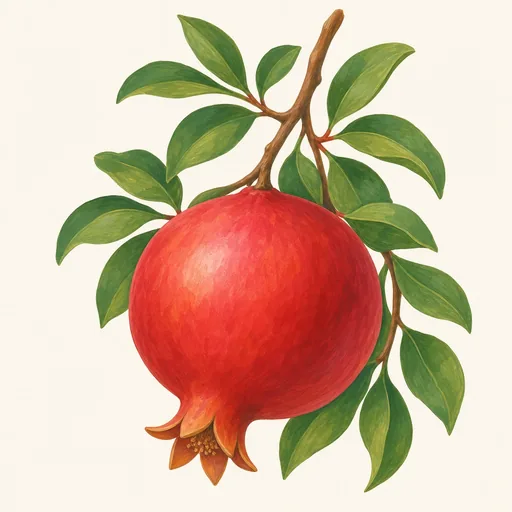
Pomegranate
Punica granatum · Lythraceae
- Plant outFrom the last frost until 4 weeks afterApr 10 – May 14
- Plant in autumn6–8 weeks before the first autumn frostAug 30 – Sep 19
- Space3–5 m (10–16 ft) apart
- HarvestAfter 2–3 years
Description
Pomegranate is a deciduous shrub or small tree grown for its round, leathery-skinned fruit. Native to a region extending from Iran toward northern India, it has been cultivated for thousands of years and now grows widely in warm, dry climates. Plants usually reach 2–5 m (6–16 ft) tall, with glossy, narrow leaves and showy orange-red flowers. Some flowers develop into fruit, while others fall without setting fruit. Thorny branches are common, and suckers can give the plant a bushy shape.
The fruit has a tough rind that varies from yellowish to deep red, depending on the cultivar. Inside, thin white membranes separate clusters of juicy arils, each surrounding a seed. Arils may be sweet, tart, or both; their color ranges from pale pink to dark ruby. They are eaten fresh, pressed for juice, or used in salads, sauces, and desserts. Pomegranate juice is also made into syrups and molasses. Rind color alone does not reliably indicate ripeness or flavor. A mature fruit often feels heavy for its size.
Give pomegranates full sun and well-drained soil. Established plants tolerate drought, but regular deep watering during flowering and fruit development improves fruit quality and helps reduce splitting. They perform best where summers are hot and winters are mild, although dormant plants can withstand some frost. Excess rain or abrupt changes in watering near harvest can cause fruit to crack. Fruit generally ripens in late summer or autumn, depending on climate and cultivar. Harvest it when fully ripe: pomegranates do not become sweeter after picking. Prune lightly to remove dead wood and unwanted suckers while preserving productive branches. Pomegranates can be grown as shrubs, trained into small trees, or kept in large containers where winters require protection.
Growing Conditions
3–6 m (10–20 ft) tall, 3–5 m (10–16 ft) wide
- Smallest
- Largest
Full sun, 6+ hours
Tolerates part sun
Moderate
Keep evenly moist, not soggy.
Ideal 20–35 °C (68–95 °F)
Survives down to −15 °C (5 °F).
pH 5.5–7.5 · acidic to neutral
Where it Grows
Planting
When to Plant
Plant pomegranate when temperatures are mild and the soil is workable, so its roots can establish before summer heat or winter cold. In areas with freezing winters, late winter to early spring is usually best: set out a dormant bare-root plant after the ground thaws, or plant a nursery-grown shrub around the last frost. If severe freezes are likely, wait until they pass. In warm, mild-winter areas, fall is also a good choice; plant early enough to allow about six to eight weeks of root growth before cold weather. Container-grown plants can be planted through much of the growing season, but avoid periods of extreme heat and drought. Choose a site before buying: pomegranates need full sun, ideally at least six to eight hours daily, and well-drained soil. Check the mature size of the cultivar and your local winter lows; some pomegranates need protection from hard freezes.
How to Plant
Choose a sunny spot with good drainage and enough room for the mature plant. Pomegranates can grow as shrubs or small trees, so follow the cultivar’s spacing guidance; about 10 to 15 feet between full-size plants is common. If water puddles for long periods after rain, choose another site or plant on a raised mound. Water a container-grown plant before removing its pot. Dig a hole about twice as wide as the root ball, but no deeper. Gently loosen circling roots and set the plant so the top of its root ball is level with, or slightly above, the surrounding soil. Spread the roots of a bare-root plant without bending them sharply, keeping the crown at its original soil level. Backfill with the soil you removed, firm it lightly, and water thoroughly to settle it. Avoid putting fertilizer or a gravel layer in the hole. Add 2 to 3 inches of organic mulch over the root area, leaving a gap around the stems. Water deeply and regularly during the first growing season, allowing the surface soil to dry slightly between waterings. Adjust for rainfall and drainage; established pomegranates tolerate some drought, but young plants need consistent moisture.
Growth Timeline
- Establishing 2 years
- First harvest possible years 2–3
Planting Calendar
- Plant outdoors: from the last frost until 4 weeks after
- Autumn planting: 6–8 weeks before the first autumn frost
- Plant out: Apr 10 – May 14
- Autumn planting: Aug 30 – Sep 19
Care
Care Calendar
- Prune · Feb 27 – Apr 2
Remove dead wood and unwanted suckers while the plant is dormant. - Feed · Apr 10 – May 14
Feed lightly in spring if growth is weak; avoid excess nitrogen. - Mulch · Apr 10 – May 14
Spread mulch over the root area, keeping it away from the trunk. - Protect · Oct 11 – Nov 14
In marginal climates, insulate young plants before hard freezes.
Watering
Water newly planted pomegranates deeply whenever the upper few inches of soil begin to dry, rather than giving frequent light sprinkles. During their first growing season, check the soil regularly and adjust for heat, rainfall, and drainage. Established plants tolerate drought, but consistent moisture during flowering and fruit development improves growth and fruit quality. In dry weather, soak the root zone thoroughly, then let the soil partly dry before watering again. Avoid repeated swings from severe drought to heavy watering, especially as fruit nears maturity; these fluctuations can contribute to splitting. Reduce irrigation after harvest and during winter dormancy, particularly where rain supplies moisture. Use drip irrigation or a soaker hose to keep foliage dry and deliver water beyond the trunk, where active roots grow. If leaves yellow and the soil remains wet, check drainage before adding more water: pomegranates dislike waterlogged roots.
Pruning
Prune in late winter or early spring, before new growth begins. Decide whether to maintain a multistemmed shrub or train a small tree: for a shrub, retain several well-spaced main stems; for a tree, select a sturdy trunk and remove competing basal shoots. Each year, cut out dead, damaged, or crossing wood and thin crowded growth so light and air reach the canopy. Remove unwanted suckers at their point of origin throughout the growing season. Keep pruning moderate. Pomegranates flower and fruit on new growth arising from older wood, so heavy cutting or repeatedly shearing branch tips can reduce the crop. Shorten overly long branches only as needed for structure or access, and use clean, sharp tools. Where winters are cold, wait until frost damage is apparent before removing questionable branches. Old, neglected plants can be renewed gradually over several seasons rather than cut back all at once.
Weeding
Keep weeds and grass out of the area around a young pomegranate. They compete for water and nutrients just as the plant is establishing its roots, and tall weeds can conceal suckers or pests. Pull small weeds while the soil is slightly moist, or cut them off at ground level before they set seed. Work shallowly: digging and hoeing near the plant can injure roots and encourage unwanted suckers. A mulch layer helps suppress new weeds, but remove existing perennial weeds before spreading it. Maintain a clear ring around the trunk rather than allowing lawn grass to grow against the bark; this also reduces damage from mowers and string trimmers. Inspect the area periodically, especially after rain or irrigation, and remove seedlings while they are easy to control. If using an herbicide nearby, follow its label carefully and prevent spray or drift from contacting pomegranate leaves, shoots, or bark.
Mulching
Spread about 2–4 inches (5–10 cm) of organic mulch, such as wood chips or shredded leaves, over the soil beneath and somewhat beyond the canopy. Leave several inches of bare space around the trunk or main stems so the bark stays dry. Mulch slows evaporation, moderates soil temperature, and reduces weed competition, which is particularly useful for young plants and in hot, dry climates. Apply it to moist soil after watering or rain, and extend the mulched area as the plant grows. Check the depth periodically and top it up as it decomposes, rather than piling on a thick new layer each year. Do not mound mulch against the stems or mix large amounts of undecomposed woody material into the soil. If the ground stays persistently soggy, address drainage first; mulch should help conserve appropriate moisture, not keep the root zone waterlogged.
Fertilizing
Start with a soil test if growth is poor or the site’s fertility is uncertain. Pomegranates often need little supplemental fertilizer in reasonably fertile soil. In spring, apply compost over the root zone or use a balanced fertilizer according to its label and the plant’s size; keep fertilizer away from the trunk and water it in. Young plants may benefit from modest feeding while they establish, whereas vigorous, mature plants may need none. If additional fertilizer is warranted, divide the season’s amount into small applications in spring and early summer instead of giving one heavy dose. Avoid fertilizing late in the season, when tender new growth may be vulnerable to cold. Too much nitrogen encourages leafy shoots at the expense of flowering and fruiting. Pale leaves can have causes other than nutrient deficiency, including poor drainage, so inspect watering and soil conditions before increasing fertilizer.
Pest Management
Inspect leaves, shoots, and developing fruit regularly so problems can be addressed early. Aphids, scale insects, and mealybugs may feed on growth; a strong water spray can dislodge aphids, while pruning heavily infested twigs may help with scale. Horticultural oil or insecticidal soap can be useful where labeled for the pest and plant; follow directions and avoid spraying in excessive heat. Fruit-feeding insects vary by region, so identify the culprit before treating. Remove fallen, damaged, or rotting fruit and thin crowded branches to improve airflow. Watch for leaf spots or fruit rot after humid weather, and avoid wetting foliage when irrigating. Protect ripening fruit from birds with securely installed netting, checking it often so wildlife does not become trapped. Encourage beneficial insects and avoid routine broad-spectrum sprays, especially while flowers are open and pollinators are visiting. Seek local extension advice for persistent or unfamiliar damage.
Harvesting
Harvest pomegranates when they have reached the mature color typical of the cultivar and feel heavy for their size. Depending on climate and variety, this is usually from late summer through fall, often several months after flowering. The fruit may become more angular as its seeds fill out, but skin color alone is not a reliable guide across all varieties. If unsure, cut open a sample fruit to check that the arils are fully colored and taste sweet-tart rather than unripe. Pomegranates do not continue ripening after picking, so leave sound fruit on the plant until it is ready, but collect it before rain or overwatering causes splitting. Use clean pruning shears to cut the stem close to the fruit; pulling can tear the skin or damage branches. Handle fruit gently, discard any showing rot, and refrigerate sound fruit for longer storage.
Growing in Containers
Grows well in a pot of at least 50 litres (13 US gallons), with drainage holes. Best kept outdoors.
Propagation
From cuttings
- Take 6–10-inch hardwood cuttings from healthy, dormant shoots in late winter.
- Cut just below a node and remove any remaining leaves.
- Insert the lower half of each cutting into a well-draining propagation mix.
- Keep the mix lightly moist until roots develop.
- Transplant once the cuttings are well rooted.
From seed
- Remove seeds from a ripe fruit and rinse off the pulp.
- Sow the seeds about ¼ inch deep in moist seed-starting mix.
- Keep the mix warm and lightly moist until germination.
- Transplant seedlings after they develop several true leaves.
- Expect seedlings to differ from the parent plant.
Common Problems
- Yellowing leaves
- Sticky residue on leaves
- Black sooty coating
- Curled or cupped leaves
Aphids are small, soft-bodied insects that feed by piercing plants and drawing out sap. The group includes many…
- Cracked or split fruit
Fruit cracking is a physiological disorder in which the skin of a developing or ripening fruit splits as the flesh…
- Spots on leaves
- Yellowing leaves
- Leaves dropping
Fungal leaf spot is a general name for diseases caused by many different fungi, not a single species. These fungi…
- Yellowing leaves
- Sticky residue on leaves
- Black sooty coating
- Stunted growth
Scale insects are small, sap-feeding insects that settle on garden and houseplants. Adults often look like bumps on…
- Fruit splitting: Often follows heavy rain or irregular watering, especially near harvest.
- Fruit rot and leaf spots: Fungal diseases are more likely in humid conditions or crowded growth.
- Root rot: Poorly drained soil or persistent overwatering can damage roots.
- Insect pests: Aphids, scale insects, mealybugs, and whiteflies may feed on leaves and shoots.
- Sunscald: Exposed fruit can develop pale, damaged patches during intense heat.
Varieties
A common commercial cultivar that performs best where autumns stay warm.
- large fruit
- tart-sweet
- late
Its pale fruit can develop good sweetness in a shorter warm season.
- sweet
- soft-seeded
- early
This cultivar is prized for richly flavored, dark red arils.
- sweet-tart
- soft-seeded
It produces red fruit earlier than many standard cultivars.
- early
- soft-seeded
- productive
It is a useful choice for gardeners near the colder edge of pomegranate-growing regions.
- cold-tolerant
- sweet-tart
A selection related to Wonderful that typically ripens earlier.
- early
- red arils
More about varieties
- Wonderful: A widely grown variety with large, deep-red fruit and tart-sweet juice.
- Eversweet: Pale-skinned fruit with relatively sweet, mild juice.
- Parfianka: Red fruit prized for its balanced sweet-tart flavor and soft seeds.
- Angel Red: Known for bright-red juice and comparatively soft seeds.
- Nana: A compact dwarf variety grown mainly as an ornamental; its fruit is small.
Health Benefits
Pomegranate arils are eaten fresh, added to meals, or pressed for juice. They provide dietary fiber, potassium, and plant compounds called polyphenols, including anthocyanins and ellagitannins. Fiber in the whole arils helps support normal digestion; juice contains little of that fiber.
Pomegranate is often promoted for heart health because its polyphenols have antioxidant activity. Small human studies have examined effects on blood pressure and other cardiovascular markers, but results are mixed and do not establish pomegranate as a treatment for heart disease. Researchers have also studied its potential effects on inflammation and exercise recovery. These findings are preliminary, so it is best viewed as a nutritious food rather than a remedy.
Whole arils can be a useful addition to a varied diet. Juice is an option, but it is easy to drink a large amount of fruit sugar without the filling effect of the arils. Choose unsweetened juice if you want to avoid added sugar. Anyone managing blood sugar can account for the carbohydrate in either form. If you take medication or have a condition that requires dietary restrictions, ask a healthcare professional before using concentrated pomegranate extracts or drinking large amounts of juice.
Fun Facts
- The edible, juicy coverings around pomegranate seeds are called arils.
- The fruit’s crown-shaped top is the remains of its flower’s calyx.
- A pomegranate plant can bear both fruit-producing flowers and flowers that do not develop into fruit.
- Its scientific name, Punica granatum, includes a Latin word meaning “seeded.”
- Established pomegranate plants tolerate drought, though regular watering helps them produce good-quality fruit.
Notice an error or have a question about Pomegranate? Contact us