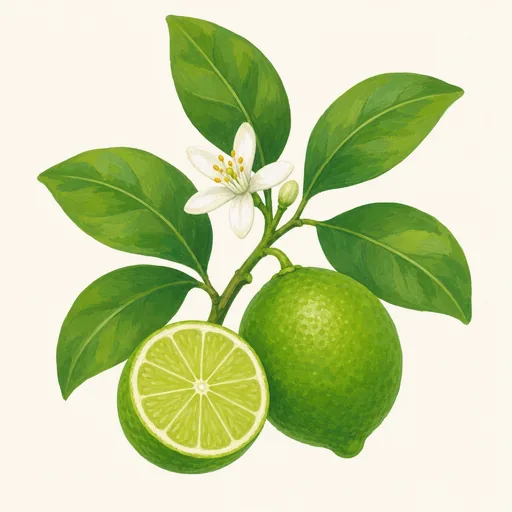
Lime
Citrus × aurantiifolia · Rutaceae
- Plant out2–6 weeks after the last frostApr 24 – May 28
- Space3–6 m (10–20 ft) apart
- HarvestAfter 1–3 years
Description
Lime is a small, aromatic citrus fruit valued for its sharp acidity and fragrant peel. The name is used for several related citrus plants; Citrus × aurantiifolia is the key lime, while the larger Persian lime commonly sold in supermarkets is a different hybrid. Key lime trees are evergreen, usually reaching 2–5 metres in cultivation. They have glossy green leaves, fragrant white flowers and often thorny branches. Their round fruits are typically 2.5–5 centimetres across, with thin skins that turn from green to yellow as they ripen. The pale greenish-yellow flesh is juicy, strongly acidic and usually contains seeds.
Limes are used more for flavouring than for eating on their own. Their juice brightens drinks, marinades, sauces, curries and desserts; their finely grated zest adds citrus aroma without as much sourness. Key limes are especially associated with key lime pie. The peel contains aromatic oils, and both the juice and peel are used in cooking across tropical and subtropical regions. Like other citrus fruits, limes provide vitamin C, although the amount depends on the fruit and how it is stored.
Lime trees grow best in warm climates with plenty of sun and well-drained soil. They are sensitive to frost, particularly when young, and need regular watering while becoming established. Flowers and fruit may appear at several times of year in suitable climates. Fruits are often harvested green for sale, even though they can continue to yellow on the tree. A heavy crop may need several pickings because individual fruits do not all mature together. Gardeners in cooler places can grow compact lime trees in containers and move them under cover for winter, provided they receive ample light. As with other citrus, good drainage helps prevent root problems.
Growing Conditions
2–6 m (7–20 ft) tall, 2–4 m (7–13 ft) wide
- Smallest
- Largest
Full sun, 6+ hours
Tolerates part sun
Moderate
Keep evenly moist, not soggy.
Ideal 18–30 °C (64–86 °F)
Survives down to −2 °C (28 °F).
pH 5.5–7 · acidic to neutral
Where it Grows
Planting
When to Plant
Plant a lime tree outdoors in spring, after the last frost, when the soil has warmed and nighttime temperatures are consistently above about 50°F (10°C). This gives the roots a growing season to establish before cooler weather. In a frost-free climate, you can also plant in early summer, provided you can water regularly while the tree settles in. Avoid planting during a heat wave or when the ground is waterlogged.
Limes are sensitive to frost, so year-round outdoor planting is generally suited to warm, frost-free areas. If winters are cold where you live, grow a lime in a container instead. You can pot it in spring and keep it outside in a sunny, sheltered spot during warm weather. Move it indoors before nights fall below about 50°F (10°C). A young tree is ready to plant or repot when its roots hold the potting mix together without being tightly crowded or circling heavily.
How to Plant
Choose a spot with at least six to eight hours of direct sun, good air circulation, and soil that drains readily. Allow enough room for the mature tree; spacing depends on the variety and rootstock. If the soil stays soggy after rain, use a raised bed or grow the lime in a container.
Water the tree in its nursery pot before planting. Dig a hole about twice as wide as the root ball but no deeper. Remove the pot, gently loosen any roots circling the outside, and set the tree so the top of its root ball is level with or slightly above the surrounding soil. Keep the graft union, if present, well above ground. Backfill with the excavated soil, firm it lightly, and water thoroughly. Do not put fertilizer in the planting hole. Add a 2–3-inch (5–8 cm) layer of mulch over the root area, leaving several inches clear around the trunk.
For container growing, choose a pot with drainage holes that is only modestly wider than the root ball. Use a free-draining potting mix suitable for citrus, plant at the same depth, and water until excess drains out. During establishment, water when the upper soil begins to dry, rather than keeping it constantly wet.
Growth Timeline
- Establishing 1 year
- First harvest possible years 1–3
Planting Calendar
- Plant outdoors: 2–6 weeks after the last frost
- Plant out: Apr 24 – May 28
Care
Care Calendar
- Feed · Apr 10 – Sep 3
Feed during active growth with a citrus fertilizer, following the label. - Repot · Apr 10 – May 28
Repot container trees when rootbound, typically every few years. - Prune · Apr 17 – May 28
Remove dead, damaged, or crossing branches after frost danger has passed. - Protect · Oct 11 – Oct 31
Move container trees indoors before frost or cover outdoor trees during cold spells.
Watering
Water lime trees deeply, then let the upper few inches of soil begin to dry before watering again. Check the soil rather than following a fixed calendar: a newly planted tree needs more frequent attention than an established tree, and a container-grown lime may dry out quickly in hot weather. Apply water around the root zone, not just against the trunk. Good drainage is essential because persistently wet soil can damage citrus roots. During hot, dry spells and while fruit is developing, keep moisture reasonably consistent; severe drying followed by heavy watering can stress the tree. Reduce watering during cool or rainy periods, but do not let a potted tree dry out completely. If leaves wilt, check soil moisture before adding water—both drought and waterlogged roots can cause similar symptoms.
Pruning
Prune lime trees lightly to maintain a manageable shape and let light and air into the canopy. Remove dead, broken, diseased, or crossing branches with clean tools. Cut off shoots arising from below the graft union, if the tree is grafted; these belong to the rootstock and can outgrow the fruiting variety. Avoid cutting back large portions of the canopy, since exposed bark can sunburn and heavy pruning removes productive wood. In areas with occasional frost, wait until the risk has passed before making substantial cuts so you can see which wood survived. Otherwise, prune as needed after harvest or during a period of active growth. Wear gloves when working with thorny varieties, and make cuts just outside the branch collar rather than leaving long stubs.
Weeding
Keep grass and weeds from growing close to the lime tree’s trunk. They compete with its shallow feeder roots for water and nutrients, especially while the tree is young. Maintain a weed-free area beneath much of the canopy, widening it as the tree grows. Pull small weeds by hand when the soil is moist, or cut them off carefully at ground level. Avoid deep hoeing or digging, which can injure citrus roots near the surface. A layer of organic mulch can suppress new weeds, though seedlings that emerge through it should still be removed before they set seed. If using a herbicide, follow its label and prevent spray or drift from touching the trunk, leaves, or exposed roots. Keep any surrounding grass trimmed without striking the bark with a string trimmer.
Mulching
Spread a layer of wood chips, shredded bark, or other coarse organic mulch over the soil beneath the lime tree. Mulch helps conserve moisture, moderate soil temperature, and limit weeds while gradually adding organic matter. A layer about 2–4 inches (5–10 cm) deep is generally useful; extend it outward as space allows, especially over the root zone. Leave several inches of bare ground around the trunk. Piling mulch against the bark holds moisture there and can encourage decay. Keep the layer loose rather than packing it down, and replenish it as it decomposes. Water the soil beneath the mulch when needed instead of assuming the surface reflects moisture at root depth. In containers, use a thinner layer if desired, leaving room to check the potting mix and water thoroughly.
Fertilizing
Feed lime trees with a fertilizer formulated for citrus, following its label for the tree’s size, age, and whether it grows in the ground or a container. Citrus needs nitrogen as well as nutrients such as iron, zinc, and magnesium. In warm growing regions, divide the recommended amount among several applications during active growth rather than applying it all at once. Avoid heavy feeding late in the season where cold weather is possible: tender new growth is more vulnerable to frost. Spread fertilizer across the root zone, away from direct contact with the trunk, and water it in as directed. Container trees need smaller, more frequent doses because nutrients wash through potting mix. Pale leaves can have several causes, including waterlogged soil or unsuitable pH, so investigate the growing conditions before adding extra fertilizer.
Pest Management
Inspect new shoots and the undersides of leaves regularly. Aphids, scale insects, mealybugs, mites, and citrus leafminers can affect lime trees; early detection makes them easier to manage. A firm spray of water may dislodge aphids, while pruning a small, heavily infested shoot can remove localized pests. Encourage beneficial insects and avoid routine broad-spectrum insecticide use. Horticultural oil or insecticidal soap may help with some soft-bodied pests, but use only products labeled for citrus and follow directions to avoid leaf injury, particularly in hot weather. Ants can protect honeydew-producing pests, so managing ants may also help. Prevent root problems by maintaining good drainage. In regions where citrus greening disease occurs, watch for uneven leaf mottling and misshapen, bitter fruit; contact a local extension service if you suspect it.
Harvesting
Pick limes when they have reached the usual size for the variety, feel heavy for their size, and give slightly when gently squeezed. Most are harvested green; a lime left on the tree may turn yellow as it matures, but color alone is not a reliable guide to flavor. Try one fruit if you are unsure when your tree’s crop is ready. Use clean snips for fruit that does not detach easily, leaving a short stem rather than pulling hard enough to damage a branch. Handle fruit gently to avoid bruising or punctures from thorns. Lime trees in warm conditions may flower and fruit over an extended period, so check them regularly instead of expecting one harvest date. Use harvested fruit promptly, or refrigerate it to extend its storage life.
Growing in Containers
Grows well in a pot of at least 40 litres (11 US gallons), with drainage holes. Can be grown indoors as a houseplant.
Propagation
From seed
- Collect seeds from a ripe, seeded lime.
- Rinse off the pulp and sow the seeds promptly in moist seed-starting mix.
- Keep the mix warm and lightly moist until seedlings emerge.
- Pot up the seedlings when they have several true leaves; expect fruit to take years and possibly differ from the parent.
From cuttings
- Take a healthy, nonflowering stem cutting in warm weather.
- Remove the lower leaves and dip the cut end in rooting hormone.
- Insert the cutting into a free-draining rooting mix.
- Keep it warm and humid in bright, indirect light until roots develop.
By grafting
- Obtain a healthy citrus rootstock and budwood from the lime variety you want.
- Insert a bud into a cut in the rootstock bark.
- Wrap the graft snugly, leaving the bud exposed.
- After the bud takes, cut back the rootstock above it and remove shoots growing below the graft.
Companion Plants
Good neighbors
- Sweet alyssum: Its flowers attract hoverflies and other beneficial insects that prey on citrus aphids.
Common Problems
- Yellowing leaves
- Sticky residue on leaves
- Black sooty coating
- Curled or cupped leaves
Aphids are small, soft-bodied insects that feed by piercing plants and drawing out sap. The group includes many…
- Winding tunnels in leaves
- Spots on leaves
- Leaves dropping
Leaf miners are the larvae of several kinds of flies, moths, beetles, and sawflies, rather than a single species with…
- Yellowing leaves
- Sticky residue on leaves
- Black sooty coating
- Stunted growth
Scale insects are small, sap-feeding insects that settle on garden and houseplants. Adults often look like bumps on…
- Yellowing leaves
- Wilting
- Stunted growth
- Leaves dropping
Root rot is a general name for the decay of plant roots, not a single disease with one scientific name. It can result…
- Brown or crispy leaf edges
- Wilting
- Bleached or scorched patches
- Leaves dropping
Frost damage is an injury caused when plant tissues become cold enough for ice to form or for cells to lose water to…
- Citrus leafminer: Larvae leave winding trails in young leaves, which may curl or look distorted.
- Aphids, scale insects, and spider mites: These sap-feeding pests can weaken growth; aphids and scale may also leave sticky honeydew.
- Root rot: Poor drainage or frequent overwatering can cause yellowing leaves, leaf drop, and declining growth.
- Nutrient deficiencies: Yellow leaves, sometimes with green veins, can result from inadequate nutrients or soil that is too alkaline.
- Citrus canker: This bacterial disease produces raised spots on leaves, stems, and fruit; its importance varies by region.
- Citrus greening: An insect-spread disease that can cause misshapen, bitter fruit and tree decline. There is no cure.
Varieties
This common grocery-store lime is a practical choice for home growers.
- nearly seedless
- larger fruit
- less thorny
Its strongly flavored fruit grows on a thorny tree that needs frost protection.
- small fruit
- aromatic
- cold sensitive
It offers Key-lime-type fruit with easier handling than a typical thorny tree.
- fewer thorns
- small fruit
- cold sensitive
Its tart juice vesicles separate into small beads when the fruit is cut.
- elongated fruit
- caviar-like pulp
- thorny
More about varieties
- Key lime (Mexican lime): A small, aromatic, very tart lime; ripe fruit may turn yellow.
- Persian lime (Tahiti lime): The larger, usually seedless lime commonly sold in supermarkets.
- Bearss lime: A widely grown selection of Persian lime with large, generally seedless fruit.
- Makrut lime: A different citrus species grown chiefly for its fragrant leaves and peel; its juice is not commonly used like ordinary lime juice.
Health Benefits
Limes are best known as a source of vitamin C, which supports normal immune function, helps the body make collagen, and improves absorption of iron from plant foods. Lime juice also contains small amounts of other nutrients and plant compounds, including flavonoids. The whole fruit provides some fiber, though a squeeze of juice contributes very little.
In everyday use, lime can add flavor to water, vegetables, beans, and other foods without adding much sugar or salt. This can make it a useful ingredient for people trying to drink less sugary soda or season food with less salt. Its acidity also helps slow browning in some cut fruits, although it does not make food safe to store indefinitely.
Lime is not a treatment for infections or a substitute for medical care. Its juice is acidic and can aggravate mouth sores or reflux in some people; frequent exposure can also wear down tooth enamel. Rinsing with water after acidic drinks is sensible. Lime juice or peel on skin, followed by sunlight, can cause a painful reaction called phytophotodermatitis, so wash exposed skin before spending time outdoors.
Fun Facts
- Many limes are harvested green for sale, but some turn yellow as they ripen.
- Persian limes are usually seedless, while Key limes commonly contain seeds.
- Much of a lime’s distinctive aroma comes from oils in the outer peel, or zest.
- The word “limey” arose from the historical association of British sailors with citrus used to help prevent scurvy.
Notice an error or have a question about Lime? Contact us