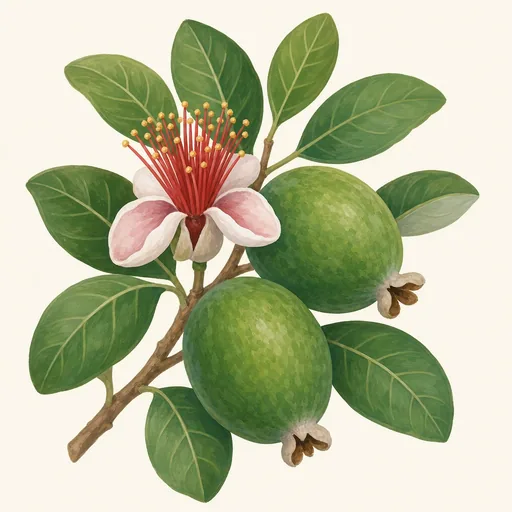
Feijoa
Acca sellowiana · Myrtaceae
- Plant out1–4 weeks after the last frostApr 17 – May 14
- Plant in autumn6–8 weeks before the first autumn frostAug 30 – Sep 19
- Space3–4.5 m (10–15 ft) apart
- HarvestAfter 3–6 years
Description
Feijoa, also called pineapple guava, is an evergreen shrub or small tree in the myrtle family. Native to parts of South America, it usually reaches 2–5 metres tall. Its oval leaves are glossy green above and silvery beneath, giving the plant an attractive appearance even when it is not flowering. In spring or early summer, it produces showy flowers with fleshy white-and-pink petals and a cluster of bright red stamens. The petals are edible and have a mildly sweet taste.
The fruit is an oval, green berry, typically 3–8 centimetres long. Its skin stays green as it ripens, so colour alone is a poor guide to harvest. Ripe fruit often falls from the tree and can then be eaten immediately or left at room temperature for a few days to soften. Inside, the pale flesh surrounds a soft, jelly-like centre containing small edible seeds. Its fragrant flavour is often described as a blend of pineapple, strawberry and guava. The skin is edible but can taste tart or astringent; many people cut the fruit in half and scoop out the flesh. Feijoas are eaten fresh or made into jams, desserts and drinks.
Feijoa grows best in full sun and well-drained soil. Established plants tolerate some drought and light frost, although regular water during fruit development improves the crop. They can be grown as ornamental shrubs or hedges. Some varieties set fruit alone, but many produce more when a different variety flowers nearby and provides cross-pollination. Fruit generally ripens in autumn. Because ripe feijoas bruise easily and do not keep for long, home growers often gather fallen fruit frequently and refrigerate it promptly.
Growing Conditions
3–5 m (10–16 ft) tall, 2.5–4 m (8–13 ft) wide
- Smallest
- Largest
Full sun, 6+ hours
Tolerates part sun
Moderate
Keep evenly moist, not soggy.
Ideal 15–28 °C (59–82 °F)
Survives down to −10 °C (14 °F).
pH 5.5–7.5 · acidic to neutral
Where it Grows
Planting
When to Plant
Plant feijoa in spring after the last frost, once the soil is workable and beginning to warm. This gives the roots a growing season to establish before winter. In mild climates with little frost, early autumn is also a good choice: the soil remains warm, and cooler weather reduces the need for frequent watering. Avoid planting immediately before a hard freeze or during summer heat and drought. Wait if the ground is frozen or waterlogged, since new roots need air as well as moisture.
A young feijoa is more vulnerable to cold than an established plant, so choose spring if winters are uncertain in your area. Container-grown plants can be planted whenever conditions are suitable, but they still need regular watering while establishing. If you plan to grow feijoa in a pot, spring is a convenient time to move it into a larger container. For fruit, choose a site that receives plenty of direct sun.
How to Plant
Choose a sunny, sheltered spot with well-drained soil. Feijoa tolerates a range of soils but grows poorly where water stands around its roots. Allow roughly 3–4 m (10–13 ft) between plants grown as individual shrubs or small trees; plants intended for a hedge can be spaced more closely. If reliable fruiting matters, check whether your chosen variety is self-fertile. Planting a second compatible variety nearby can improve pollination.
Water the plant in its nursery pot before planting. Dig a hole about twice as wide as the root ball, but no deeper. Loosen the soil around the hole; if the site drains badly, improve drainage or choose a raised position rather than digging a deeper hole. Remove the pot, gently loosen roots that circle tightly, and set the plant so the top of its root ball is level with the surrounding soil. Backfill with the excavated soil, firm gently, and water thoroughly.
Spread 5–8 cm (2–3 in) of mulch over the root area, keeping it clear of the stem. Water regularly through the first growing season, allowing the surface soil to dry slightly between waterings. For a container, use a pot with drainage holes and a free-draining potting mix.
Growth Timeline
- Establishing 3 years
- First harvest possible years 3–6
Planting Calendar
- Plant outdoors: 1–4 weeks after the last frost
- Autumn planting: 6–8 weeks before the first autumn frost
- Plant out: Apr 17 – May 14
- Autumn planting: Aug 30 – Sep 19
Care
Care Calendar
- Prune · Feb 27 – Apr 2
Remove dead or crowded branches and lightly shape the shrub. - Feed · Apr 10 – May 14
Apply a balanced fertilizer in spring, following the label rate. - Mulch · Apr 10 – May 14
Spread organic mulch over the root zone, keeping it clear of the trunk. - Protect · Oct 18 – Nov 28
Cover young plants during hard freezes and remove the cover afterward.
Watering
Water newly planted feijoas deeply after planting, then keep the root zone evenly moist through their first growing season. Let the soil surface dry slightly between waterings rather than keeping it soggy. Once established, plants tolerate short dry spells, but regular deep watering during flowering, fruit development, and prolonged heat helps prevent small fruit and premature fruit drop. As a starting point, check the soil 5–10 cm (2–4 inches) down; water when it feels dry at that depth, then soak the area beneath the canopy. Adjust for rainfall, soil type, and container size rather than following a fixed calendar. Container-grown plants dry out faster and need more frequent checks. Reduce watering during cool, rainy periods, and ensure pots and planting sites drain freely. Apply water at soil level where possible; consistently wet foliage can encourage disease.
Pruning
Prune feijoa lightly to maintain an open, manageable shape and allow light and air into the canopy. In late winter or early spring, remove dead, damaged, crossing, or crowded branches. In mild climates, shaping just after harvest is also practical; avoid heavy pruning immediately before flowering, as it can remove potential flowering growth. Shorten overly long shoots selectively, cutting back to a side branch rather than shearing the whole plant if fruit production is the goal. Remove shoots growing from the base if you want a single-trunk tree, or retain several stems for a shrub. Feijoa can also be maintained as a hedge, though frequent clipping usually reduces flowering and fruiting. Keep tools sharp and clean, and step back periodically to assess the shape. For a neglected plant, spread major renovation over more than one season.
Weeding
Keep a weed-free area around young feijoas so grasses and other vigorous plants do not compete for water and nutrients while the roots establish. Extend this area gradually toward the drip line—the ground beneath the outer edge of the canopy—as the plant grows. Pull weeds by hand when the soil is moist, or cut them off at ground level. Work carefully near the trunk and avoid deep hoeing, which can damage shallow feeder roots. Remove weeds before they set seed, especially persistent grasses that spread by runners or rhizomes. A layer of organic mulch helps suppress new seedlings, but check beneath it occasionally for weeds pushing through. Around established plants, low-growing vegetation farther from the trunk is less concerning if moisture is adequate. If using herbicides nearby, prevent spray drift and keep the product off feijoa leaves, stems, and exposed roots.
Mulching
Spread 5–8 cm (2–3 inches) of coarse organic mulch, such as wood chips, shredded bark, or leaf litter, over the soil around a feijoa. Start a few centimetres away from the trunk to keep the bark dry, and extend the mulch toward the drip line if space allows. Mulch slows evaporation, moderates soil temperature, reduces weeds, and gradually contributes organic matter as it breaks down. It is especially useful for young plants and in climates with hot, dry summers. Water the soil first if it is dry; mulch works best when it helps retain existing moisture. Check the layer each year and top it up as needed without piling new material over old mulch that is already too thick. In poorly drained sites, avoid heavy, water-retentive mulch against the base, and make sure the underlying soil does not remain persistently wet.
Fertilizing
Feijoas usually need modest feeding in reasonably fertile garden soil. In early spring, apply compost around the root zone or use a balanced, slow-release fertilizer at the label rate for the plant’s size. If growth is weak or leaves are pale and the soil is not waterlogged, a second light feeding in early summer may help. Avoid excessive nitrogen: it can encourage leafy growth at the expense of flowers and fruit. Keep fertilizer away from the trunk, spread it beneath the canopy, and water it in unless the product directs otherwise. Container-grown feijoas have fewer nutrient reserves; feed them with a fertilizer suitable for fruiting plants according to its label, and flush pots occasionally with plain water to limit salt buildup. If a plant grows well but fruits poorly, check sunlight and pollination before adding fertilizer. A soil test is useful when deficiencies are suspected.
Pest Management
Check leaves, young shoots, and developing fruit regularly. Scale insects and mealybugs may cluster on stems or leaf undersides; small infestations can be rubbed off, while horticultural oil or insecticidal soap can be used according to the label. Keep the canopy open and avoid overfertilizing with nitrogen, which can encourage tender growth attractive to pests. Remove fallen or damaged fruit promptly to reduce breeding sites for fruit-feeding insects. Depending on the region, fruit flies or guava moth may damage feijoas; use locally recommended traps, exclusion bags or netting, and orchard sanitation where those pests occur. Check netting often so wildlife does not become entangled. Birds may also peck ripe fruit. If leaf spots or other disease symptoms appear, remove badly affected material and improve airflow. Identify the problem before treating it, and avoid spraying insecticides during bloom, when pollinators visit the flowers.
Harvesting
Feijoas are generally ready in autumn, with timing varying by climate and cultivar. The most reliable sign of ripeness is that the fruit detaches easily and drops naturally; check beneath the plant daily during peak harvest. You can also cup a fruit and lift it gently: a ready fruit should come away without pulling. Avoid shaking branches hard, as fallen fruit bruises easily. Collect fruit from clean ground or place soft material beneath the plant to cushion it. Use fallen fruit promptly and discard any that is badly bruised, split, or pest-damaged. The skin often remains green when ripe, so colour alone is not a dependable guide. The flesh should develop its characteristic fragrance and a soft, jelly-like centre. Store sound fruit in the refrigerator for a short period, or scoop out the flesh and freeze it for longer storage.
Growing in Containers
Grows well in a pot of at least 50 litres (13 US gallons), with drainage holes. Best kept outdoors.
Propagation
From seed
- Remove seeds from a ripe fruit and rinse away the pulp.
- Sow seeds shallowly in moist seed-starting mix.
- Keep warm and evenly moist until they germinate.
- Transplant seedlings after they develop several true leaves.
From cuttings
- Take semi-hardwood cuttings from healthy growth in late summer.
- Remove the lower leaves and dip the cut ends in rooting hormone.
- Insert the cuttings into a free-draining propagation mix.
- Keep humid in bright, indirect light until roots form.
By layering
- Bend a flexible low branch to the ground.
- Lightly wound the stem where it will touch the soil.
- Peg that section down and cover it with soil.
- Keep the soil moist until roots form, then sever and transplant the new plant.
Companion Plants
Good neighbors
- Pineapple guava (a different cultivar): Planting another cultivar nearby can improve cross-pollination and fruit set.
Common Problems
- Yellowing leaves
- Sticky residue on leaves
- Black sooty coating
- Stunted growth
Scale insects are small, sap-feeding insects that settle on garden and houseplants. Adults often look like bumps on…
- Yellowing leaves
- Sticky residue on leaves
- Black sooty coating
- Curled or cupped leaves
Mealybugs are small, sap-feeding insects in the family Pseudococcidae. They occur on many houseplants, ornamentals…
- Flowers or buds dropping
- Distorted new growth
Poor pollination occurs when too little viable pollen reaches a flower’s receptive stigma, or when pollen fails to…
- Yellowing leaves
- Wilting
- Stunted growth
- Leaves dropping
Root rot is a general name for the decay of plant roots, not a single disease with one scientific name. It can result…
- Poor fruit set: Some cultivars need pollen from a different feijoa cultivar. Too few pollinators or frost during flowering can also reduce the crop.
- Root rot: Waterlogged soil can damage roots; plant in well-drained soil.
- Scale insects and mealybugs: These sap-feeding pests may appear on leaves and stems.
- Guava moth: Where present, its larvae can tunnel into fruit.
Varieties
A dependable choice where there is room for only one plant.
- self-fertile
- medium fruit
Produces sweet fruit and can crop without a second cultivar.
- self-fertile
- early
Grow with another cultivar for more reliable yields of its large fruit.
- large fruit
Produces large fruit relatively late in the season.
- large fruit
- late
An American selection valued for its large, sweet fruit.
- large fruit
- sweet
A late-ripening selection best grown with a pollinating partner.
- large fruit
- late
More about varieties
- ‘Coolidge’ — Self-fertile and often grown where there is room for only one plant.
- ‘Unique’ — An early-fruiting, self-fertile New Zealand cultivar.
- ‘Mammoth’ — Produces large fruit; benefits from a pollination partner.
- ‘Triumph’ — A late-season cultivar with large fruit; needs cross-pollination for reliable crops.
- ‘Apollo’ — Known for large, aromatic fruit.
Health Benefits
Feijoa fruit is eaten fresh and used in smoothies, preserves, and baked goods. It provides vitamin C, which helps the body make collagen and supports normal immune function. It also contains dietary fiber, which supports regular bowel movements and can help make fruit a satisfying snack. Feijoa supplies some potassium, a mineral involved in normal muscle and nerve function.
Like many fruits, feijoa contains plant compounds with antioxidant activity. Laboratory studies have investigated these compounds, but that does not establish that eating feijoa treats inflammation, prevents cancer, or cures any illness. Its best-supported wellness role is as one part of a varied diet that includes plenty of fruit and vegetables.
The soft flesh can be scooped out and eaten raw. The skin is edible too, though its sharper, more astringent taste leads many people to leave it behind. Eating the skin adds to the portion of fruit consumed, but there is no need to do so to enjoy feijoa. Whole fruit is generally a more filling choice than strained juice because it retains its fiber. Feijoa also contains naturally occurring sugars, so portion size may matter for people monitoring carbohydrate intake.
Fun Facts
- Feijoa is native to southern South America.
- Its botanical name is Acca sellowiana; it was formerly classified as Feijoa sellowiana.
- It belongs to the myrtle family, along with guava, but is not a true guava.
- The fleshy flower petals are edible and have a sweet taste.
- Ripe fruit often drops from the plant, making fallen fruit a useful clue that harvest time has arrived.
Notice an error or have a question about Feijoa? Contact us