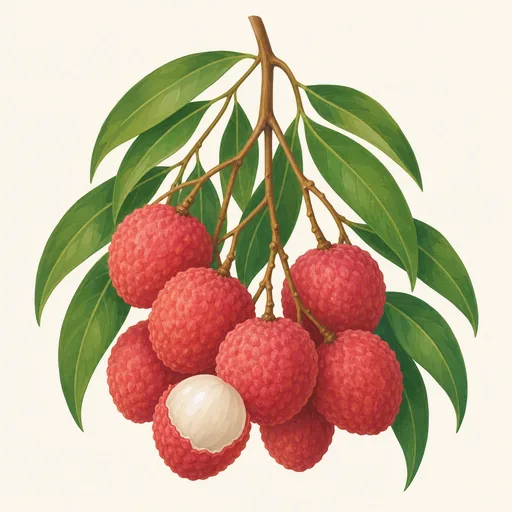
Lychee
Litchi chinensis · Sapindaceae
- Plant out2–6 weeks after the last frostApr 24 – May 28
- Space8–10 m (26–33 ft) apart
- HarvestAfter 3–5 years
Description
Lychee is a subtropical evergreen tree grown for its small, round to oval fruits. It usually reaches 10–15 metres in orchards, although older trees can grow taller. Its dense crown carries glossy, narrow leaflets, and new growth often emerges bronze or reddish before turning green. In spring, clusters of small, pale flowers attract insects. A tree can bear many flowers but set relatively few fruits.
Each fruit has a thin, rough rind that changes from green to pink or red as it matures. Inside is translucent, juicy, white flesh surrounding a single glossy brown seed. The flesh is sweet and fragrant, with a lightly tart note. It is eaten fresh or used in desserts, drinks, and preserves. The rind and seed are not eaten. Lychees do not become sweeter after picking, so growers harvest them when fully coloured and mature. Their appearance can deteriorate quickly after harvest as the rind dries and browns, even while the flesh remains edible.
Lychee grows best where summers are warm and humid and winters are cool and relatively dry, without severe frost. A distinct cool period helps many varieties flower; persistently warm winters may leave a healthy tree with little fruit. Young trees need protection from frost, strong wind, and drought. Well-drained, slightly acidic soil is preferable, and regular watering is especially important during flowering and fruit development. Waterlogged roots and prolonged dry spells can both cause problems.
Trees grown from seed can take many years to fruit and may not resemble their parent. Named varieties are therefore usually propagated by air layering or grafting. Established trees may produce uneven crops from year to year. For home growers, choosing a variety suited to the local winter climate is as important as providing a sunny planting site and enough room for the mature canopy.
Growing Conditions
8–12 m (26–39 ft) tall, 6–10 m (20–33 ft) wide
- Smallest
- Largest
Full sun, 6+ hours
Tolerates part sun
Moderate
Keep evenly moist, not soggy.
Ideal 20–32 °C (68–90 °F)
Survives down to −2 °C (28 °F).
pH 5–6.5 · acidic
Where it Grows
Planting
When to Plant
Plant lychee in spring, after the last frost, when the soil has warmed and the tree has a full growing season to establish. Young lychee trees are especially vulnerable to freezing temperatures, so wait until cold nights have passed. In frost-free tropical areas, the start of the rainy season is also a good planting time: rain helps keep the root ball moist while new roots grow. Avoid planting during a heat wave, a prolonged dry spell, or a period of waterlogged soil. If summers are very hot, choose a mild stretch of weather and be ready to water regularly. In a climate with occasional frost, plant in spring rather than autumn so the tree can establish before winter. Where winters are too cold to grow lychee outdoors, plant it in a large container and move it to a sheltered place before temperatures approach freezing.
How to Plant
Choose a sunny, sheltered site with well-drained soil and room for the tree to mature. Allow roughly 20–30 feet (6–9 m) between a lychee and other large trees or buildings, unless you plan to keep it smaller by pruning. Lychee grows best in slightly acidic soil; avoid sites that stay soggy after rain. For reliable fruit, buy a healthy air-layered or grafted tree of a named variety rather than planting a seed, which may not produce fruit like its parent.
Water the tree in its container before planting. Dig a hole two to three times as wide as the root ball but no deeper. Gently remove the container, loosen any roots circling the outside, and set the tree so the top of the root ball is level with or slightly above the surrounding ground. Backfill with the soil you removed, firm it gently, and water thoroughly. Do not bury the trunk or add fertilizer directly to the planting hole.
Spread 2–4 inches (5–10 cm) of mulch over the root area, keeping it several inches away from the trunk. Water regularly while the tree establishes, allowing the surface soil to dry slightly between waterings; keep it moist, not waterlogged. Protect young trees from frost and strong, drying winds.
Growth Timeline
- Establishing 3 years
- First harvest possible years 3–5
Planting Calendar
- Plant outdoors: 2–6 weeks after the last frost
- Plant out: Apr 24 – May 28
Care
Care Calendar
- Mulch · Mar 27 – May 14
Spread organic mulch over the root zone, keeping it away from the trunk. - Protect · Jun 19 – Sep 3
Net ripening fruit where birds are likely to take it. - Protect · Oct 11 – Dec 26
Cover young trees when frost threatens, removing the cover during warmer days. - Prune · Jul 3 – Sep 17
Prune lightly just after harvest to shape the tree and encourage new growth. - Feed · Jul 3 – Sep 17
Feed after harvest with a fruit-tree fertilizer, avoiding heavy nitrogen applications.
Watering
Keep the soil evenly moist while a young lychee tree establishes, watering deeply whenever the upper few inches begin to dry. Adjust the frequency to rainfall, temperature, and soil drainage rather than following a fixed schedule. Established trees generally need the most water during spring growth, flowering, fruit development, and hot weather. Water slowly over the root zone, which extends beyond the trunk, and let excess water drain away; persistently soggy soil can damage roots. Avoid sharp swings between drought and heavy watering while fruit is swelling, as they can contribute to fruit splitting. A cooler, relatively dry winter rest can help mature trees flower, but do not deliberately stress a young tree or let an established tree wilt. Resume regular watering as growth and flowers develop. Drip irrigation or a soaker hose makes it easier to supply steady moisture without wetting the foliage.
Pruning
Prune lychee lightly, preferably soon after harvest, so the tree has time to produce and mature new shoots before its next flowering season. Remove dead, damaged, diseased, or crossing branches first. Thin crowded growth where needed to improve light and airflow, and shorten overly vigorous shoots to keep fruit within reach. Use clean, sharp tools and make cuts just outside the branch collar; avoid leaving stubs. Lychee bears flower clusters at shoot tips, so heavy pruning or pruning late in the season can remove potential flowering wood and reduce the next crop. Young trees benefit from gentle shaping to develop a sturdy, well-spaced framework. On a mature tree, spread major size reductions over several years rather than removing much of the canopy at once. If a branch is infested, dispose of the affected material and clean tools before moving to healthy growth.
Weeding
Keep grass and weeds from competing with a young lychee tree for water and nutrients, especially during its first few years. Maintain a weed-free area around the trunk that expands as the tree grows; mulch can help keep that area clear. Pull small weeds by hand while the soil is moist, or cut them at ground level. Lychee has shallow feeder roots, so avoid deep hoeing, digging, or tilling beneath the canopy. If using a string trimmer or mower nearby, protect the bark: even small wounds can weaken a tree or provide an entry point for disease. Do not let climbing weeds smother low branches. Where herbicides are used, follow the product label and keep spray or drift off the trunk, foliage, and exposed roots. Check the area regularly after rain, when new weeds are easiest to remove.
Mulching
Spread a 2–4 inch (5–10 cm) layer of coarse organic mulch, such as wood chips or shredded leaves, over the soil beneath the canopy. Extend it outward as the tree grows, ideally toward the drip line, but leave several inches of bare soil around the trunk. Mulch touching the bark can hold moisture against it and encourage decay. An organic layer helps conserve water, moderates soil temperature, suppresses weeds, and gradually adds organic matter as it breaks down. This is especially useful because lychee’s shallow roots are easily disturbed by cultivation. Apply mulch to moist soil, and replenish it when it thins; there is no need to dig old mulch into the ground. Keep the layer loose rather than piling it into a mound. Continue checking soil moisture beneath the mulch, since rain may not always penetrate a thick, dry layer immediately.
Fertilizing
Feed young lychee trees lightly during active growth, using small, spaced applications of a fertilizer labeled for fruit trees and following its rate instructions. Too much fertilizer, particularly nitrogen, can burn roots or produce vigorous leaves instead of a balanced tree. As the tree matures, base feeding on growth, cropping, and, where possible, a soil or leaf analysis. Apply fertilizer over the root zone rather than against the trunk, and water it in unless the label says otherwise. Avoid heavy nitrogen applications late in the growing season: tender new shoots may not mature in time to flower well. Fruiting trees also need adequate potassium, but do not add large amounts without evidence of a need. In alkaline soil, lychee may show iron or other micronutrient deficiencies; identify the cause before treating yellow leaves. Compost and mulch can improve soil condition, but they do not replace a measured nutrient program when a deficiency is present.
Pest Management
Inspect new shoots, the undersides of leaves, and developing fruit regularly. Depending on the region, lychee pests can include scale insects, mealybugs, aphids, fruit borers, and lychee erinose mite. Learn which pests occur locally before choosing a treatment. Prune and dispose of heavily infested growth where practical, and control ants that protect honeydew-producing insects. Encourage beneficial insects and avoid spraying merely because an insect is present. If treatment is needed, select a product labeled for the pest and for use on lychee in your area; follow its timing, harvest interval, and pollinator precautions. Contact a local extension service for advice if leaves develop the characteristic felt-like patches associated with erinose mite. Birds and other fruit-eating animals may also take ripe fruit. Securely installed, wildlife-safe netting can protect a manageable tree; check it frequently so animals do not become trapped.
Harvesting
Harvest lychees when their skins have developed the mature color typical of the cultivar and the fruit tastes sweet and fully flavored. Skin color varies among cultivars, so sample a few fruits rather than relying on redness alone. Lychees do not continue to ripen after picking, and fruit on the same tree may become ready at different times. Use clean clippers to cut ripe clusters with a short length of stem attached. Handle the fruit gently: torn skin and bruising shorten its storage life. Avoid breaking branches or stripping off shoots while picking, since healthy growth supports future crops. Harvest during the cooler part of the day when possible, then shade and refrigerate the fruit promptly. The skin can turn brown during storage even while the flesh remains edible; high humidity and suitable refrigeration help slow drying and browning. Wash fruit before eating and discard any that smells fermented or shows decay.
Growing in Containers
Grows well in a pot of at least 75 litres (20 US gallons), with drainage holes. Can be grown indoors as a houseplant.
Propagation
By layering
- Select a healthy branch in spring or early summer.
- Remove a ring of bark below a leaf node.
- Wrap the exposed area in moist sphagnum moss and seal it with plastic.
- Keep the moss moist until roots are visible.
- Cut below the rooted section and pot it in well-draining mix.
From seed
- Remove a seed from a ripe fruit and clean off the flesh.
- Sow it promptly; lychee seeds lose viability quickly.
- Plant it about 2 cm deep in moist, well-draining mix.
- Keep it warm and evenly moist until it sprouts.
- Pot up the seedling once it is established; seed-grown trees may not resemble the parent.
Common Problems
- Spots on leaves
- Brown or crispy leaf edges
- Bleached or scorched patches
- Leaves dropping
Anthracnose is a name for several fungal diseases, not a single species. Depending on the plant, the cause may be a…
- Holes in leaves
- Stems chewed or cut through
- Flowers or buds dropping
Birds are a class of animals, not a single pest species. In gardens, their effects depend on the species, season, and…
- Cracked or split fruit
Fruit cracking is a physiological disorder in which the skin of a developing or ripening fruit splits as the flesh…
- Yellowing leaves
- Sticky residue on leaves
- Black sooty coating
- Stunted growth
Scale insects are small, sap-feeding insects that settle on garden and houseplants. Adults often look like bumps on…
- Poor flowering or fruit set, often associated with warm winters, excessive nitrogen fertilizer, or unfavorable weather during bloom.
- Fruit cracking when heavy rain or irregular watering follows a dry period.
- Fruit drop caused by water stress, poor pollination, or other growing stresses.
- Anthracnose and fruit rots, especially in humid conditions.
- Scale insects, mealybugs, and mites, which may weaken growth or blemish fruit.
- Birds and bats feeding on ripening fruit; waterlogged soil can also lead to root problems.
Varieties
A commonly grown cultivar with juicy, sweet-tart fruit.
- early
- productive
This established cultivar bears flavorful fruit, usually with a relatively large seed.
- vigorous
- large fruit
Its richly flavored fruit often has a relatively small seed.
- sweet
- small seed
It produces large, sweet fruit, often with small seeds.
- large fruit
- sweet
Its exceptionally large fruit and slower growth suit gardeners with limited space.
- very large fruit
- slow-growing
This Hawaiian selection is prized for its juicy, sweet fruit.
- sweet
- juicy
Also sold as ‘Bosworth 3’, it bears pink-red fruit on a relatively small tree.
- compact
- small seed
More about varieties
- Mauritius (Tai So): A widely grown, relatively early cultivar with red fruit.
- Brewster: Produces large, flavorful fruit, usually with a substantial seed.
- Hak Ip: Known for dark red skin and sweet flesh; seeds are sometimes small.
- Sweetheart: Valued for large fruit and a high proportion of small, shriveled seeds.
- Kaimana: A Hawaiian selection prized for its sweet fruit.
Health Benefits
Lychee is chiefly enjoyed as a sweet, refreshing fruit rather than used as a treatment. Its best-established nutritional benefit is vitamin C, which supports normal immune function, collagen formation, and the absorption of iron from plant foods. Lychee also provides water, a little dietary fiber, and potassium. These nutrients can contribute to a varied diet, but eating lychee has not been shown to prevent or cure a specific illness.
Fresh lychee can be eaten on its own or added to fruit salads, desserts, and drinks. Dried and canned lychees are also popular, though canned fruit packed in syrup may contain substantial added sugar. As with other sweet fruits, portion size may matter to people managing blood glucose. Lychee contains plant compounds with antioxidant activity in laboratory studies, but that does not establish a particular health benefit from eating it.
Eat only the ripe flesh: discard the peel and seed. Do not give children unripe lychees, especially in place of a meal. Consumption of unripe fruit on an empty stomach has been linked to dangerous low blood sugar in undernourished children. Anyone with a suspected lychee allergy should avoid the fruit and seek medical advice.
Fun Facts
- Lychee belongs to the soapberry family, alongside longan and rambutan.
- It has been cultivated in southern China for more than 2,000 years.
- The juicy, translucent part eaten around the seed is called an aril.
- Lychees do not become sweeter after harvest, so they should be picked ripe.
- The tree is evergreen and can grow well over 10 meters tall if left unpruned.
Notice an error or have a question about Lychee? Contact us