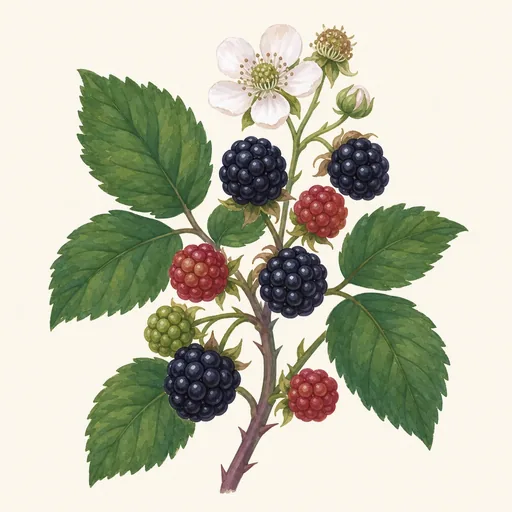
Blackberry
Rubus fruticosus · Rosaceae
- Plant outFrom 4 weeks before to 2 weeks after the last frostMar 13 – Apr 30
- Plant in autumn4–6 weeks before the first autumn frostSep 13 – Oct 3
- Space0.9–1.8 m (3–6 ft) apart
- HarvestAfter 1–2 years
Description
Blackberry is the edible fruit of brambles in the genus Rubus, especially plants grouped under the name Rubus fruticosus. Despite its name, the fruit is not a true berry: it is an aggregate of small, juicy drupelets, each containing a seed. Ripe fruits are glossy black to deep purple, with a sweet-tart flavor. Unlike raspberries, they come off the plant with the central core attached.
Blackberry plants are perennial at the roots, but most canes live for two years. First-year canes, called primocanes, generally grow and form leaves; second-year canes, or floricanes, bear flowers and fruit before dying. Some modern varieties fruit on first-year canes. The arching or trailing stems can root where their tips touch soil, creating dense thickets. Leaves usually have three to five toothed leaflets, and white or pale pink flowers attract bees and other pollinators.
The fruit is eaten fresh or made into jam, pies, sauces, juice, and wine. It provides dietary fiber, vitamin C, and dark anthocyanin pigments. Blackberries are delicate and highly perishable, so they are best picked when fully black and easily detached, then refrigerated promptly.
In gardens, blackberries grow best in full sun and well-drained, moderately fertile soil. Regular watering during flowering and fruit development helps produce plump berries. Depending on the variety, canes may need trellising. Pruning out spent floricanes and thinning crowded new growth improves airflow and makes harvesting easier. Thornless cultivars are easier to handle, while wild plants can spread aggressively and become invasive in some regions. Birds and mammals eat the fruits and disperse the seeds. Because blackberries comprise a complex group of closely related species and hybrids, Rubus fruticosus is often used broadly rather than for a single, precisely defined species.
Growing Conditions
1.2–3 m (4–10 ft) tall, 0.9–2.4 m (3–8 ft) wide
- Smallest
- Largest
Full sun, 6+ hours
Tolerates part sun
Moderate
Keep evenly moist, not soggy.
Ideal 18–27 °C (64–81 °F)
Survives down to −29 °C (−20 °F).
pH 5.5–6.5 · acidic
Where it Grows
Planting
When to Plant
Plant bare-root blackberries while they are dormant, usually in late winter or early spring, as soon as the soil has thawed and is workable. Aim to plant before buds open, but do not work soil that is frozen or waterlogged. In regions with mild winters, fall planting is also possible: plant after summer heat has passed, leaving several weeks for roots to establish before a hard freeze. Container-grown plants offer more flexibility and can generally go in during spring or fall. Avoid planting them during extreme heat or drought, when keeping new roots moist is difficult. The right date depends more on local weather and soil conditions than on a calendar. If a bare-root plant arrives before you can plant it, keep its roots cool and moist, not submerged, until the ground is ready. Whatever the season, plan to water regularly through the first growing season, especially during dry spells.
How to Plant
Choose a site with at least six to eight hours of direct sun and soil that drains well; blackberry roots do poorly in standing water. Clear perennial weeds before planting. If drainage is poor, use a raised bed rather than putting the plant in a low, wet spot. A soil test can guide any needed adjustments; blackberries generally grow best in slightly acidic soil. Install a trellis before planting trailing or semi-erect varieties so you do not disturb the roots later.
Dig a hole wide enough to spread the roots without bending them, but no deeper than needed. For a container plant, loosen circling roots and set the top of the root ball level with the surrounding soil. For a bare-root plant, spread the roots over a small mound of soil and set the crown at about its nursery depth. Backfill with the original soil, firm it gently to remove large air pockets, and water thoroughly. Do not put fertilizer directly against the roots.
Allow roughly 2–3 feet between erect plants and 4–6 feet between trailing plants; check the variety’s recommended spacing. Add a layer of mulch to conserve moisture and suppress weeds, keeping it away from the crown. Water whenever the soil begins to dry while the plant establishes.
Growth Timeline
- Establishing 1 year
- First harvest possible years 1–2
Planting Calendar
- Plant outdoors: from 4 weeks before to 2 weeks after the last frost
- Autumn planting: 4–6 weeks before the first autumn frost
- Plant out: Mar 13 – Apr 30
- Autumn planting: Sep 13 – Oct 3
Care
Care Calendar
- Prune · Feb 27 – Apr 2
Remove dead or weak canes and thin the remaining canes to improve airflow. - Prune · Jul 5 – Oct 3
After the summer harvest, cut spent fruiting canes to the ground while leaving new canes. - Feed · Mar 27 – Apr 30
Apply a balanced fertilizer around the plants as growth begins. - Stake · Apr 10 – May 28
Tie growing canes to a trellis to keep them upright and accessible. - Mulch · Apr 10 – May 14
Spread organic mulch around the roots, keeping it clear of the crowns. - Protect · May 22 – Jul 23
Cover ripening fruit with bird netting, secured so birds cannot get underneath.
Watering
Keep the soil consistently moist, especially while plants are establishing and while berries are developing. Established blackberries generally need about 1–2 inches (2.5–5 cm) of water per week from rain and irrigation combined; hot, dry weather and sandy soil may call for more. Check the soil a few inches below the surface rather than watering on a fixed schedule. Water deeply enough to moisten the root zone, then let the surface begin to dry before watering again. Drip irrigation or a soaker hose delivers water to the roots without wetting the leaves and fruit, which can encourage disease. Water in the morning if using a sprinkler. Avoid both prolonged drought, which can reduce berry size, and waterlogged soil, which can damage roots. A layer of mulch helps keep moisture more even.
Pruning
Identify whether your variety fruits on second-year canes (floricanes) or first-year canes (primocanes), because pruning differs. For traditional floricane blackberries, cut canes that have finished fruiting to the ground soon after harvest; they will not fruit again. In late winter, remove dead, damaged, or weak canes, then space and tie the strongest remaining canes to a trellis. Where recommended for your variety, tip vigorous new upright canes during the growing season to encourage fruiting side shoots; do not apply the same tipping rule to every trailing variety. Primocane-fruiting plants can be cut entirely to the ground during dormancy for one autumn crop. Keep tools sharp and clean, and wear sturdy gloves around thorny canes. Good pruning improves light and airflow and makes picking easier.
Weeding
Keep a weed-free strip around blackberry crowns and along the row, particularly while plants are young. Grasses and broadleaf weeds compete for water and nutrients, and dense growth can make harvesting difficult or shelter pests. Pull weeds when they are small, preferably after rain when roots come out easily. If you hoe, work shallowly: blackberry roots can grow close to the surface, and deep cultivation can injure them. Mulch can suppress many new weeds, but remove established perennial weeds before laying it down. Check the edges of the planting regularly for runners and invading grasses. Avoid letting weeds set seed. If using an herbicide, verify that its label specifically permits use around blackberries and follow its directions carefully; spray drift can injure canes, leaves, and nearby plants.
Mulching
Spread about 2–4 inches (5–10 cm) of clean organic mulch, such as wood chips, shredded leaves, or straw, over the soil around blackberry plants. Mulch helps conserve moisture, reduces weeds, and moderates soil temperature. Leave a small gap around each crown so damp material does not rest against the base of the canes. Replenish the layer as it breaks down, usually in spring, but avoid piling on so much that the soil stays soggy. Remove troublesome perennial weeds before mulching, since they may grow through it. If using straw, choose material without weed seeds. Mulch does not replace watering: check moisture beneath it during dry weather. In a poorly drained site, improve drainage rather than relying on mulch to compensate for wet soil.
Fertilizing
Start with a soil test if possible; it can reveal whether the soil needs nutrients or a pH adjustment. Blackberries generally grow best in slightly acidic soil, around pH 5.5–6.5. In established plantings, apply a modest amount of balanced fertilizer or compost in early spring as growth begins, following the product label and local soil-test recommendations. Spread it over the root area, not directly against the crowns, and water it in if directed. Newly planted blackberries should not receive a heavy dose of fertilizer against their roots. Avoid excessive nitrogen: it can produce lush canes at the expense of fruit and may encourage tender growth. Pale leaves and poor growth can have several causes, including wet soil, so check conditions before adding more fertilizer. Avoid feeding late in the growing season where winter cold is a concern.
Pest Management
Inspect leaves, canes, and ripening fruit regularly so problems are caught early. Prune out dead or infested canes, remove old fruit and plant debris, and keep the planting open for airflow; these steps help limit cane diseases and fruit rots. Watch for cane borers, aphids, and spotted wing drosophila, a small fly whose larvae can infest ripening berries. Pick fruit promptly and frequently, and remove damaged or overripe berries rather than leaving them on the plants. Good drainage and avoiding overhead watering help reduce fungal disease. If a plant shows suspected orange rust, seek local extension advice: it is a systemic disease and affected plants generally must be removed. Use pesticides only when needed, choosing a product labeled for blackberries and the identified pest. Follow all directions, especially harvest waiting periods, and avoid spraying when pollinators are visiting flowers.
Harvesting
Pick blackberries when they are fully black, plump, and come away with a gentle pull. A berry that resists is usually not ready; blackberries do not become sweeter after picking. Color alone is not always enough, so taste a few to learn when your variety is at its best. During peak season, check plants every two or three days, since berries ripen in stages and overripe fruit spoils quickly. Harvest in the cool of the morning after dew has dried, if practical. Handle berries gently and place them in shallow containers to avoid crushing them. Wear gloves and long sleeves for thorny varieties, and take care not to damage new canes while reaching for fruit. Refrigerate berries promptly, use them within a few days, and wash them just before eating or preserving.
Growing in Containers
Grows well in a pot of at least 40 litres (11 US gallons), with drainage holes. Best kept outdoors.
Propagation
By layering
- Bend a healthy cane tip to the ground in late summer.
- Bury the tip a few inches deep, leaving the cane attached to the parent plant.
- Keep the soil moist while roots form.
- Sever the rooted tip from the parent in spring and transplant it.
From cuttings
- Take pencil-thick root sections from a healthy plant while it is dormant.
- Cut the roots into pieces about 2–4 inches long.
- Lay the pieces horizontally in moist soil and cover them lightly.
- Keep the soil moist until shoots emerge, then transplant the young plants.
From suckers
- Choose a healthy, rooted sucker while the plant is dormant.
- Dig around the sucker and sever its connecting root from the parent.
- Replant it promptly at its original depth.
- Water it thoroughly and keep the soil moist as it establishes.
Companion Plants
Keep apart from
- Raspberry: Keep raspberry plantings separate from blackberries because these related brambles share several pests and diseases.
- Tomato: Avoid planting blackberries in soil recently used for tomatoes because both can host verticillium wilt.
- Potato: Avoid planting blackberries in soil recently used for potatoes because both can host verticillium wilt.
Common Problems
- Spots on leaves
- Brown or crispy leaf edges
- Bleached or scorched patches
- Leaves dropping
Anthracnose is a name for several fungal diseases, not a single species. Depending on the plant, the cause may be a…
- Holes in leaves
- Stems chewed or cut through
- Flowers or buds dropping
Birds are a class of animals, not a single pest species. In gardens, their effects depend on the species, season, and…
- Fuzzy gray mold
- Spots on leaves
- Wilting
- Soft or rotting stems
Gray mold, also called Botrytis blight, is a fungal disease caused most commonly by Botrytis cinerea. It affects many…
- Holes in leaves
- Insects visible on the plant
- Wilting
The Japanese beetle is an introduced scarab beetle that feeds on many garden plants, including roses, grapes, beans…
- Orange or rust-colored spots
- Spots on leaves
- Yellowing leaves
- Leaves dropping
Rust is a group of plant diseases caused by fungi in the order Pucciniales, not a single species. Different rust fungi…
- Cane diseases: Anthracnose and cane blight can cause spots, dieback, and reduced harvests. Remove affected canes and improve airflow.
- Orange rust: This disease causes bright orange spores on leaves. Infected plants should be removed, including their roots.
- Root rot: Poorly drained soil can damage roots and cause wilting. Plant in well-drained ground.
- Fruit pests: Spotted-wing drosophila can lay eggs in ripening berries; pick fruit promptly and remove fallen berries.
- Birds and sprawling growth: Birds may eat ripe fruit, while vigorous canes can spread beyond their allotted space. Netting and regular pruning can help.
Varieties
A vigorous variety with firm fruit that ripens late in the blackberry season.
- late season
- cold hardy
Produces large, sweet berries on long canes that benefit from a sturdy trellis.
- large fruit
- vigorous
An early-ripening variety with large berries and vigorous, upright canes.
- early
- large fruit
An upright-growing variety that produces firm, sweet berries in midsummer.
- upright
- midseason
Its erect canes produce large berries and need less support than trailing varieties.
- upright
- large fruit
Can bear fruit on first-year canes in autumn, though the crop may be cut short by early frost.
- thornless
- fall fruiting
More about varieties
- Chester Thornless: A productive, late-season variety with thornless canes.
- Triple Crown: A thornless variety valued for large, flavorful berries.
- Ouachita: An upright, thornless variety that is relatively easy to manage.
- Natchez: An early-ripening, thornless variety with large berries.
- Prime-Ark Freedom: A thornless variety that can fruit on first-year canes in suitable climates.
Health Benefits
Blackberries are commonly eaten fresh, frozen, or cooked as part of a varied diet. They provide dietary fiber, which supports normal digestion and can help with fullness after a meal. They also supply vitamin C, needed for collagen formation and normal immune function, and vitamin K, which contributes to normal blood clotting. Blackberries contain manganese and plant compounds, including anthocyanins—the pigments responsible for much of their dark color.
These compounds are often studied for antioxidant activity. Eating blackberries can contribute to a healthy dietary pattern, but claims that they prevent or treat a particular disease are not established. Whole berries offer fiber that juice generally lacks. Unsweetened fresh or frozen berries are useful options for people who want fruit without the added sugar often found in jams, syrups, and desserts.
For everyday use, add blackberries to yogurt, oatmeal, or salads, or eat them on their own. Wash them shortly before eating, as the delicate fruit spoils quickly when wet. Anyone taking warfarin should aim for a consistent vitamin K intake and ask their clinician about significant dietary changes. Blackberries are food, not a substitute for medical care.
Fun Facts
- A blackberry is an aggregate fruit: each small, juicy bump is a drupelet.
- Unlike a raspberry, a picked blackberry keeps its pale central core.
- Most varieties fruit on second-year canes, although some can also fruit on first-year canes.
- Blackberry roots are perennial, even though individual canes typically live for only two growing seasons.
- Blackberry flowers provide food for bees and other pollinators.
Notice an error or have a question about Blackberry? Contact us