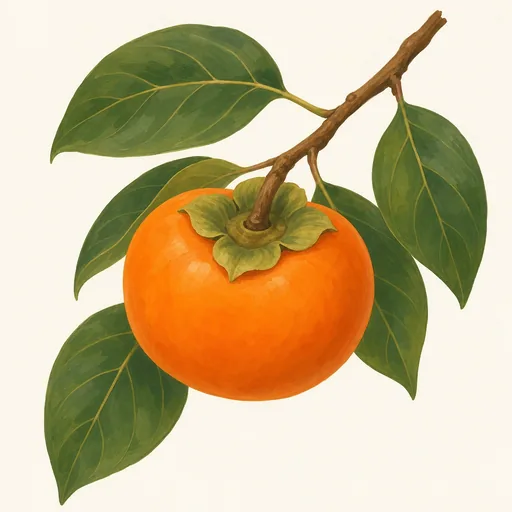
Persimmon
Diospyros kaki · Ebenaceae
- Plant outFrom 4 weeks before the last frost until the last frostMar 13 – Apr 16
- Plant in autumn4–8 weeks before the first autumn frostAug 30 – Oct 3
- Space4.5–7.5 m (15–25 ft) apart
- HarvestAfter 2–6 years
Description
Persimmon is the sweet, orange to reddish-orange fruit of a deciduous tree in the ebony family. The most widely cultivated species is Diospyros kaki, often called Asian or Japanese persimmon. Its fruits range from squat and tomato-shaped to elongated and acorn-shaped, with smooth skin and soft flesh when fully ripe. The tree’s glossy green leaves often turn yellow, orange, or red in autumn; ripe fruit may remain on bare branches after the leaves fall. Small flowers appear in spring, and fruit generally ripens in autumn.
Two broad fruit types matter to gardeners. Astringent varieties, such as ‘Hachiya’, contain tannins that make firm fruit unpleasantly puckering. Let them become very soft before eating, or use a suitable postharvest treatment to remove astringency. Non-astringent varieties, such as ‘Fuyu’, can be eaten while still firm, though they sweeten as they ripen. Some cultivars respond differently to pollination, so this distinction is a useful guide rather than a complete classification. Persimmons are eaten fresh, added to salads, baked, or dried. The skin is edible, and fruits may be seedless or contain several seeds, depending on the cultivar and pollination.
Persimmon trees grow best in full sun and well-drained soil, with regular water while young and during fruit development. Established trees tolerate some drought, but uneven watering can reduce fruit quality. They need a warm growing season; winter cold tolerance varies by cultivar, and late frosts can harm new growth. Avoid excessive nitrogen fertilizer, which encourages leafy growth at the expense of fruit. Some cultivars set fruit without pollination, whereas others benefit from a compatible tree nearby. Young trees may drop fruit naturally, and branches carrying a heavy crop can need support. Harvest fruit once it has developed its characteristic color, handling it gently because bruises shorten storage life.
Growing Conditions
3–9 m (10–30 ft) tall, 3–8 m (10–26 ft) wide
- Smallest
- Largest
Full sun, 6+ hours
Tolerates part sun
Moderate
Keep evenly moist, not soggy.
Ideal 18–30 °C (64–86 °F)
Survives down to −18 °C (0 °F).
pH 6–7.5 · acidic to neutral
Where it Grows
Planting
When to Plant
Plant persimmon while the tree is dormant, preferably in late winter or early spring, after the soil has thawed and can be worked but before buds begin to open. This timing is especially useful for bare-root trees and in regions with cold winters: roots can establish before summer heat without exposing a newly planted tree to a full winter. In mild climates, fall planting is another option once hot weather has passed, provided the tree has several weeks to settle in before a hard freeze. Container-grown trees can also be planted during the growing season, but avoid periods of extreme heat or drought. To judge whether conditions are right, check that the soil is moist rather than waterlogged and that the forecast does not call for an immediate hard freeze. If a bare-root tree arrives before the site is ready, keep its roots cool and damp until planting.
How to Plant
Choose a site with full sun, well-drained soil, and room for the mature tree. Allow roughly 15 to 20 feet from other trees or structures for many Asian persimmons; vigorous American persimmons may need more space. Check the mature size of your particular cultivar and rootstock. Before planting, water a container-grown tree thoroughly, or keep bare roots moist and soak them briefly if they seem dry. Dig a hole two to three times as wide as the root system but no deeper than the roots need. Loosen circling roots on a container tree and spread bare roots outward. Set the tree so its root flare is at ground level; keep any graft union above the soil. Backfill with the original soil, firming it gently to remove large air pockets. Do not add fertilizer to the planting hole. Water deeply after planting, then add 2 to 3 inches of mulch over the root zone, leaving a gap around the trunk. Keep the soil evenly moist, not soggy, through the first growing season. Stake only if the tree cannot stand securely on its own, and remove the stake once it is stable. Check whether your chosen cultivar needs a pollination partner if you want fruit.
Growth Timeline
- Establishing 2 years
- First harvest possible years 2–6
Planting Calendar
- Plant outdoors: from 4 weeks before the last frost until the last frost
- Autumn planting: 4–8 weeks before the first autumn frost
- Plant out: Mar 13 – Apr 16
- Autumn planting: Aug 30 – Oct 3
Care
Care Calendar
- Prune · Feb 13 – Apr 2
Remove dead or crossing wood and keep a strong framework; avoid heavy pruning. - Feed · Apr 10 – May 14
Apply a modest amount of balanced fertilizer only if growth is weak. - Mulch · Apr 10 – May 14
Spread mulch over the root zone, leaving a gap around the trunk. - Thin · May 22 – Jul 9
Thin heavy crops after fruit set to reduce branch breakage and uneven cropping. - Protect · Oct 11 – Nov 14
Guard young trunks against rodents and protect young or marginally hardy trees from severe cold.
Watering
Water newly planted persimmons deeply after planting, then water when the upper few inches of soil begin to dry. During the first one or two growing seasons, aim for consistently moist—not waterlogged—soil while roots establish. A slow, thorough soaking once or twice a week during dry weather is usually more useful than frequent light sprinkling; adjust for rainfall, soil type, and heat. Established trees often need little irrigation where rainfall is regular, but watering during prolonged drought helps prevent stress and supports fruit growth. Pay particular attention during flowering and fruit development, when severe drying can contribute to fruit drop. Apply water over the root area rather than against the trunk. Well-drained soil is important: persistent saturation can damage roots. A layer of mulch helps keep moisture more even, but check the soil beneath it before watering so you do not irrigate an already wet tree.
Pruning
Prune persimmons primarily while dormant, in late winter before new growth begins. Young trees benefit from a sturdy framework: keep a few well-spaced main branches with broad attachment angles, and remove competing leaders, crowded shoots, and branches growing toward the center. Make gradual changes rather than cutting away large portions of the canopy at once. On established trees, remove dead, broken, diseased, or rubbing wood and thin selectively to improve light and air movement. Persimmons can carry heavy crops on relatively brittle branches, so maintaining a balanced structure helps reduce breakage; support heavily loaded limbs if necessary. Avoid severe annual pruning, which can encourage vigorous shoots at the expense of fruit. Remove suckers arising from below a graft union, since they come from the rootstock rather than the selected variety. Use clean, sharp tools and cut just outside the branch collar.
Weeding
Keep a weed-free area around young persimmon trees so grass and other plants do not compete with their developing roots for water and nutrients. Start with a modest circle around the trunk and widen it as the tree grows; a mulched area extending toward the drip line is useful where space permits. Pull weeds by hand or cut them at the soil surface, especially close to the trunk, to avoid damaging shallow roots. If you cultivate, work only very lightly. Do not let string trimmers or mowers strike the bark: trunk injuries can weaken a tree and provide entry points for disease. Avoid piling pulled weeds against the trunk, particularly if they have seeds or spreading roots. Once a tree is established, nearby groundcover or lawn may be manageable, but maintaining a clear, mulched zone still reduces competition and makes watering and fallen-fruit cleanup easier.
Mulching
Spread 2–3 inches (5–8 cm) of organic mulch, such as wood chips, shredded leaves, or composted bark, over the soil around a persimmon tree. Keep it several inches away from the trunk; mulch piled against bark can hold moisture there and encourage decay. On a young tree, cover at least the area immediately around the root ball, then expand the mulched circle as the tree grows. Mulch helps conserve soil moisture, moderates temperature, and suppresses weeds that compete with roots. Add more as it breaks down, rather than letting the layer become excessively deep. Water the soil before mulching if it is dry, and occasionally check beneath the mulch to judge whether irrigation is needed. Avoid working mulch into the soil or using it to cover the graft union. Keep fallen or spoiled fruit out of the mulch when cleaning up pest-prone areas.
Fertilizing
Persimmons often grow well with little added fertilizer, especially in reasonably fertile garden soil. Before feeding an established tree, consider its annual growth, leaf color, fruiting, and a soil test. Excess nitrogen can produce lush shoots, delay ripening, or reduce fruiting, so avoid routine heavy applications. If growth is weak and a nutrient shortage is indicated, apply a modest amount of fertilizer in early spring, following the product label and soil-test guidance. Distribute it over the root zone, not in a pile against the trunk, and water it in if the soil is dry. Avoid fertilizing late in the growing season, when new growth may be vulnerable to cold. Newly planted trees generally do not need strong fertilizer in the planting hole; focus first on proper planting, watering, and weed control. Yellow leaves are not always a sign of hunger—poor drainage or root problems can look similar.
Pest Management
Inspect leaves, shoots, branches, and developing fruit regularly. Persimmon pest problems vary by region and species, but may include scale insects, mealybugs, caterpillars, borers, and fruit-feeding insects; birds and other wildlife may also take ripe fruit. Identify a problem before treating it, since occasional insects or minor leaf damage rarely justify spraying. Maintain tree vigor with appropriate watering, avoid excess nitrogen, and prune out badly infested or dead twigs when practical. Remove fallen fruit and heavily damaged fruit to reduce places where pests can persist. Protect trunks from mower injury, which can make trees more vulnerable to borers. Netting may help with birds if it is securely fitted and checked so animals do not become trapped. If treatment is necessary, choose a product labeled for persimmons and the identified pest in your location, and follow its timing, application, and preharvest instructions.
Harvesting
Harvest timing depends on the species and variety. Non-astringent Asian persimmons, such as ‘Fuyu’, can usually be eaten when fully colored and still firm. Astringent varieties, such as ‘Hachiya’, must become very soft before eating unless their astringency has been removed by an appropriate postharvest process; tasting them while firm is unpleasant. Many American persimmons also need to soften fully. Color alone is not a reliable test for every variety, so learn the type you are growing. Clip fruit with a short piece of stem and its calyx attached rather than pulling, which can tear the fruit or damage a branch. Handle ripe fruit gently and check the tree frequently, since soft persimmons bruise and spoil quickly. Some varieties can hang after leaf fall, but frost is not required to make persimmons ripe. Pick fruit before wildlife or hard freezes cause losses.
Growing in Containers
Grows well in a pot of at least 75 litres (20 US gallons), with drainage holes. Best kept outdoors.
Propagation
From seed
- Remove seeds from ripe fruit and wash off the pulp.
- Keep the seeds in a moist medium in the refrigerator for 2–3 months.
- Sow the seeds about 2 cm deep in well-drained potting mix.
- Keep the mix moist and warm until seedlings emerge.
- Transplant carefully to avoid damaging the taproots.
By grafting
- Collect dormant scion wood from the persimmon cultivar you want to grow.
- Select a healthy, compatible persimmon rootstock.
- Graft when the rootstock begins active growth in spring.
- Align the cambium layers, then wrap and seal the graft.
- Remove shoots that grow from below the graft.
Common Problems
- Spots on leaves
- Brown or crispy leaf edges
- Bleached or scorched patches
- Leaves dropping
Anthracnose is a name for several fungal diseases, not a single species. Depending on the plant, the cause may be a…
- Holes in leaves
- Stems chewed or cut through
- Flowers or buds dropping
Birds are a class of animals, not a single pest species. In gardens, their effects depend on the species, season, and…
- Stems chewed or cut through
- Stunted growth
Deer are browsing mammals that feed on many garden plants. “Deer” refers to several species in the family Cervidae…
- Spots on leaves
- Yellowing leaves
- Leaves dropping
Fungal leaf spot is a general name for diseases caused by many different fungi, not a single species. These fungi…
- Yellowing leaves
- Sticky residue on leaves
- Black sooty coating
- Stunted growth
Scale insects are small, sap-feeding insects that settle on garden and houseplants. Adults often look like bumps on…
- Premature fruit drop: Can follow drought, irregular watering, poor pollination, or an unusually heavy crop.
- Leaf spots and anthracnose: Fungal diseases may mark leaves or fruit, especially in humid conditions. Clear fallen leaves and improve airflow.
- Root rot: More likely in waterlogged soil; plant in a well-drained site.
- Scale insects and mealybugs: Sap-feeding pests that may leave sticky honeydew on leaves and branches.
- Bird and animal damage: Ripening fruit attracts wildlife; netting can help protect a small tree.
- Unpleasantly puckery fruit: Astringent varieties are normally high in soluble tannins until fully ripe. This is a ripeness issue, not necessarily a disease.
Varieties
Its squat fruit can be eaten crisp or allowed to soften.
- sweet while firm
- widely grown
Its flattened fruit can be eaten firm, making it convenient for fresh eating.
- sweet while firm
- productive
This relatively small tree is a useful choice where the growing season is short.
- early
- compact
Let its acorn-shaped fruit become fully soft before eating to avoid astringency.
- large fruit
- soft-ripe
Its elongated fruit develops rich flavor when fully soft.
- sweet
- soft-ripe
This American selection is often fruitful without a separate pollinator; eat its fruit fully soft.
- cold hardy
- small fruit
It bears relatively large fruit for an American persimmon, which should be eaten fully soft.
- cold hardy
- large fruit
This hybrid offers better cold tolerance than many Asian persimmons but must ripen until soft.
- cold hardy
- soft-ripe
More about varieties
- ‘Fuyu’: A widely grown, nonastringent Asian persimmon that can be eaten while firm.
- ‘Jiro’: Another nonastringent Asian variety, usually eaten crisp.
- ‘Hachiya’: A large, acorn-shaped Asian persimmon that must become very soft before eating.
- ‘Saijo’: An astringent Asian variety valued for its sweet fruit when fully ripe.
- ‘Meader’: An American persimmon variety suited to colder climates than most Asian varieties; eat its fruit fully ripe.
Health Benefits
Persimmons are eaten primarily as a fruit, but they can contribute to a balanced diet. They provide dietary fiber, which supports normal digestion and can help make a meal more filling. They also supply vitamin C and carotenoids; the body can convert some carotenoids to vitamin A, which helps maintain normal vision and immune function. Persimmons contain other plant compounds, including tannins and flavonoids, that have been studied for antioxidant activity. These compounds are not a proven treatment for any disease.
Fresh persimmon can be eaten on its own or added to salads, yogurt, or oatmeal. Firm, nonastringent varieties such as ‘Fuyu’ are convenient to slice. Astringent varieties such as ‘Hachiya’ should be eaten only when thoroughly soft: unripe fruit can cause an intensely dry, puckering sensation. Eating large amounts of unripe persimmon, particularly on an empty stomach, has rarely been associated with hard masses called bezoars in the digestive tract.
Dried persimmons are also popular, but drying concentrates their sugars and calories. If you monitor carbohydrate intake, account for persimmon as you would other fruit. Persimmons can be a nutritious food; they are not a substitute for medical care.
Fun Facts
- Botanically, a persimmon fruit is a berry.
- The name Diospyros, the genus that includes persimmons, is often translated as “fruit of the gods.”
- In Japan, traditionally dried persimmons are called hoshigaki; a white coating can form from natural sugars on the fruit’s surface.
- Asian persimmon (Diospyros kaki) and American persimmon (Diospyros virginiana) are different species.
- Some persimmons are delicious while still crisp, while astringent varieties generally need to soften fully before they taste sweet rather than puckery.
Notice an error or have a question about Persimmon? Contact us