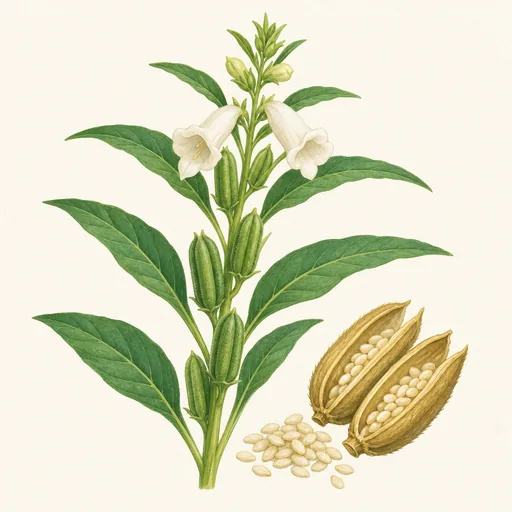
Sesame
Sesamum indicum · Pedaliaceae
- Start indoors4–6 weeks before the last frostFeb 27 – Mar 19
- Sow outdoors2–4 weeks after the last frostApr 24 – May 14
- Plant out2–4 weeks after the last frostApr 24 – May 14
- Space15–30 cm (6–12 in) apart
- Harvest90–120 days after plantingJul 23 – Oct 2
Description
Sesame is an annual flowering plant grown chiefly for its edible seeds and oil, rather than as a vegetable. It has upright, often branching stems and typically reaches about 0.5–2 metres tall. Its green leaves vary in shape, even on the same plant: lower leaves may be broader or lobed, while upper leaves are usually narrower. White to pale pink, tubular flowers develop where the leaves meet the stems. After pollination, elongated capsules form and mature from green to brown. Traditional varieties split open when dry, scattering their small seeds; many modern varieties have been selected to reduce this seed loss.
Sesame grows best in warm weather and full sun. It needs a frost-free growing season, and its seeds germinate poorly in cold soil. Plants prefer well-drained soil and can tolerate dry conditions once established, but adequate moisture during establishment and flowering helps produce a good crop. Waterlogged soil is particularly harmful. Depending on the variety and conditions, plants are generally ready to harvest about three to five months after sowing. Growers often cut the stalks when the lower capsules begin to ripen, then dry them before collecting the seeds.
The seeds may be white, cream, brown, red or black. They are eaten whole, often toasted, and used in breads, sweets and seasonings. Ground seeds make tahini, while pressed seeds yield sesame oil. In some places, young leaves are also cooked and eaten. Sesame seeds provide fat, protein and minerals, although their nutrient content varies with processing. Sesame is a significant food allergen, so people with a sesame allergy must avoid the seeds and foods made from them. In a home garden, seed production is most practical where summers are long, warm and relatively dry.
Growing Conditions
0.6–1.5 m (2–5 ft) tall, 30–60 cm (12–24 in) wide
- Smallest
- Largest
Full sun, 6+ hours
Moderate
Keep evenly moist, not soggy.
Ideal 25–35 °C (77–95 °F)
Survives down to 2 °C (36 °F).
pH 6–7.5 · neutral
Where it Grows
Planting
When to Plant
Plant sesame after the last spring frost, once the soil has warmed to at least 70°F (21°C) and nights are reliably mild. Warm soil matters more than the calendar: sesame germinates poorly in cold, wet ground, and young plants are damaged by frost. In many temperate gardens, this means planting several weeks after the usual last-frost date. Check soil temperature a few inches below the surface in the morning for several days rather than relying on one warm afternoon.
Choose a planting date that leaves enough growing time before autumn frost. Depending on the variety, sesame generally needs about 90–120 or more warm, frost-free days to produce mature seed. In a short-season area, start seeds indoors about three to four weeks before you expect to set plants outside. Transplant only after the soil is warm and frost risk has passed, and handle seedlings gently because their roots dislike disturbance.
How to Plant
Choose a spot with full sun and well-drained soil. Sesame tolerates dry conditions once established but struggles in soggy ground, so avoid low spots where water collects. Loosen the soil and mix in a modest amount of finished compost if it is poor; heavy feeding, especially with nitrogen, can encourage leafy growth at the expense of seed production.
For direct sowing, make a shallow furrow and place seeds about ¼ inch (6 mm) deep. Sow a few seeds every 6–12 inches (15–30 cm), with rows roughly 18–30 inches (45–75 cm) apart. Cover lightly and water gently so the small seeds stay in place. Keep the surface evenly moist, not saturated, until seedlings emerge. Once they have several true leaves, thin to one healthy plant per spot. This gives each plant room to branch and makes it easier to harvest its pods.
If you started seeds indoors, use individual or biodegradable pots to limit root disturbance. Harden seedlings off gradually, then transplant them at the same spacing without breaking up their root balls. Water after planting and keep weeds down while the plants are small. Once established, water during prolonged dry spells, particularly while plants are flowering and forming pods, but let the soil drain between waterings.
Growth Timeline
- Germination 5–14 days
- Seedlings indoors 4–9 weeks
- Growing in the garden 90–120 days
- Harvest 2–4 weeks
Planting Calendar
- Start seeds indoors: 4–6 weeks before the last frost
- Sow outdoors: 2–4 weeks after the last frost
- Plant outdoors: 2–4 weeks after the last frost
- Germination: 5–14 days
- Start indoors: Feb 27 – Mar 19
- Sow outdoors: Apr 24 – May 14
- Plant out: Apr 24 – May 14
- Harvest: Jul 23 – Oct 2
Care
Care Calendar
- Thin · May 1 – May 28
Thin seedlings to about 6–12 inches apart once they have several true leaves. - Mulch · May 8 – Jun 4
Apply a light mulch after the soil warms to suppress weeds and conserve moisture.
Watering
Keep the seedbed evenly moist while sesame germinates and seedlings establish, using gentle watering that does not wash away the small seeds. Once plants are established, water deeply but less often, allowing the soil surface to dry between waterings. Sesame tolerates dry periods better than waterlogged soil, so ensure beds and containers drain freely. Give particular attention to moisture during flowering and early seed-pod development: prolonged drought then can reduce seed set and yield. Water at soil level rather than wetting the foliage, especially where leaf diseases are a problem. Adjust the schedule to rainfall, soil type, and heat rather than watering by the calendar; sandy soil dries faster than loam. As pods begin to mature, reduce irrigation and avoid keeping the ground consistently wet. Excess water late in the season can encourage disease and delay drying before harvest.
Weeding
Keep the planting area especially clean during sesame’s first few weeks. Young sesame plants grow slowly and compete poorly with weeds, although established plants are more vigorous. Remove weeds before they set seed, using shallow hand cultivation or a hoe so you do not damage sesame’s roots. Work carefully around small seedlings: their stems can be broken or buried easily. Thin crowded sesame plants to the spacing recommended for your variety, which gives them room to develop and makes later weeding easier. Once plants are taller, pull weeds by hand close to the stems rather than cultivating deeply. A light mulch between established plants can help suppress new weeds, provided it does not cover the stems or keep the soil soggy. Check bed edges as well as the crop itself. Avoid broad-spectrum herbicides unless a product is specifically labeled for sesame and your location.
Mulching
Apply a light layer of clean straw or other weed-free organic mulch after seedlings are established and the soil has warmed. Leave a small gap around each stem to improve airflow and discourage rot. Mulch helps reduce weed growth and slows moisture loss during hot weather, which can be useful while plants flower and fill pods. Keep the layer modest rather than piling material against the plants; sesame favors warm, well-drained conditions and does not benefit from persistently damp soil. Do not mulch over newly sown seeds or tiny seedlings, because even a thin covering can obstruct emergence. In a rainy climate or on heavy soil, use less mulch and watch that the surface can dry between waterings. Remove weeds before spreading mulch, and check underneath it periodically for slugs or other pests that may shelter there.
Fertilizing
Start with a soil test if possible. Sesame performs best in reasonably fertile, well-drained soil but usually does not need heavy feeding. Before planting, incorporate a moderate amount of finished compost if the soil is poor; avoid fresh manure. Use soil-test recommendations to correct nutrient deficiencies, particularly phosphorus or potassium where levels are low. If nitrogen is needed, apply a modest amount before planting or early in growth rather than feeding heavily throughout the season. Too much nitrogen can produce leafy plants, delay maturity, and increase lodging at the expense of seed production. Avoid placing concentrated fertilizer directly against seeds or young roots. In containers, use a balanced fertilizer sparingly, following the label, and stop routine feeding as pods mature. Watch plant growth and color, but do not assume every yellow leaf signals a fertilizer shortage: waterlogging and disease can cause similar symptoms.
Pest Management
Inspect plants regularly, including leaf undersides and developing pods. Aphids, whiteflies, leafhoppers, and caterpillars may affect sesame; the pests present vary by region. A strong water spray can dislodge small aphid colonies, while hand-picking may control caterpillars in a small planting. If treatment is necessary, identify the pest first and choose a product labeled for both sesame and that pest. Follow the label, and avoid spraying open flowers when bees are visiting. Good drainage, adequate plant spacing, and watering at soil level help limit disease. Remove badly diseased plants and fallen crop debris, and rotate sesame with unrelated crops rather than planting it repeatedly in the same bed. Choose locally recommended, disease-resistant varieties where available. Check weeds around the plot, which can harbor pests, but avoid injuring sesame roots while removing them.
Harvesting
Check pods frequently as the crop approaches maturity. With traditional sesame varieties, ripe capsules split and shed their seeds, so waiting for every pod to dry on the plant can cause losses. Harvest when leaves are dropping and the lower pods have yellowed or browned, before many capsules open. Cut the stems in dry weather and stand them upright in small bundles over a clean tarp or sheet in a dry, airy, sheltered place. As the remaining pods dry and open, shake or thresh the stems over the tarp to collect the seeds. Remove plant debris, then dry the seeds thoroughly before storing them in an airtight container in a cool, dry place. Non-shattering varieties can remain standing longer; follow the variety’s harvest guidance. Handle dry pods gently, because even a short trip from bed to drying area can spill ripe seed.
Growing in Containers
Grows well in a pot of at least 20 litres (5.3 US gallons), with drainage holes. Best kept outdoors.
Propagation
From seed
- Wait until frost has passed and the soil is warm, ideally at least 70°F (21°C).
- Sow seeds about ¼ inch (6 mm) deep in a sunny spot with well-drained soil.
- Water gently and keep the soil lightly moist until seedlings emerge.
- Thin seedlings to about 6–12 inches (15–30 cm) apart.
Common Problems
- Yellowing leaves
- Sticky residue on leaves
- Black sooty coating
- Curled or cupped leaves
Aphids are small, soft-bodied insects that feed by piercing plants and drawing out sap. The group includes many…
- Spots on leaves
- Yellowing leaves
- Leaves dropping
Fungal leaf spot is a general name for diseases caused by many different fungi, not a single species. These fungi…
- Yellowing leaves
- Wilting
- Stunted growth
- Leaves dropping
Fusarium wilt is a soilborne fungal disease that affects many garden crops and ornamentals, including tomatoes, beans…
- Galls or swellings
- Stunted growth
- Yellowing leaves
- Wilting
Root-knot nematodes are microscopic roundworms that live in soil and feed inside plant roots. Several species in the…
- Yellowing leaves
- Wilting
- Stunted growth
- Leaves dropping
Root rot is a general name for the decay of plant roots, not a single disease with one scientific name. It can result…
- Waterlogged soil: Poor drainage can cause root rot; sesame grows best in well-drained soil.
- Fungal diseases: Leaf spots, Fusarium wilt, and charcoal rot can damage plants, especially under stressful growing conditions.
- Insect pests: Aphids, whiteflies, and caterpillars may feed on leaves or transmit disease.
- Cool weather: Sesame needs warmth to grow and may fail to mature where the growing season is too short.
- Seed shattering: Ripe pods of traditional varieties can split open and spill their seeds before harvest.
Varieties
This traditional Southern sesame is grown for seeds used in baking and cooking.
- heirloom
- edible seeds
Sold by seed color rather than as one standardized cultivar; check the packet for its growing season.
- black seeds
- edible seeds
Sold by seed color rather than as one standardized cultivar; check the packet for its growing season.
- pale seeds
- edible seeds
More about varieties
- White-seeded sesame: A widely grown type with a mild flavor, often used in baking and tahini.
- Black-seeded sesame: Common in Asian cuisines; its dark seed coat gives it a distinctive appearance and a more pronounced flavor.
- Brown-seeded sesame: Often grown for oil or used whole in food; seed color and flavor vary among cultivars.
Health Benefits
Sesame seeds are a nutrient-dense food used in breads, toppings, tahini, and sesame oil. They provide unsaturated fats, protein, fiber, and minerals, including copper and magnesium. Whole, unhulled seeds contain substantially more calcium than hulled seeds, although the amount the body absorbs can vary. Grinding seeds into tahini makes them easy to incorporate into meals.
Sesame also contains lignans, including sesamin and sesamolin, which have attracted research interest for their antioxidant activity. Some studies suggest that eating sesame regularly may modestly improve certain blood-lipid or blood-pressure measures, but results are mixed. Sesame should be viewed as part of a balanced diet, not as a treatment for cardiovascular disease or other conditions.
Sesame oil is commonly used in cooking and sometimes in massage or skin-care products. Its usefulness on skin depends on the formulation and the person using it; it is not a substitute for proven treatments. Sesame is also a significant food allergen. Reactions can be severe, so anyone with a sesame allergy must avoid sesame seeds, tahini, and products containing sesame oil where relevant. For others, the seeds and oil can be flavorful ways to add variety to meals.
Fun Facts
- Sesame is one of the world's oldest cultivated oilseed crops.
- The phrase “open sesame” evokes the way ripe pods of traditional plants split open to release their seeds.
- Sesame flowers are tubular and can attract bees.
- Sesame seeds contain roughly half their weight in oil, though the amount varies by cultivar.
Notice an error or have a question about Sesame? Contact us