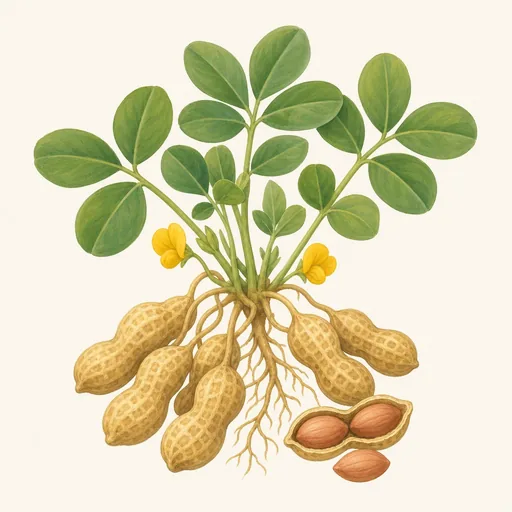
Peanut
Arachis hypogaea · Fabaceae
- Start indoors2–4 weeks before the last frostMar 13 – Apr 2
- Sow outdoors2–4 weeks after the last frostApr 24 – May 14
- Plant out2–4 weeks after the last frostApr 24 – May 14
- Space15–30 cm (6–12 in) apart
- Harvest100–150 days after plantingAug 2 – Oct 25
Description
Peanut is a warm-season annual legume grown for its edible seeds. Although often called a nut, it is botanically a legume, related to peas and beans. The plant forms a low, branching mound of green stems and leaves, usually 30–50 cm tall. Its small yellow flowers appear above ground and typically pollinate themselves. After fertilization, a stalk called a peg grows downward and pushes the developing ovary into the soil. The familiar shell and its seeds then mature underground.
Peanuts originated in South America and are now cultivated in warm regions worldwide. They grow best in full sun, with a long frost-free season and loose, well-drained sandy or loamy soil. Dense or waterlogged soil can make it difficult for pegs to enter the ground and for pods to develop. Plants need steady moisture during flowering and pod formation, but drier conditions near harvest help the crop cure. Like many legumes, peanuts can form root nodules with bacteria that fix atmospheric nitrogen, although successful nodulation depends on suitable bacteria being present.
A peanut pod usually contains one to four seeds inside a fibrous shell. Seed coats may be tan, red, or other colors, depending on the variety. Common market types include runner, Virginia, Spanish, and Valencia peanuts. Gardeners typically sow shelled, unroasted seeds after the soil has warmed and lift the whole plant when the pods are mature. Harvested plants or pods need thorough drying before storage. Peanuts are eaten roasted or boiled and are used in peanut butter, sauces, confectionery, and cooking oil. They also provide protein and fats. Peanuts can cause severe allergic reactions in some people, and poorly dried or stored crops may develop aflatoxins, so sound, properly stored pods are important.
Growing Conditions
30–50 cm (12–20 in) tall, 30–60 cm (12–24 in) wide
- Smallest
- Largest
Full sun, 6+ hours
Moderate
Keep evenly moist, not soggy.
Ideal 20–30 °C (68–86 °F)
Survives down to 0 °C (32 °F).
pH 5.8–7 · acidic to neutral
Where it Grows
Planting
When to Plant
Plant peanuts in spring after all danger of frost has passed and the soil has warmed to at least 65°F (18°C); 70°F (21°C) or warmer is better for reliable germination. Check the soil temperature a couple of inches below the surface in the morning rather than relying only on the air temperature. Peanuts need a long, warm growing season: allow roughly 120 to 150 frost-free days before your expected first autumn frost, depending on the variety. In cooler regions, choose an early-maturing variety and start seeds indoors about three to four weeks before the last expected frost. Move seedlings outside only after the soil is warm, hardening them off first and handling their roots gently. If your season is too short to provide warm soil in spring and enough time before autumn frost, grow peanuts in large containers that you can keep warm or move under cover.
How to Plant
Choose a site with full sun and loose, well-drained soil. Sandy loam is ideal because, after flowering, peanut plants push their developing pods into the soil. Work in a little finished compost if needed, but avoid heavy applications of nitrogen fertilizer, which can encourage leaves at the expense of pods. In heavy clay, use a raised bed filled with loose soil.
Plant raw, unroasted, untreated peanut seeds sold for growing. Remove the shells carefully, leaving each seed’s thin reddish skin intact. Sow seeds 1 to 2 inches (2.5–5 cm) deep, about 6 to 8 inches (15–20 cm) apart, in rows 2 to 3 feet (60–90 cm) apart. Once seedlings are established, thin them to about 10 to 12 inches (25–30 cm) apart if crowded. Water after sowing and keep the soil lightly moist, not soggy, until seedlings emerge. If you started plants indoors, transplant them at the same depth they grew in their pots, without disturbing the roots. Keep the soil around the plants loose and free of weeds; avoid thick mulch that could prevent the flower stalks, called pegs, from entering the soil.
Growth Timeline
- Germination 7–14 days
- Seedlings indoors 2–7 weeks
- Growing in the garden 100–150 days
- Harvest 1–2 weeks
Planting Calendar
- Start seeds indoors: 2–4 weeks before the last frost
- Sow outdoors: 2–4 weeks after the last frost
- Plant outdoors: 2–4 weeks after the last frost
- Germination: 7–14 days
- Start indoors: Mar 13 – Apr 2
- Sow outdoors: Apr 24 – May 14
- Plant out: Apr 24 – May 14
- Harvest: Aug 2 – Oct 25
Care
Care Calendar
- Thin · May 1 – May 21
Thin seedlings to about 6–8 inches apart. - Feed · May 22 – Jun 25
At first bloom, add gypsum if soil calcium is low; avoid high-nitrogen fertilizer. - Protect · Oct 4 – Oct 31
Cover plants on cold nights if pods are still maturing, and harvest before a hard freeze.
Watering
Keep the soil evenly moist while peanut plants establish, then aim for about 1 inch (2.5 cm) of water per week from rain or irrigation, adjusting for heat, soil type, and drainage. Water is especially important during flowering, when the flower stalks, called pegs, enter the soil, and while pods develop. Dry conditions at these stages can reduce the crop. Water deeply at the soil surface rather than giving frequent light sprinkles, and check the soil before watering again: it should be moist, not soggy. Avoid standing water, which encourages root and pod diseases. A soaker hose or drip line helps keep leaves dry and may reduce leaf disease. As harvest approaches, avoid unnecessary watering so the soil is workable for digging, but do not let developing pods suffer a prolonged drought. Container-grown peanuts dry out faster and need more frequent checks.
Weeding
Keep the planting area weed-free, especially while peanut plants are young and before their spreading foliage shades the soil. Weeds compete for water, nutrients, and light, and tall weeds make it harder to spot pests or judge when plants are ready to harvest. Pull weeds by hand or cultivate shallowly while plants are small. Peanut flowers form pegs that grow downward into the soil and develop into pods underground; deep hoeing near the plants can break pegs or damage pods. Once flowering and pegging begin, hand-pull nearby weeds carefully rather than working the soil. Remove weeds while they are small, ideally after rain or watering, when roots come out more easily. Keep the spaces between rows manageable too, but avoid piling soil or pulled weeds onto the plants. Do not let weeds set seed, or they may become a bigger problem in future crops.
Mulching
Use mulch cautiously around peanuts because their flower pegs must reach the soil to form pods. Before flowering, a thin layer of clean straw or other loose, weed-free organic material between rows can suppress weeds, conserve moisture, and reduce soil splashing onto leaves. Leave the soil immediately around the plants accessible, and avoid a thick or matted layer that pegs cannot penetrate. As plants spread and pegging begins, do not add heavy mulch over the area where pods will develop. Keep mulch from pressing against stems, particularly in damp weather, to discourage rot. In a small garden, regular shallow weeding and a light surface covering between plants may be easier than extensive mulching. Peanuts need loose, well-drained soil for peg entry and pod growth, so do not use mulch as a substitute for preparing the bed. Remove any mulch that obstructs pegs or keeps the soil persistently wet.
Fertilizing
Start with a soil test when possible. Peanuts are legumes and, when their roots have effective nitrogen-fixing bacteria, usually need little added nitrogen. Too much nitrogen can produce leafy plants at the expense of pods. If peanuts have not been grown in the soil before, use a peanut-compatible inoculant on the seed according to its label. Incorporate any needed phosphorus and potassium before planting, following soil-test recommendations rather than applying a high-nitrogen fertilizer routinely. Calcium in the upper soil layer is particularly important because developing pods absorb it directly. Where soil tests show a need, agricultural gypsum is commonly applied around early flowering so calcium is available where pegs enter the ground; follow local guidance for rates. Aim for a slightly acidic, well-drained soil, and correct pH based on a test. Avoid placing concentrated fertilizer against seeds or plants, and avoid digging fertilizer into the soil after pegging begins.
Pest Management
Inspect plants regularly, including leaf undersides and the soil surface. Aphids, thrips, caterpillars, and other insects may occur, while leaf spot and rust can damage foliage; problems vary by region. Healthy plants tolerate some feeding, so identify a pest and assess damage before treating it. Rotate peanuts and other legumes away from the same bed for several years to reduce disease and soil-pest buildup. Use healthy seed, allow good airflow, avoid waterlogged soil, and water at the base of plants to limit leaf wetness. Remove severely diseased plant debris after harvest. Hand-pick larger caterpillars in a small planting, and avoid broad-spectrum insecticides that also kill beneficial insects. If damage becomes significant, consult local extension guidance for a treatment labeled for peanuts and the identified problem, and follow its directions and harvest interval. Keep an eye out for burrowing animals that may eat developing pods.
Harvesting
Harvest peanuts when most pods are mature, usually about 120–160 days after planting, depending on the variety and weather. Yellowing foliage is a clue, but check a few pods before digging the whole crop. Mature pods are well filled, with a pronounced netlike pattern on the shell; the inside of the shell typically darkens as the pod matures. Dig a sample rather than relying only on the calendar, since pods on one plant mature at different times. Loosen soil with a garden fork several inches away from the plant, then lift it gently to avoid leaving pods behind. Shake off loose soil and collect detached pods. Let plants and pods dry in a sheltered, well-ventilated place, protected from rain, until the pods are thoroughly dry. Remove pods from the plants, discard moldy or damaged ones, and store dry peanuts in a cool, dry place. Moist storage can encourage dangerous mold.
Growing in Containers
Grows well in a pot of at least 20 litres (5.3 US gallons), with drainage holes. Best kept outdoors.
Propagation
From seed
- Choose raw, unroasted peanuts intended for planting.
- Shell them carefully, leaving the thin skins intact.
- Sow them 1–2 inches deep after the soil has warmed to at least 65°F (18°C).
- Keep the soil lightly moist until the seedlings emerge.
Companion Plants
Good neighbors
- Corn: Peanuts can grow between widely spaced corn plants, covering bare soil and helping suppress weeds.
Common Problems
- Spots on leaves
- Yellowing leaves
- Leaves dropping
Fungal leaf spot is a general name for diseases caused by many different fungi, not a single species. These fungi…
- Orange or rust-colored spots
- Spots on leaves
- Yellowing leaves
- Leaves dropping
Rust is a group of plant diseases caused by fungi in the order Pucciniales, not a single species. Different rust fungi…
- Galls or swellings
- Stunted growth
- Yellowing leaves
- Wilting
Root-knot nematodes are microscopic roundworms that live in soil and feed inside plant roots. Several species in the…
- Yellowing leaves
- Sticky residue on leaves
- Black sooty coating
- Curled or cupped leaves
Aphids are small, soft-bodied insects that feed by piercing plants and drawing out sap. The group includes many…
- Yellowing leaves
- Wilting
- Stunted growth
- Leaves dropping
Root rot is a general name for the decay of plant roots, not a single disease with one scientific name. It can result…
- Leaf spot: Fungal diseases that cause dark spots and premature leaf drop.
- White mold (southern blight): A soilborne fungus that can rot stems and pods, especially in warm, humid conditions.
- Root-knot nematodes: Tiny soil pests that damage roots and reduce growth and yields.
- Thrips and aphids: Sap-feeding insects; thrips can also spread tomato spotted wilt virus.
- Poor pod development: Compacted soil, drought, or insufficient calcium in the pod-forming zone can reduce the harvest.
- Mold after harvest: Peanuts dried or stored improperly can develop Aspergillus mold and potentially harmful aflatoxins.
Varieties
A useful choice where the frost-free season is relatively short.
- early
- small seeds
Its pods commonly hold three or more sweet, red-skinned seeds.
- red-skinned seeds
- early
Grow it where there is enough warm weather to mature its large pods.
- large seeds
- long season
This runner peanut is best suited to gardens with a long, warm season.
- high yielding
- long season
More about varieties
- Runner: Produces fairly uniform kernels; widely used for peanut butter.
- Virginia: Known for large kernels; often sold roasted in the shell.
- Spanish: Has smaller kernels with reddish skins and a relatively high oil content; commonly used for snacks and sweets.
- Valencia: Often has three or more small kernels per pod; popular for boiled peanuts.
Health Benefits
Peanuts are a nutrient-dense food that provides plant protein, fiber, and mostly unsaturated fats. They also supply nutrients including niacin, folate, vitamin E, and magnesium. Eaten as part of a balanced diet, they can be a satisfying snack or a convenient way to add protein and calories to meals. Peanut butter offers similar nutrients, though its added salt, sugar, and oils vary by product.
Research links regular consumption of nuts and peanuts with better cardiovascular outcomes. Their unsaturated fats may help support healthy blood cholesterol levels when peanuts replace foods high in saturated fat; simply adding them to an otherwise unchanged diet is not the same thing. A small handful of unsalted peanuts is a practical serving, since they are energy-dense.
Peanuts also have important safety considerations. A peanut allergy can cause a severe, potentially life-threatening reaction, so anyone with a known allergy must avoid them and follow medical advice. Whole peanuts can be a choking hazard for young children. Peanuts that are visibly moldy or improperly stored should not be eaten: some molds can produce aflatoxins, which are harmful. Choose properly stored products from reputable sources, and use peanuts as one part of a varied diet rather than as a treatment for any condition.
Fun Facts
- Peanuts are legumes, not botanical nuts; they are related to peas and beans.
- After a peanut flower is pollinated, a stalk called a peg grows downward and pushes the developing pod into the soil.
- Peanut flowers bloom above ground, but the pods mature underground.
- The peanut plant originated in South America.
- With the help of bacteria in root nodules, peanut plants can obtain nitrogen from the air.
Notice an error or have a question about Peanut? Contact us