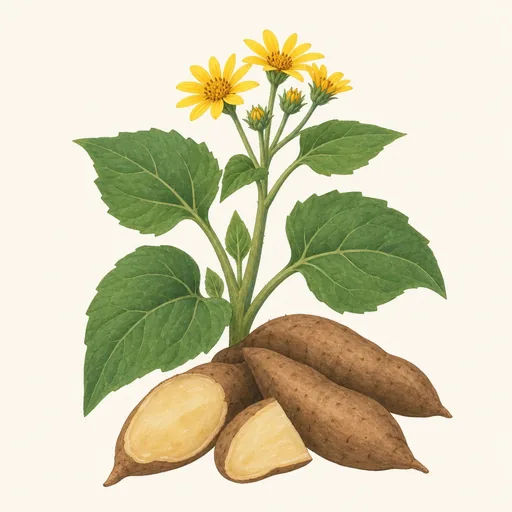
Yacon
Smallanthus sonchifolius · Asteraceae
- Plant out1–3 weeks after the last frostApr 17 – May 7
- Space0.9–1.2 m (3–4 ft) apart
- Harvest180–240 days after plantingOct 14 – Jan 23
Description
Yacon is a perennial member of the sunflower family grown for its large, edible storage roots. It originated in the Andes, where people have cultivated it for centuries. Above ground, the plant forms a clump of sturdy stems, often reaching 1.5 to 2.5 meters tall. Its broad, slightly hairy leaves grow in opposite pairs, and mature plants may produce small, yellow, daisy-like flowers. Underground, a crown of knobby rhizomes produces the next season’s shoots, while separate, elongated roots swell to store food.
The storage roots have thin, tan to purplish skin and pale flesh. They are juicy and crisp rather than starchy, with a mild sweetness often compared with pear or apple. They can be peeled and eaten raw in salads, or cooked, dried, or processed into syrup. Much of their sweetness comes from fructooligosaccharides, carbohydrates that are not digested in the same way as ordinary sugars. Storage can make the roots taste sweeter as some of these carbohydrates break down. Large servings may cause gas or bloating in some people.
Yacon grows best in full sun, fertile, well-drained soil, and a long, relatively mild growing season. Gardeners usually plant pieces of the sprouting crown after the danger of frost has passed; the edible storage roots themselves are not normally used for propagation. Keep plants watered during dry spells and give them room to spread. Although the crown can survive mild winters with protection, frost kills the leaves, so in colder places yacon is typically grown as an annual and its crowns are stored indoors. Harvest the storage roots after the foliage dies back, before the soil freezes. Handle them gently: their thin skins bruise easily. Store sound roots in a cool, frost-free place.
Growing Conditions
1.5–2.5 m (5–8 ft) tall, 0.8–1.2 m (3–4 ft) wide
- Smallest
- Largest
Full sun, 6+ hours
Tolerates part sun
Moderate
Keep evenly moist, not soggy.
Ideal 15–25 °C (59–77 °F)
Survives down to −7 °C (19 °F).
pH 5.5–7.5 · acidic to neutral
Where it Grows
Planting
When to Plant
Plant yacon outdoors in spring, after the last frost, once the soil has warmed to about 15°C (60°F). Its leaves and stems are frost-tender, so a brief warm spell is not enough: wait until nights are reliably mild and no frost is forecast. Yacon needs a long growing season—ideally at least five frost-free months—to make a worthwhile crop of edible tubers. In cooler climates, start pieces of the sprouting crown in pots indoors about four to six weeks before the last frost. Keep them warm and lightly moist, then gradually acclimatize the young plants to outdoor conditions before transplanting. If a late frost threatens after planting, cover them or bring potted plants inside. Where winters are frost-free, plant when warmth and moisture will support steady growth, often near the start of the rainy season. Avoid planting into cold, waterlogged soil, which can cause the crown to rot.
How to Plant
Grow yacon from pieces of its crown—the knobbly structure at the base of the stems—with at least one visible bud on each piece. The large, smooth edible tubers are for eating; a tuber without a piece of bud-bearing crown will not grow into a plant. If dividing a stored crown, use a clean knife and handle the buds gently. You can first sprout divisions in pots of free-draining compost, keeping them warm and only lightly moist until growth begins.
Choose a sunny position with fertile, well-drained soil and room for a large, leafy plant. Loosen the soil and mix in finished compost; avoid heavy applications of nitrogen fertilizer, which favor leaves over tubers. Set each crown piece with its buds facing upward, covering the crown with roughly 2–5 cm (1–2 in) of soil. If transplanting a potted plant, set it at about the same depth it grew in the pot. Space plants about 90–120 cm (3–4 ft) apart. Water thoroughly after planting, then keep the soil evenly moist, not soggy. Once the soil is warm, add mulch to conserve moisture and suppress weeds, leaving a little space around the stems. Protect young plants from slugs and unexpected frost.
Growth Timeline
- Growing in the garden 180–240 days
- Harvest 1–3 weeks
Planting Calendar
- Plant outdoors: 1–3 weeks after the last frost
- Plant out: Apr 17 – May 7
- Harvest: Oct 14 – Jan 23
Care
Care Calendar
- Divide · Apr 10 – May 14
Separate stored crowns into pieces with at least one growing bud each. - Mulch · Apr 24 – May 28
Mulch around emerging plants to retain moisture and suppress weeds. - Feed · May 8 – Jun 11
Apply compost or a balanced fertilizer without overfeeding nitrogen. - Lift and store · Oct 25 – Nov 14
After frost kills the foliage, lift the roots before the ground freezes and store the bud-bearing crowns frost-free.
Watering
Keep yacon’s soil evenly moist, especially while plants establish and while storage roots are swelling in late summer and autumn. Water deeply when the upper few centimeters of soil feel dry, rather than giving frequent shallow sprinkles. How often this is needed depends on rainfall, temperature, and soil type; plants in sandy soil or containers need checking more often. Direct water toward the soil instead of routinely wetting the foliage. Good drainage matters as much as moisture: roots and crowns can rot in persistently waterlogged ground. Mulch helps prevent the soil from drying out between waterings. Yacon may survive brief dry spells, but prolonged drought can reduce growth and yield. As foliage dies back near harvest, water less frequently, without letting plants that are still actively growing become severely dry.
Pruning
Yacon needs little routine pruning. Its tall stems and broad leaves feed the developing storage roots, so avoid cutting back healthy growth during the growing season. Remove broken, badly damaged, or diseased stems with clean tools, and take diseased material away from the bed rather than leaving it beside the plant. Flowers need not be removed; yacon is normally propagated from buds on its crown, not from seed. If plants become too tall for an exposed site, support them rather than cutting them back heavily. After frost has blackened the foliage, you can cut down the dead stems to make lifting the roots easier. Leave a short length of stem attached to the crown if it helps you locate and handle it. Avoid cutting into the crown or its buds.
Weeding
Keep the area around young yacon plants free of weeds so they do not compete for water, nutrients, and light. Weed regularly while plants are small; once their broad leaves shade the ground, fewer weeds are likely to establish. Pull weeds by hand close to the stems, particularly later in the season when storage roots are developing beneath the soil. If using a hoe between plants, work shallowly and stay well away from the crowns to avoid damaging roots or new growth. Remove perennial weeds, including their underground parts, before planting if possible; digging them out later risks disturbing the crop. A layer of organic mulch can suppress new weeds, but check beneath it occasionally for persistent weeds. Do not let large weeds set seed in the bed.
Mulching
Spread an organic mulch, such as clean straw, shredded leaves, or compost, around yacon after planting and once the soil has warmed. A layer about 5–8 cm deep helps conserve moisture, reduce weeds, and limit abrupt changes in soil temperature. Keep mulch a few centimeters away from the stems so the crown stays airy rather than constantly damp. Top it up if it breaks down or is blown away, and water the soil first if it is dry before mulching. In a cool climate, mulch can help protect crowns from a brief light frost, but it will not reliably prevent damage from deeply frozen ground. Where winters freeze, lift crowns for frost-free storage instead of depending on mulch to overwinter them. Avoid piling wet mulch against the plant.
Fertilizing
Before planting, incorporate some well-rotted compost into soil that drains well. Yacon benefits from reasonably fertile soil, but heavy feeding—especially with nitrogen—can encourage abundant leaves and stems without a corresponding improvement in storage-root yield. If the soil is already fertile, additional fertilizer may not be needed. In poorer soil, use a modest amount of balanced fertilizer according to its label, preferably guided by a soil test. Avoid placing concentrated fertilizer directly against the crown or tender roots. Do not keep applying high-nitrogen feeds through the season simply because the plant is large; its naturally vigorous top growth is not a sign that more fertilizer is required. Keep moisture consistent as well, since fertilizer cannot compensate for drought or waterlogged soil. Replenish soil organic matter between crops rather than relying on heavy in-season feeding.
Pest Management
Inspect new shoots and the undersides of leaves regularly. Slugs and snails may damage young growth; hand-pick them, reduce nearby hiding places, or use a locally approved bait according to its label. Aphids can often be dislodged with a firm spray of water, while small numbers of leaf-chewing caterpillars can be removed by hand. Check for damage before treating: mature yacon can tolerate some leaf loss. Rodents or soil-dwelling pests may damage storage roots, so monitor for activity and avoid leaving harvested roots exposed. Good drainage and adequate spacing help reduce conditions that favor rot and foliar disease. Remove badly diseased plant material, clean tools after use, and avoid replanting into soil where crowns have repeatedly rotted. Identify a persistent problem before choosing a pesticide, and follow local label directions.
Harvesting
Harvest yacon in autumn, usually after the first light frost has blackened the foliage but before the ground freezes. The longer growing season generally gives the storage roots more time to develop. Cut back dead stems, then begin digging well outside the crown with a garden fork; the large storage roots are brittle and can extend outward. Lift the whole clump gently and separate the edible storage roots from the smaller, bud-bearing crown pieces used for replanting. Handle roots carefully to avoid bruising. Freshly dug roots are often less sweet; their sweetness develops after harvest as some stored carbohydrates turn to sugars. Let sound roots rest for a week or two at room temperature, checking for shriveling or decay. Store them cool and frost-free. Keep crown pieces separately in barely damp material until spring planting.
Growing in Containers
Grows well in a pot of at least 40 litres (11 US gallons), with drainage holes. Best kept outdoors.
Propagation
By division
- Save the bud-bearing crown when harvesting the storage tubers.
- Keep the crown cool and frost-free over winter.
- Divide it in spring, leaving at least one visible bud on each piece.
- Plant the pieces in pots and keep the soil lightly moist.
- Transplant outdoors after the last frost.
From cuttings
- Take a healthy young stem cutting with two or three nodes.
- Remove the lower leaves.
- Insert the cutting into moist potting mix.
- Keep it warm and humid until roots form.
- Plant it outdoors after the last frost.
Common Problems
- Brown or crispy leaf edges
- Wilting
- Bleached or scorched patches
- Leaves dropping
Frost damage is an injury caused when plant tissues become cold enough for ice to form or for cells to lose water to…
- Holes in leaves
- Slime trails
- Stems chewed or cut through
Slugs and snails are soft-bodied mollusks that feed on many garden plants. Snails carry a visible shell; most slugs…
- Yellowing leaves
- Sticky residue on leaves
- Black sooty coating
- Curled or cupped leaves
Aphids are small, soft-bodied insects that feed by piercing plants and drawing out sap. The group includes many…
- Yellowing leaves
- Wilting
- Stunted growth
- Leaves dropping
Root rot is a general name for the decay of plant roots, not a single disease with one scientific name. It can result…
- Frost damage: Yacon is frost-tender. Cold weather can kill the leaves and stems, although crowns may survive if protected.
- Root rot: Waterlogged soil can cause the storage roots and planting crowns to rot.
- Slugs and snails: These can chew young shoots and leaves, especially in damp weather.
- Aphids and spider mites: These pests may weaken foliage; spider mites are more likely in hot, dry conditions.
- Storage losses: Harvested roots can shrivel if kept too dry or rot if stored wet or damaged.
Varieties
A named purple-skinned selection grown for its crisp, sweet storage roots.
- purple-skinned roots
- sweet
A pale-rooted selection with crisp flesh, though plants sold under this name may vary.
- pale-skinned roots
- crisp
More about varieties
Yacon names are not consistently standardized, and plants sold under the same name can differ. Commonly described types include:
- Blanco (‘white’): A pale-skinned type with light-colored flesh.
- Morado (‘purple’): A type identified by purple or reddish-purple coloring, usually most visible on the skin.
- Amarillo (‘yellow’): A type described as having yellowish skin or flesh.
Health Benefits
Yacon’s crisp storage roots contain fructooligosaccharides (FOS), carbohydrates that are only partly digested in the small intestine. Some reach the colon, where they feed gut microbes. This makes fresh yacon a source of prebiotic fiber and may help some people with bowel regularity. Evidence for specific health benefits in humans remains limited, however, and yacon should not be considered a treatment for constipation or any other condition.
The roots taste sweet, but FOS contribute fewer calories than ordinary sugar. Yacon syrup is sometimes marketed for weight management or blood-sugar control. Those claims are not well established: syrup composition varies, it can contain substantial ordinary sugars, and studies do not show that it reliably treats diabetes or causes weight loss. Traditional uses of yacon leaves, including as tea for blood-sugar control, also lack enough clinical evidence to recommend them as treatment.
Start with a small serving of root if you have not eaten it before. Its fermentable carbohydrates can cause gas, bloating or diarrhea, particularly for people sensitive to FODMAPs or living with irritable bowel syndrome. During storage, some FOS break down into simpler sugars, making the roots taste sweeter.
Fun Facts
- Yacon is native to the Andes and belongs to the sunflower family.
- The crunchy, juicy storage roots are often eaten raw and have a texture more like a crisp fruit than a potato.
- The edible storage roots are distinct from the small buds on the crown used to propagate the plant.
- Stored roots often become sweeter as some of their carbohydrates change into simpler sugars.
- Yacon produces small, sunflower-like yellow flower heads, though flowering can be unreliable in cool climates.
Notice an error or have a question about Yacon? Contact us